


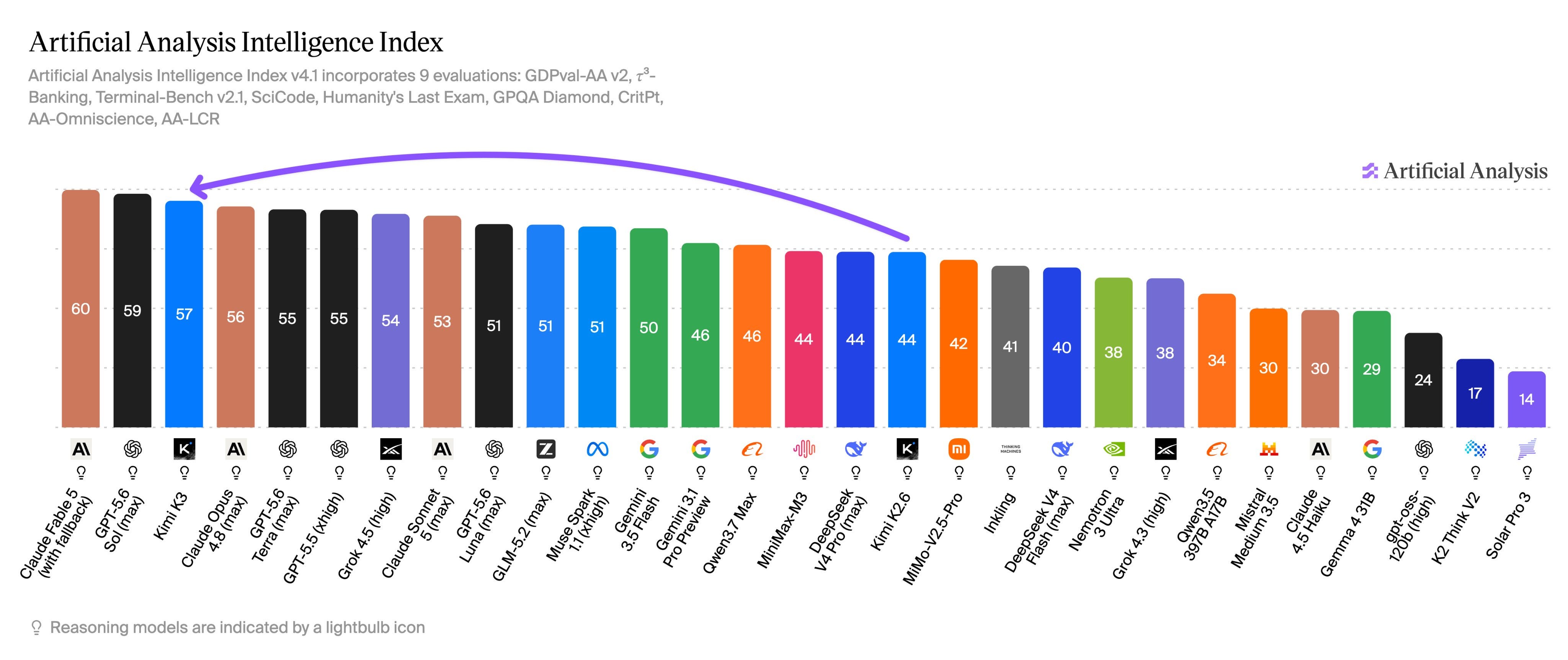
Beijing-based Moonshot AI released Kimi K3, its most powerful flagship model to date, on July 16. On the Frontend Code Arena benchmark, K3 outperforms both Claude Fable 5 and GPT-5.6 Sol at building the visuals of websites and applications, the first time any open-weight model has topped that leaderboard. It also lands at #3 on the Artificial Analysis Intelligence Index, trailing only those two frontier models and leading every other open-weight model.
At 2.8 trillion parameters, K3 is the largest open LLM any Chinese company has ever released, assuming the open weights arrive on July 27 as promised. The AI community and much of X are calling it Moonshot’s “DeepSeek R1” moment, three weeks after Z.ai (Zhipu AI) sparked its own viral storm with GLM 5.2. The timing was deliberate: K3 landed just ahead of the World Artificial Intelligence Conference in Shanghai where Chinese President Xi Jinping called for greater open-source collaboration.
What makes K3 an unusual release though is not the coding and agentic performance, nor the efficiency optimization in training and inference. It’s the positioning. In my opinion K3 is an ambitious, even risky attempt to get rid of the old stereotype of Chinese models as a cheap alternative. Instead it is a high-end, premium model built to fight the world’s best proprietary frontier models.
Architectural innovation and a self-evolving workflow
On architecture, K3 is not much different from its Chinese peers. As an MoE model, of its 896 experts only 16 activate per token, roughly 1.8 percent of the parameters. That is considerably sparser than DeepSeek V4 Pro (3.1 percent) or GLM 5.2 (5.3 percent).
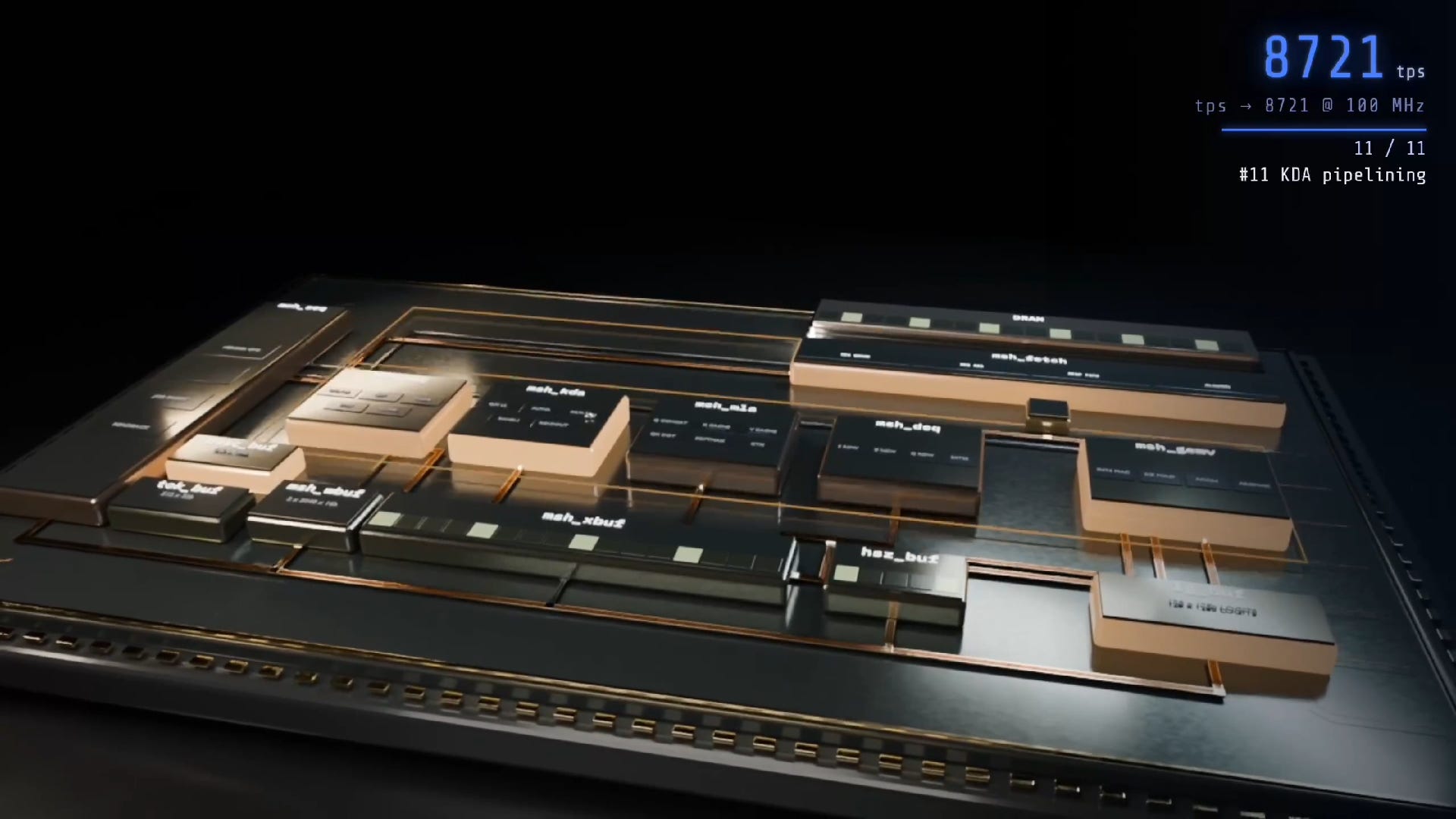
The 1M-context-window model is built on two in-house innovations to keep training and inference efficient. The first is Kimi Delta Attention (KDA), a linear attention that lets the model process long sequences without the explosive memory cost of a standard key-value (KV) cache. Where standard attention compares every new token against every prior token in the history, KDA maintains a compressed, fixed-size hidden memory state that selectively updates what information to keep or overwrite.
Moonshot doesn’t use KDA for every layer of the network. It runs a hybrid architecture in a 3:1 ratio, interspersing KDA layers with periodic multi-head latent attention, DeepSeek’s signature attention innovation. In its earlier Kimi Linear paper, the company reported cutting KV cache usage by up to 75 percent versus full-attention designs. In K3, KDA enables decoding up to 6.3x faster at million-token context lengths while still matching or beating full softmax attention on “needle-in-a-haystack” retrieval.
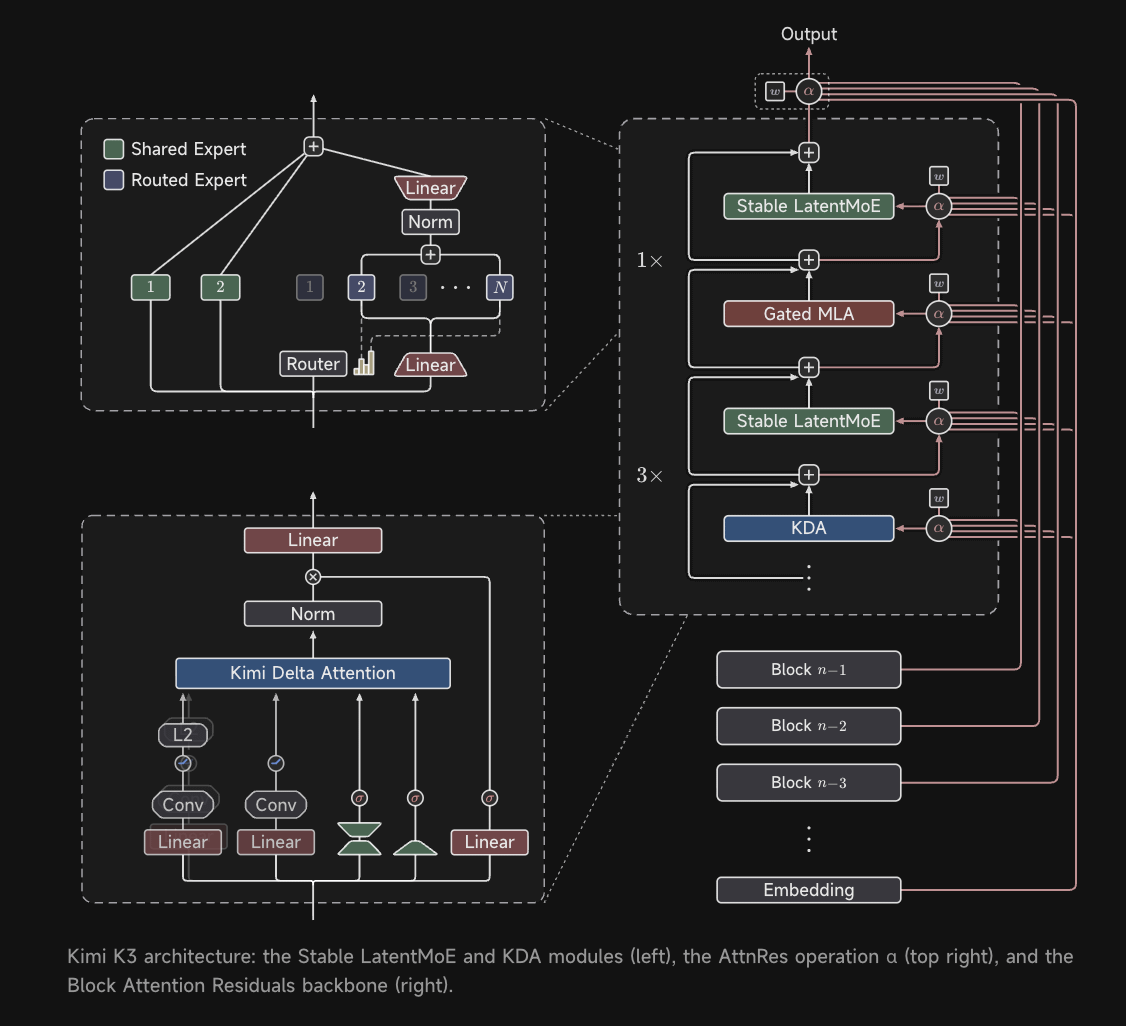
The second component is Attention Residuals (AttnRes), described as a drop-in replacement for standard residual connections that delivers roughly a 25 percent training-efficiency gain for under two percent additional compute. The technique, first proposed about four months ago, went viral as one of its co-first authors is a 17-year-old high-school senior in Shenzhen whose work drew public praise from Elon Musk and Andrej Karpathy.
I’ve compared Moonshot with DeepSeek multiple times and the two labs start to look like cousins. Both labs innovate by tweaking attention and residual frameworks. Kimi’s KDA works more like a dynamic summary, whereas DeepSeek’s DeepSeek Sparse Attention (DSA) acts as a filter that chooses what information matters most. Similarly, where DeepSeek’s mHC expands the capacity of the information stream between layers, Moonshot’s AttnRes dynamically selects which specific previous layer to draw information from.

Unlike K2 series, Kimi K3 turns on “thinking mode” on by default, reasoning through problems rather than relying on a separate reasoning model. At launch, the API supports only the Max reasoning-effort level.
K3 pairs programming with visual feedback: it examines screen captures, edits code, and checks the visible output, a closed loop Moonshot calls “Vision in the Loop” and pitches as a foundation for game development, UI design, and CAD.
The part I find most interesting is the self-evolving workflow, because I can’t recall another flagship LLM that describes self-improvement this explicitly (correct me if I’ve missed one). Given FLA Triton AttnRes at production scale, K3 was tasked with maximizing training speed without changing the numerics. Over 15 hours of nonstop iteration it designed a novel two-phase kernel algorithm, fused kernels while preserving numerics, and cut forward-plus-backward time from 283.6 ms to 114.4 ms. K3 and Fable 5 reached similar end results, but K3 improved faster per iteration, according to the company.
Performance
On the Artificial Analysis Intelligence Index, K3 scores roughly 57 for the 3rd place, behind Claude Fable 5 (~60) and GPT-5.6 Sol (~59) and ahead of Claude Opus 4.8 (~56).
Where it genuinely leads is the front end. K3 tops LMArena’s Frontend Code Arena at 1,679 points, a 17-place jump over K2.6, though it’s more middling on the general Text Arena at around No.6.
It also holds up in long context, scoring 90.4 on a one-million-token evaluation with no context management at all.
And it does more with less: K3 used 132M output tokens against K2.6’s 166M, a 21 percent reduction, while gaining 13 Intelligence Index points.
Unfortunately, I haven’t been able to use K3 myself. The model keeps going unavailable, and the Moonshot team says it has temporarily paused new paid subscriptions because its compute can’t keep up with demand.
Reaction on K3 has been overwhelmingly positive. Simon Koser, chief product officer at the AI startup Tzafon, told CNBC that K3 is impressive, strong in areas like coding, and said developers at AI labs could find it compelling. On the other hand, K3’s hallucination rate climbed from 39 percent to 51 percent, according to Artificial Analysis.
Pricing
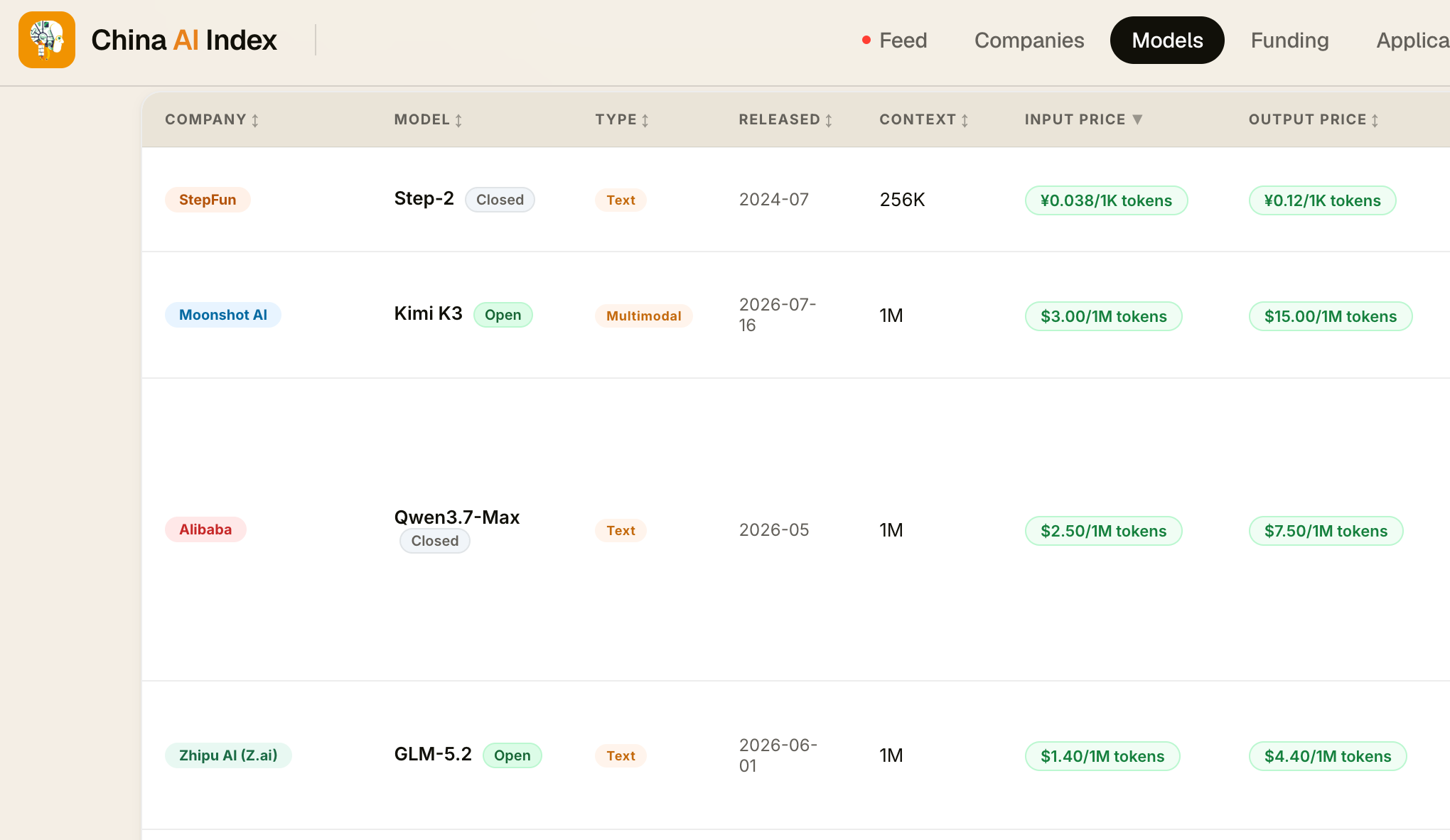
K3 costs $3 per million input tokens and $15 per million output tokens, with a $0.30 cache-hit input rate, the same tier as Anthropic’s Claude Sonnet series. That is a big jump from its predecessor. K2.6 ran roughly $0.95 in and $4 out. K3 is also the most expensive LLM any Chinese AI company has ever released over the past two years, according to the model tracker of China AI Index.
K3 averages about $0.94 per Intelligence Index task, close to GPT-5.6 Sol ($1.04) and roughly half the price of Opus 4.8 ($1.80). Yet some users on Xiaohongshu (Red Note) complained by using K3 they burned through their Kimi monthly usage far sooner than expected.
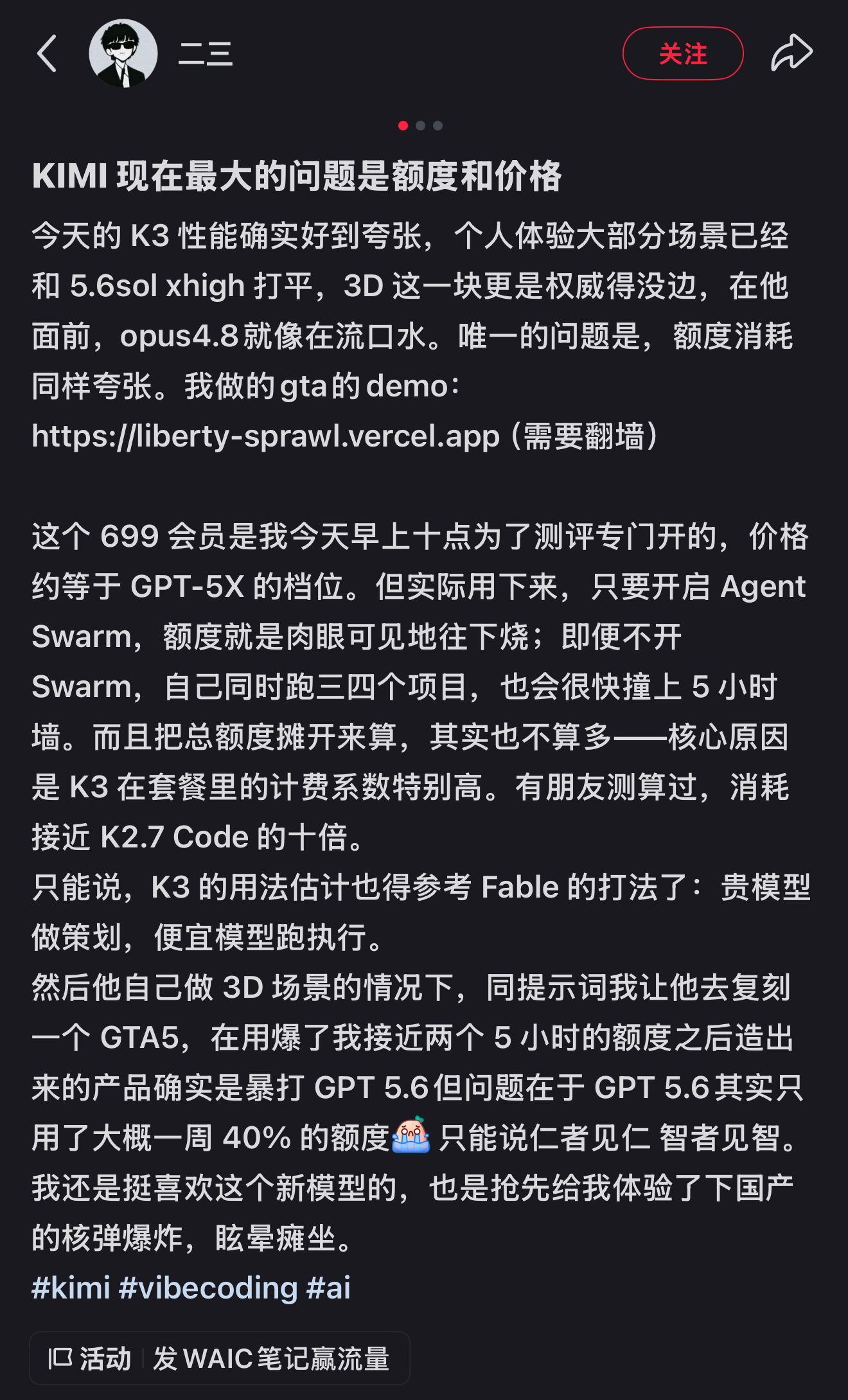
One X user said K3 ends up being more expensive than Fable 5.


Why I’m calling it ambitious
The day before launch, Moonshot dropped a teaser video—a mysterious, deliberately opaque, slightly philosophical clip reminiscent of the Fable 5 video. Put that together with the scale, the performance, and the pricing, K3 is trying to take off the “cheap” hat every Chinese open-weight model has been made to wear. For a Chinese startup, it carries itself much more like a global company, with taste and aesthetics to match. It wants to compete with OpenAI and Anthropic directly, not merely be a cheaper open-weight option.


Before a lab starts to training a new model, it usually knows what parameter scale and capability it’s aiming at. Moonshot priotizes scaling. In comparison, MiniMax’s M3 model features only 428 billion total parameters as the company deliberately restrained the size of the model so local model enthusiasts can run it affordably. It’s a matter of choice.
K3 hasn’t reached the drug-design or AI-research frontier that Mythos and Fable 5 are pushing, but it can do some proof-of-concept chip designs, the kind of work Google’s models demonstrated earlier.
I don’t think K3 dethrones OpenAI or Anthropic. But it looks probably ahead of other leading proprietary models like Meta Spark and Grok 4.5 on coding and agentic tasks. That’s the market it will actually contest and can take share in.
It also raises the obvious question: why keep a model this good open at all? My read is that the race is now cutthroat enough that no one knows how long K3 stays out front among open models. MiniMax is training a 2.7T model, Alibaba is teasing Qwen 3.8, and DeepSeek is reportedly close to shipping version 4.1. For a Chinese lab, keeping a strong model proprietary could be a losing bet for as long as someone else keeps theirs open.
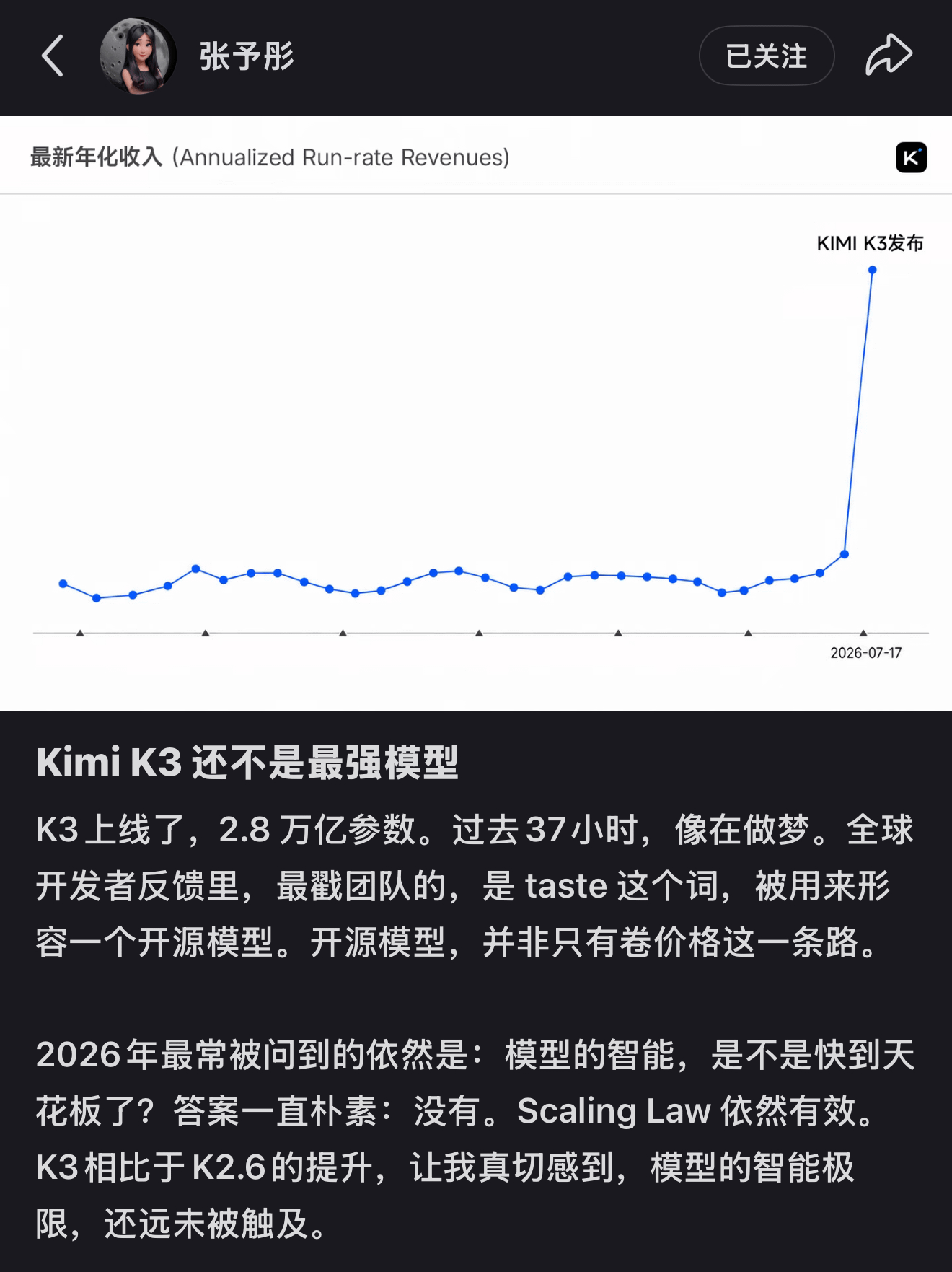
Staying open hasn’t also slowed Moonshot down. President Zhang Yutong said on Xiaohongshu that the company’s annual recurring revenue has grown exponentially since K3 released, extending a run that already took ARR from $200 million in April to $300 million in June.
It’s also worth noting what Moonshot chose not to showcase. There’s no demonstration of frontier capability in cybersecurity, drug design, or bioweapons. An open-weight model that’s excellent at website and game design looks fine and unharmful. A top-tier cyberattack model would not be.
Then there’s sentiment. Chinese users have long felt singled out by Anthropic’s hard line on China and its efforts to keep mainland users off its products, Claude Code especially. Late in June, a developer found that Claude Code had been quietly detecting China-linked connections and encoding that signal into the prompt through steganographic tricks. Anthropic didn’t deny it; an engineer called it an experiment to curb reseller abuse and guard against distillation, and the code was pulled in early July. Many Chinese users read it as plain discrimination. So when a homegrown model this strong landed, some of that anger came out as vindication: See, we don’t need you.
The unease with proprietary models isn’t only a Chinese complaint. American founders are sounding alarms too. Palantir CEO Alex Karp has warned repeatedly that companies routing proprietary data through third-party models like Claude risk handing over their competitive edge and intellectual property.
Anthropic’s most powerful model has had its own turbulence. After an 18-day suspension by the U.S. government beginning June 12, 2026, over cybersecurity jailbreak concerns, the government lifted the restriction on June 30. Anthropic then said Fable 5 would be available only through July 7, then July 12, and shortly after K3 shipped, declared it permanently available. Every twist left users and developers under a cloud of uncertainty and lost control, which is exactly why a soon-to-be-open, frontier-level model landing in that moment got the reception it did.
The least “Chinese” model
K3 is the first open-weight release to compete on capability rather than price, and the first Chinese model to go toe-to-toe with top U.S. models. Many framed it as proof that Chinese labs are no longer well behind and that the U.S. lead is narrowing.
Many read that as bad news. OpenAI’s head of future strategies argued that one probable outcome of an open-weight-dominant world is “full AI communism, which is precisely what China proposes,” with AI regarded not as a market product but as a state-provided “public good,” a kind of digital public infrastructure. His expectation is that the Trump administration eventually concludes its best move is to create large regulatory risk around the use of open-weight Chinese models.

It’s now routine to drop any new Chinese frontier model into the geopolitics frame, but I’d argue K3 is the least “Chinese” model yet. That’s neither praise nor knock. Look at the teaser, and at the use cases it shows off, and it’s built for global, high-end developers and users more than for domestic users. It’s trained entirely on Nvidia, and unlike Zhipu and DeepSeek, K3 isn’t optimized for domestic chips from day one. It doesn’t carry the national-champion pressure that DeepSeek or Zhipu shoulder, the obligation to prop up the domestic ecosystem. If Moonshot were founded in Silicon Valley or Singapore instead of Beijing, you’d won’t find anything in this release that gave it away.
Filing Kimi under the U.S.-China AI race is convenient for a particular political agenda. Sometimes a competitor model is just a competitor model.
(Disclosure: I work in comms at Ant Group, an Alibaba affiliate. Alibaba is an investor of Moonshot AI.)
Premium pricing is the real statement. You don't get treated as a frontier player if you price like the cheap alternative, so K3's $15-per-million tier is a brand move as much as an economic one.
It's also the mirror image of what's happening in Chinese consumer brands. Going global there now means leaning into Chineseness, guochao, heritage, proudly-from-China. In frontier AI, the "cheap Chinese" label is the liability, so the play is to shed it and carry yourself like a global company. Same goal with a different approach and both come to the same conclusion: the old "cheap Chinese" default is finally breaking down.
I am thinking that a lot (or a meaningful amount) of cost-conscious users (individuals and otherwise) who knew what they wanted from LLMs were using the model company-hosted APIs. The added friction of signing up for a subscription plan or API from these companies also filters out low effort users. This way, these companies should have a better view into tasks that power-users need done at volume and maybe less dross to sift through when cleaning data. If institutional power-users also use these APIs or take things local, Anthropic and OpenAI might have a growing blind spot for how to optimize for workhorse workloads.