

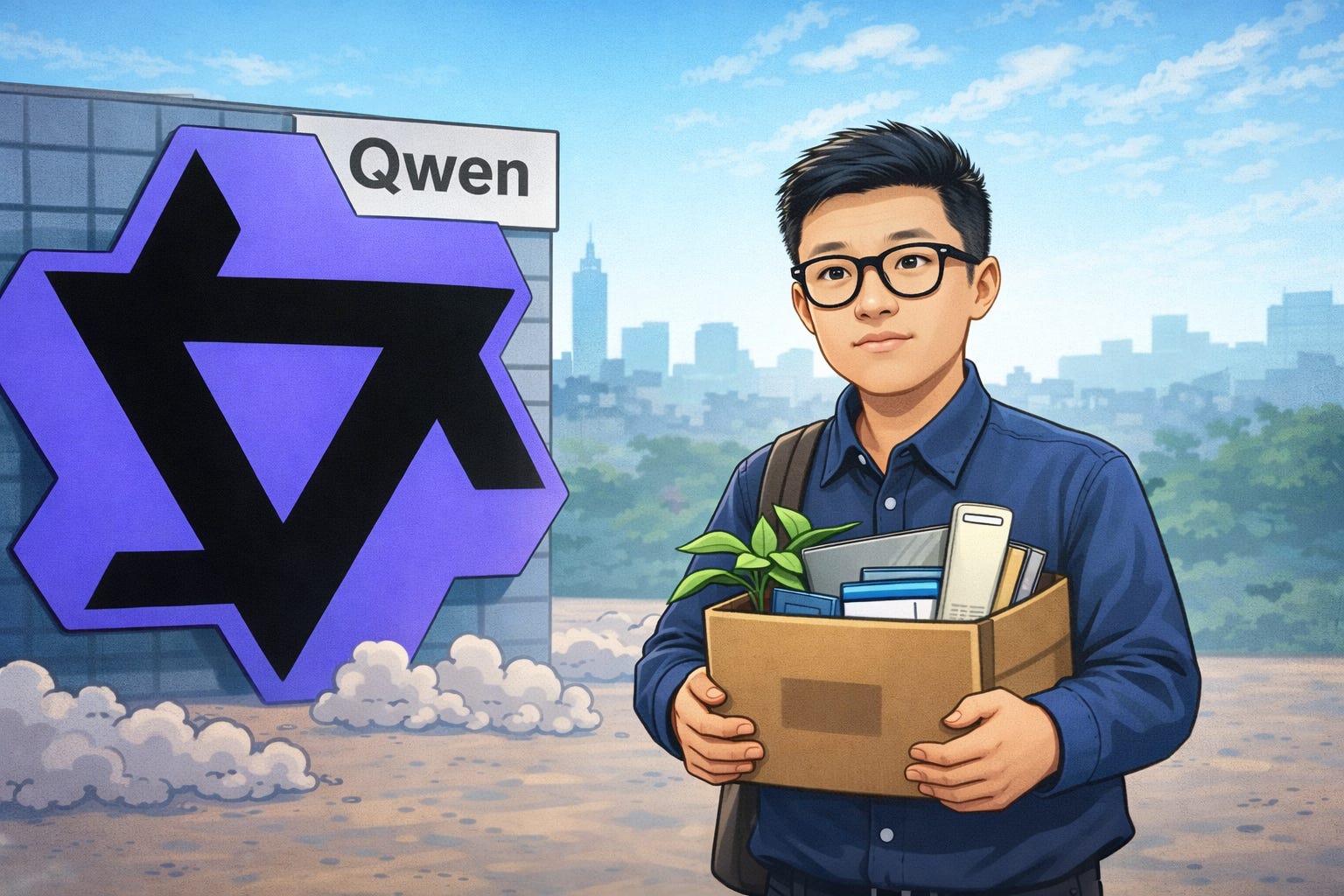
The day after Alibaba released a new series of Qwen3.5 small models that turned heads across the AI community, the man who led the effort announced he was leaving.
Lin Junyang, tech lead of Alibaba’s Qwen, posted on X that he was stepping down. According to LatePost, one of China’s most reliable tech media, Lin submitted his resignation letter yesterday on March 3, and it came as a surprise to the company’s leadership.
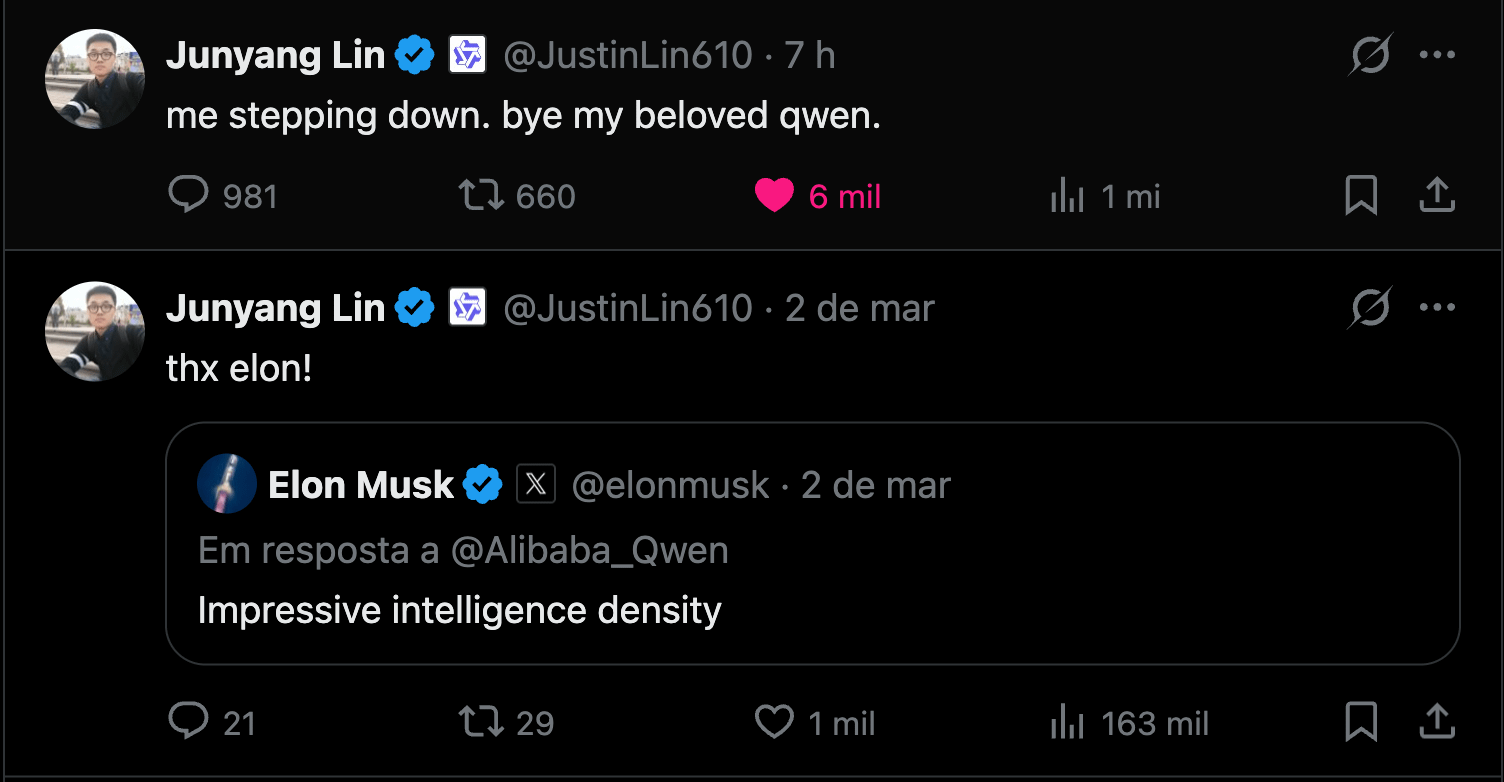
My source told me Lin hasn’t left the company yet, but according to a disclosed all-hands meeting within Alibaba’s Tongyi AI Lab, Lin has little chance to come back.
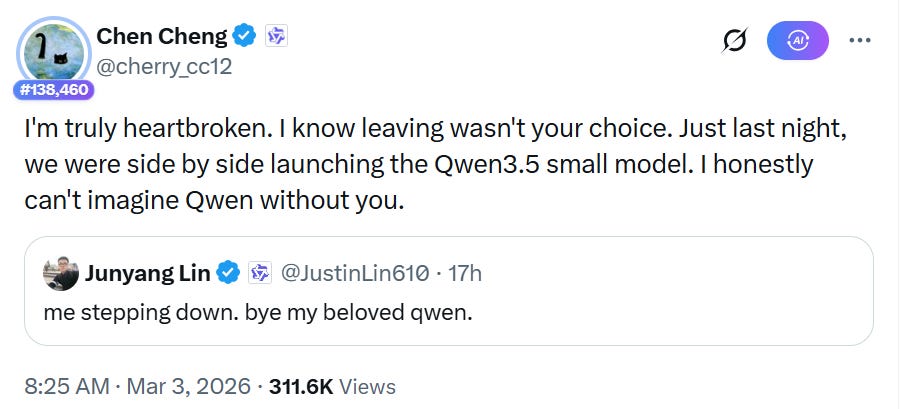
Under his post, hundreds of people from across the AI world poured in with appreciation and good wishes. Other Qwen team members posted their own messages: “Qwen is nothing without its people.”
Who is Lin Junyang
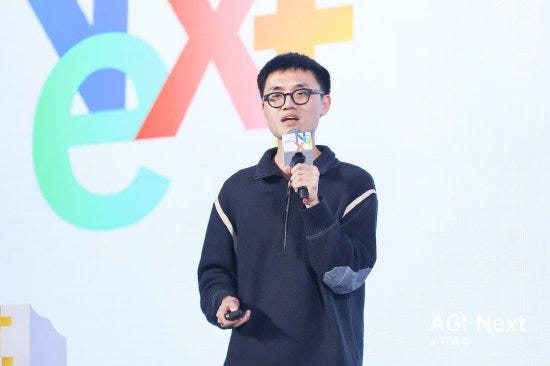
Lin is 32 years old, making him Alibaba’s youngest P10 executive — the company’s senior leadership tier. He joined Alibaba in 2019 fresh out of Peking University, where he studied computer science and linguistics. Thin, bespectacled, warm, and deeply ambitious, he was a key contributor to some of Alibaba’s most important early AI work, including the M6 and OFA models. But his defining achievement was turning Qwen from an unknown side project into the world’s most influential open-source LLM series.
As of January 2026, the Qwen model family had surpassed 700 million cumulative downloads on Hugging Face. Alibaba has open-sourced nearly 400 Qwen models, which the community has used to create over 180,000 fine-tuned derivatives.
Lin wasn’t the only one from the Qwen team who’s leaving the company, and he may not be the last.
Yu Bowen, who led Qwen’s post-training efforts, also left. His replacement is Zhou Hao, a former senior staff DeepMind researcher and a Gemini 3.0 contributor who was recruited by Zhou Jingren, CTO of Alibaba Cloud and head of Tongyi Lab. Zhou Hao will report directly to Zhou Jingren and lead Qwen’s post-training RL research.
Hui Binyuan, the lead of Qwen Code, reportedly left in January 2026 and joined Meta. Lin Kaixin, a contributor to Qwen 3.5, VL, and Coder, also tweeted his own departure.

Why Lin’s stepping down
No single reason has been confirmed, but several media reports point in the same direction.
Alibaba is reorganizing its Qwen team and the broader Tongyi AI Lab, moving away from what was a vertically integrated, startup-like operation toward a more fragmented structure that separates pre-training, post-training, text, and multimodality into distinct teams. That kind of reorganization would directly limit Lin’s management scope, and reportedly doesn’t align with his philosophy of how AI development should work.
Adding to that, the arrival of Zhou Hao created tension. Zhou was personally recruited by Zhou Jingren with a DeepMind background — a similar playbook to what ByteDance and Tencent have run, bringing in researchers from Silicon Valley to strengthen their AI teams. The intent was clearly to deepen Qwen’s research capabilities. But Lin reportedly did not accept the new arrangement easily.
There were also scope conflicts. Over the past year, Lin had expanded Qwen’s work into image generation, voice models, infrastructure, and robotics — areas that overlapped with other teams in the Tongyi Lab.
On the model performance side, Qwen’s latest releases haven’t dominated the way they once did. Qwen 3.5-Plus, which I covered in my last issue, was an ambitious model integrating multiple innovations, but it wasn’t the best open model out there. Over the past six months, Moonshot AI, MiniMax and Z.ai have been challenging Qwen on benchmarks and leaderboards. That kind of pressure compounds quickly.
There’s one more detail worth noting. In a January panel, Lin said publicly that China has less than a 20% chance of winning the AI race, along with other pointed criticisms. I don’t think that directly caused his exit, but statements like that don’t go unnoticed internally, and the resulting PR pressure doesn’t make anyone’s position easier.
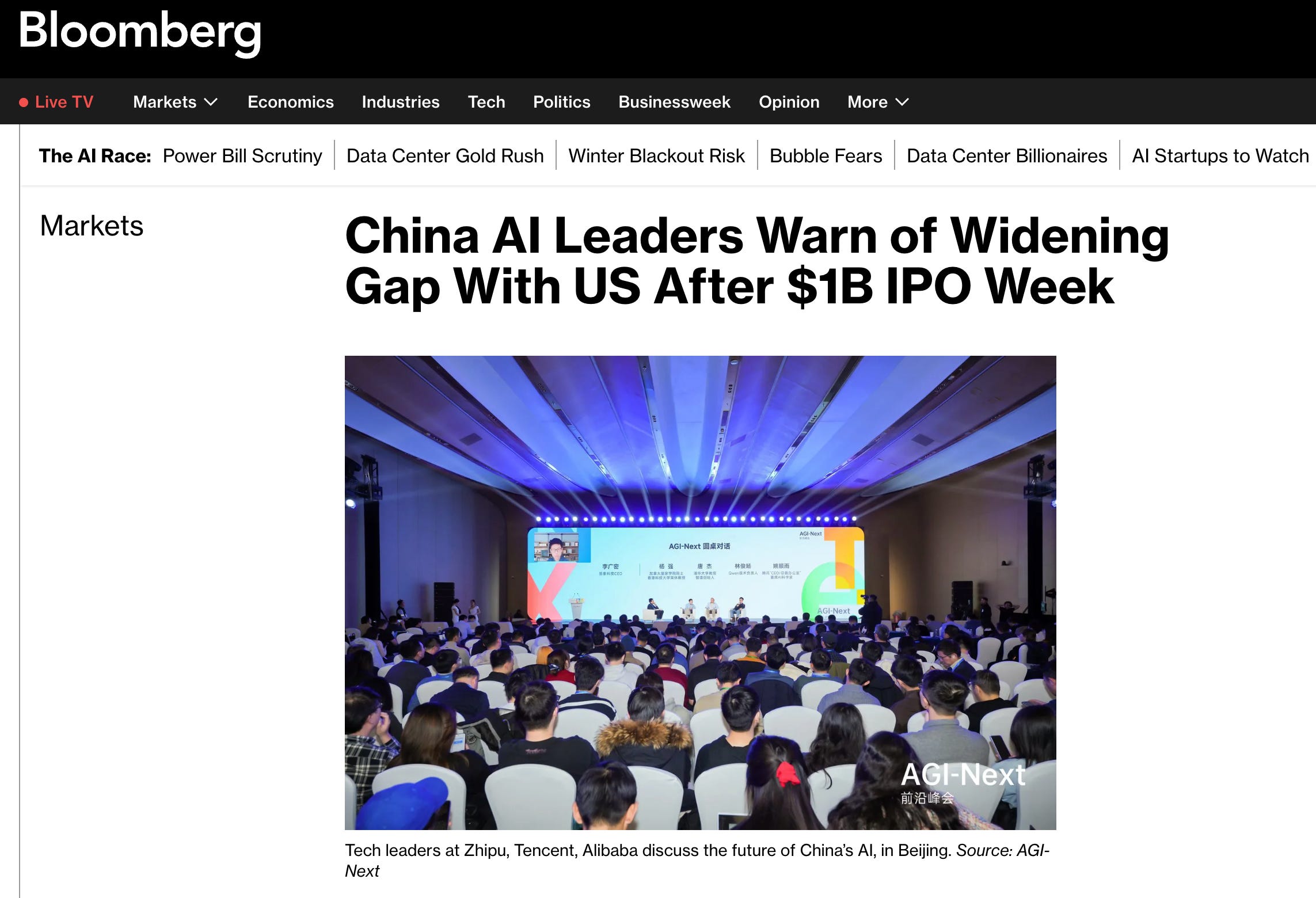
For those following Alibaba closely, this kind of talent exodus isn’t new.
Back in 2022, Alibaba’s DAMO research institute laid off around 30% of its staff and was pushed toward break-even. The departures were significant — Associate Dean Jin Rong, NLP chief Si Luo, the head of the City Brain project, the XR Lab lead, the autonomous driving chief, and Yang Hongxia, the architect behind M6. That was the first wave.
In early 2025, as Qwen gained momentum and China’s AI talent wars intensified, Alibaba lost another round of key names, including Zhou Chang, Qwen’s former tech lead. That was the second.
This is the third.

Alibaba’s ‘Unofficial’ Responses
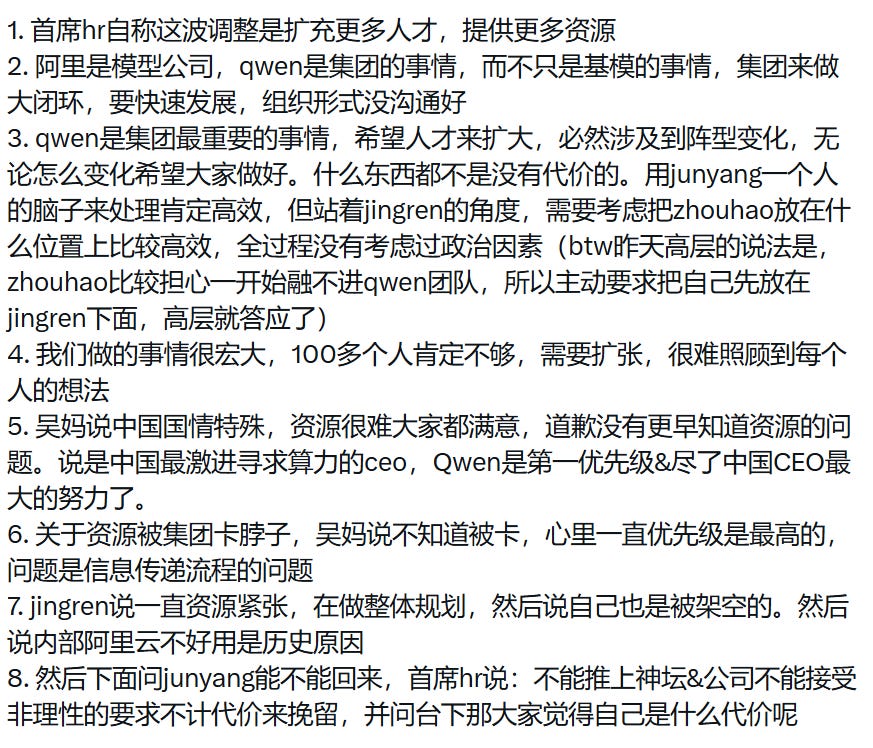
An all-hands meeting within Tongyi Lab today was essentially damage control. Leadership’s message is the restructuring of Qwen and Tongyi Lab is an expansion. Qwen is the Alibaba’s top priority, more talent is needed, and organizational change is inevitable.
Alibaba CEO Eddie Wu apologized for poor communication around compute resource restraints but insisted Qwen was always his first priority. Zhou Jingren admitted resources have been tight and, strikingly, suggested he too has been marginalized internally.
On whether Junyang could return, the chief HR officer shut it down bluntly: no one gets put on a pedestal, and the company won’t make exceptions at any cost.
My Two Cents
Reorg usually happens when a team is in trouble. But Qwen isn’t in trouble. The models are good, maybe not SOTA, but strong across multiple benchmarks. The Qwen app has closed some of the gap against Doubao. Company morale is back, riding the “Make Alibaba Great Again” wave. There’s no obvious reason to push out one of your most talented AI leads. Top AI talent is scarce everywhere. That’s exactly why LatePost described Lin’s departure as sudden.
So what’s really going on? Qwen was never supposed to be this big. Tongyi Qianwen, the predecessor of Qwen, was a closed-source model, and Qwen started as a side project. It broke through starting in late 2023 with fast-improving performance and explosive community growth, and now it’s arguably Alibaba’s most valuable AI asset, along with cloud and chips.
But that success raised the bar. The old KPIs, which could be Hugging Face downloads and the number of derivative models, no longer cut it. The new expectations are Qwen should support Alibaba’s commercial success in both enterprise market and consumer apps, and that kind of pressure on a research team with a open-source priority can be brutal and destabilizing.
Commercially, ByteDance has been eating into its AI cloud business, and despite spending 3 billion RMB promoting its Qwen app in mainland China during the Chinese New Year, Alibaba has failed to match Doubao.
Jia Yangqing, former Alibaba executive and now VP at Nvidia following the acquisition of Lepton.ai, put it plainly:
For companies, balancing open source and business is genuinely hard. We’ve seen wins like Databricks and Redis Labs, and we’ve seen cautionary tales like RethinkDB, a beloved open-source database that shut down in 2016 despite technical excellence. Was there friction between open-source vision and business priorities? Pure speculation, but if there wasn’t, that would be the exception, not the rule.
Then there’s the resource angle. Ilya’s exit from OpenAI is the most famous example as he couldn’t get enough compute. If Lin ends up leading just one slice of a restructured Qwen, his access to GPU resources shrinks accordingly.
On top of that, Alibaba is pushing hard to scale its Qwen app in mainland China, which means more compute going to inference rather than research. That squeeze will be felt.
What It Means for China’s Open-Source AI
Lin was more than a team lead. He was the face of Qwen, and by extension, China’s open-source AI movement globally. His departure is a real blow to that intiative. Some in the community are already calling it the end of an era.
I don’t think Alibaba will pivot to closed-source immediately. But they will almost certainly invest less in open-source efforts going forward. What makes that matter beyond Alibaba is that as the leader of the open-source ecosystem in China, whatever Alibaba does sets the tone for other labs.
In the U.S., almost every major American AI lab has drifted toward closed-source, driven by the pressure to monetize massive infrastructure investments. Open-source builds goodwill and community, but it doesn’t pay the bills the way API-driven, paid-access models do. Chinese AI labs will face the same dilemma if the competition intensifies.
The one wild card is DeepSeek. As long as the well-funded DeepSeek keeps releasing open-weight models and contributing to the global community, it puts pressure on other Chinese AI labs to follow. A closed model from a second-tier lab means nothing when DeepSeek is giving it away. That dynamic may be the strongest check against a broader retreat from openness, at least for now.
Super interesting I can only hope that he found his own startup committed to open source values. Or that he joins DeepSeek.
The signal here isn’t talent leaving.
It’s the structural tension between open-source AI and the capital intensity of compute infrastructure.