

China AI Weekly Digest is a new experimental format that summarizes the week’s big news, model updates, policy, products, and research, sourced from the aggregated newsfeed of China AI Index. The digest below is mostly compiled and drafted by an AI agent (given my limited capacity) sourcing from credible news outlets, then fact-checked and edited by me.
This week’s digest is based on 334 stories tracked (6 editor picks, 74 English-language, 254 Chinese-language) over July 11–18, 2026.
The Big Three
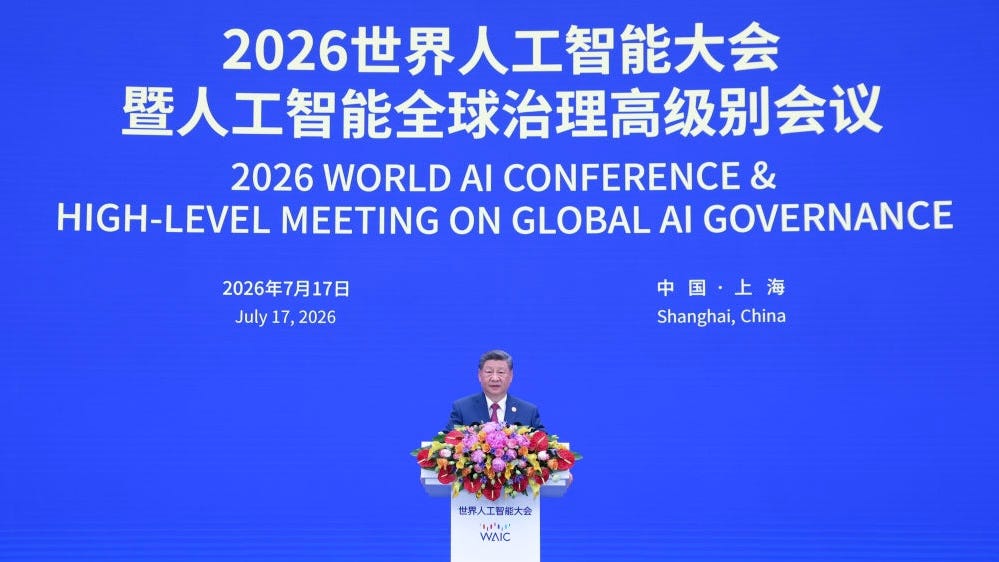
Chinese President Xi Jinping shows up at WAIC for the first time
Xi addressed the World AI Conference in person for the first time this week, pitching China as an AI partner to the developing world, pushing for “human oversight” of AI systems, and warning against creating “new historical injustices” in how AI’s benefits get distributed globally—pointed language given the backdrop of intensifying US tariff threats and export curbs. (Bloomberg/SCMP/FT)
Moonshot’s Kimi K3 rattles global tech markets.
Moonshot AI released Kimi K3, which it's calling the world's largest open-weight model, and framed it as closing the gap with—and in some benchmarks rivaling—OpenAI and Anthropic. The release landed hard: Nvidia and other US Big Tech names sold off on renewed competitive fears, and the shockwaves compounded a brutal week for chip stocks. (Bloomberg/CNBC)
CXMT prices Asia’s biggest listing of the year.
ChangXin Memory Technologies priced its Shanghai STAR Market IPO at ¥8.66/share, raising roughly $8.5–10 billion—China's largest-ever A-share semiconductor offering and its biggest listing since 2010. Retail demand came in 212x oversubscribed; the deal values CXMT near $85 billion ahead of a planned July 27 debut. It's the clearest signal yet that China's memory-chip buildout—a direct response to US export controls—now has serious public-market capital behind it. (Nikkei/SCMP/Bloomberg)
Models
Beyond Kimi K3 (above), the agent race kept accelerating this week.
Alibaba and Honor announced a partnership to build agentic AI devices, and Alibaba’s Qwen team is reportedly upgrading its AI glasses into a full agentic platform that can call skills and run always-on perception. (SCMP/雷峰网)
StepFun struck an agent-systems partnership with Ant Group’s Alipay. (36Kr)
DeepSeek quietly updated its API docs with a new field aimed at agent developers—small, but a signal the company is optimizing for the same agentic-tooling wave as everyone else. (雷峰网)
Mira Murati’s Thinking Machines drew on techniques from Chinese labs in its debut model—a rare public acknowledgment from a frontier US lab of technical influence flowing the other direction. (FT)
Washington is looking at ways to stop China from training its own models on outputs from US frontier systems, which suggests the “who’s learning from whom” narrative is getting messier in both directions. (Bloomberg)
Funding
DeepSeek’s fundraising trajectory is the story here.
DeepSeek is already lining up fresh funding at a valuation climbing toward ¥480 billion (~$67B), with IPO chatter “as soon as next year.” (FT/Bloomberg)
Zhipu AI is reportedly set to become the first Chinese AI firm to cross $1 billion in annualized revenue, with ARR up roughly 15x over six months per 36Kr. (Bloomberg/36Kr)
ModelBest (面壁智能) closed a new round pushing its valuation above ¥20 billion, alongside news its on-device model will ship on Samsung phones. (36Kr)
Embodied-AI startup LimX Dynamics (逐际动力) raised a $200 million pre-IPO round ahead of a planned Hong Kong listing. (财联社)
And Baidu is seeking to voluntarily convert its Hong Kong listing to a dual-primary structure. (36Kr)
AIsphere (爱诗科技), the Beijing startup behind AI video generator PixVerse, raised a total of $439M in its Series C funding, pushing its valuation past $2 billion. (Caixin Global)
Policy
The chip-access picture got murkier this week.
Reuters reported ZTE, a Kingsoft cloud subsidiary, and one other Chinese firm were newly licensed to buy Nvidia H200 and rival AMD chips under Washington’s existing approval regime—expanding the roster of cleared buyers. (Reuters)
The same day, the FT reported Nvidia halved its list of approved Asia buyers in a China chip crackdown, and CNBC quoted a US trade official saying “very few” H200 chips have actually shipped to China so far. (FT/CNBC)
Separately, SCMP reported Chinese regulators are developing an AI safety benchmark aimed at large-model risk. (SCMP)
Nikkei reported that Anthropic’s export curbs on Claude models pushed a wave of US firms toward cheaper Chinese open-weight alternatives, with Chinese-model token usage among affected US firms nearly doubling in the final week of June—DeepSeek, Alibaba, Moonshot, and Zhipu were named as beneficiaries. (Nikkei)
Products
The biggest product story of the week has nothing to do with a Chinese company shipping something new.
It’s Apple clearing its China AI hurdle by routing Apple Intelligence through Alibaba’s Qwen and Baidu’s Ernie models, with seven on-device generative AI services (including Apple’s) winning Chinese regulatory approval. Alibaba and Baidu shares both jumped in Hong Kong on the news. This has been a multi-quarter overhang for Apple in China, and the resolution flowing through two domestic model providers rather than a single national champion is itself a signal about how Beijing wants foreign AI partnerships structured going forward. (CNBC/Bloomberg)
WAIC 2026 also opened in Shanghai this week with over 300 physical robots on the show floor, underscoring how much the “AI conference” has become an embodied-AI trade show. Coverage highlights included SenseTime’s new compute-power/electricity co-scheduling agent system claiming an 80% improvement in token output per unit of power cost, a humanoid-robot boxing exhibition, and Xiaomi detailing its robotics “data factory” approach to training humanoid systems. (量子位/雷峰网)
SCMP reported a local Chinese official used AI to build a flood-evacuation app after floods killed dozens—a rare on-the-ground application story worth a follow if there’s a broader “local government + AI” pattern forming. (SCMP)
Research
Nikkei’s analysis on how cheaper Chinese generative AI tools are lowering the cost of tailored, persistent influence operations. (Nikkei)
A Cambridge-affiliated study finding that Boko Haram exploited both US and Chinese AI chatbots to plan attacks. (SCMP)
A study of 26,000 Chinese students finding AI homework tools cut exam scores by roughly 20%—a data point that cuts against the “AI tutor” optimism narrative and could be worth its own item. (SCMP)
Appreciate this type of post Tony ;)
One note though: the last 2 SCMP links seem to not be working (I have a valid SCMP subscription).