

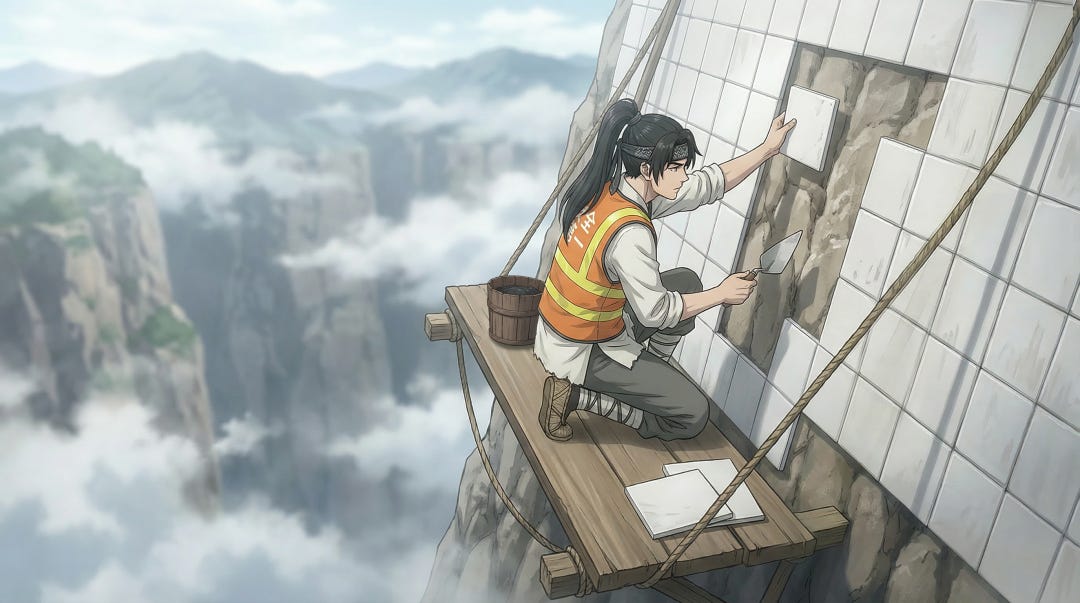
The same week OpenAI quietly killed its AI video app Sora, a series of AI-generated absurdist comedy videos was racking up 5 billion views on Chinese social media.
The video series is called “Saving a Fox on a Snowy Mountain.” It’s 90 seconds long, rendered in the style of a low-budget 1970s Chinese martial arts film, and it follows a classic folk tale setup:
A wandering woodsman rescues a fox in the snow by leaving a braised dusk, and by genre convention, the fox should later transform into a beautiful woman and repay his kindness.
Instead, when the hero opens his door expecting his destined reward, he finds not the grateful fox spirit but the braised duck he’d left behind as food. The duck, also apparently now sentient, has other plans.
“I am the braised duck you abandoned,” it says. Revenge has arrived.
The video was made by a 4-person team at a food company selling spicy marinated duck. It cost about ¥4,000 to ¥5,000 to produce in 5 hours, and was purely to promote their food.
(I couldn’t find the original version on YouTube, and this one is the closest alternative.)
That’s the whole joke, and it went viral with a speed that no one anticipated. Thousands of user-created spin-offs were spawned by swapping the duck for mountains, wood, and bean juice. Local government accounts borrowed the format for anti-fraud PSAs.
From face-swaps to full pipelines
To understand where Chinese AI video is right now, you need to understand where it came from. The starting point is a regulatory quirk that made face-swapping technology mandatory in Chinese film production.
China’s entertainment regulator maintains an informal but powerful blacklist of artists with bad conduct records. When a performer gets caught in a scandal—tax evasion, drug use, moral violations as defined by the relevant authorities—they will be banned from screens overnight.
For studios that have already completed production with a blacklisted actor, the only options are to shelve the project entirely or digitally replace every frame of that actor’s face with someone else’s. This has happened enough times, with high-profile cases involving major stars, that face-swapping became a standard post-production capability.
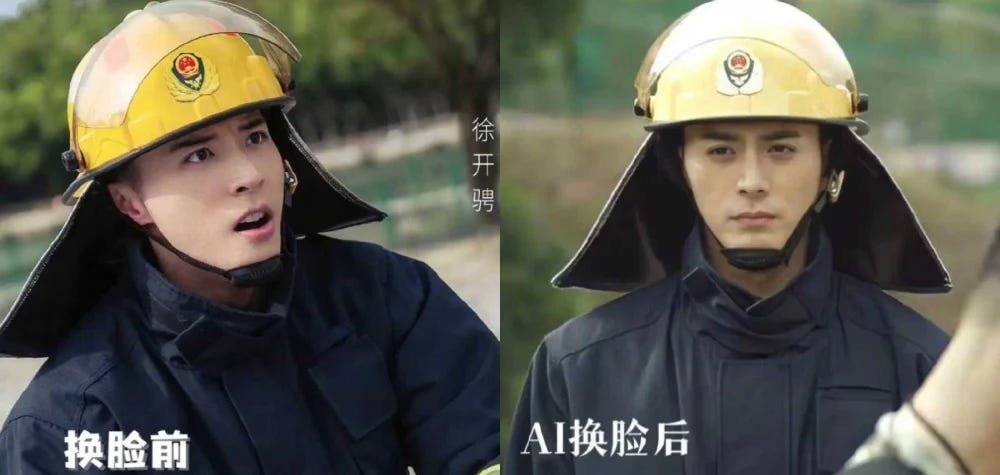
By 2025, AI had moved beyond that narrow use case into conventional post-production: crowd scenes, digital environments, stunt sequences in dramas. For example, the 2026 hit drama Swords Into Plowshares (太平年) used Kling AI from Kuaishou to generate a scene of crows eating grain, a shot that would have been expensive or impractical to production.
Today the conversation is completely different. ByteDance’s SeeDance 2.0, released in February 2026, becomes the latest SOTA video generator model. According to the company, the model achieves roughly 90% generation usability, meaning 9 out of 10 clips it produces are workable. The prior industry average was around 20%.

Such AI generation technology might not be ready to produce Hollywood-level film or dramas, end-to-end, but it is a natural fit for short dramas, a type of 1–3 minute, high-intensity vertical videos built for smartphones that emerged from China’s Internet platforms. According to DataEye-ADX industry tracking data, in January 2026 alone, 14,634 AI-generated short dramas went live in China, one new title every 90 seconds.
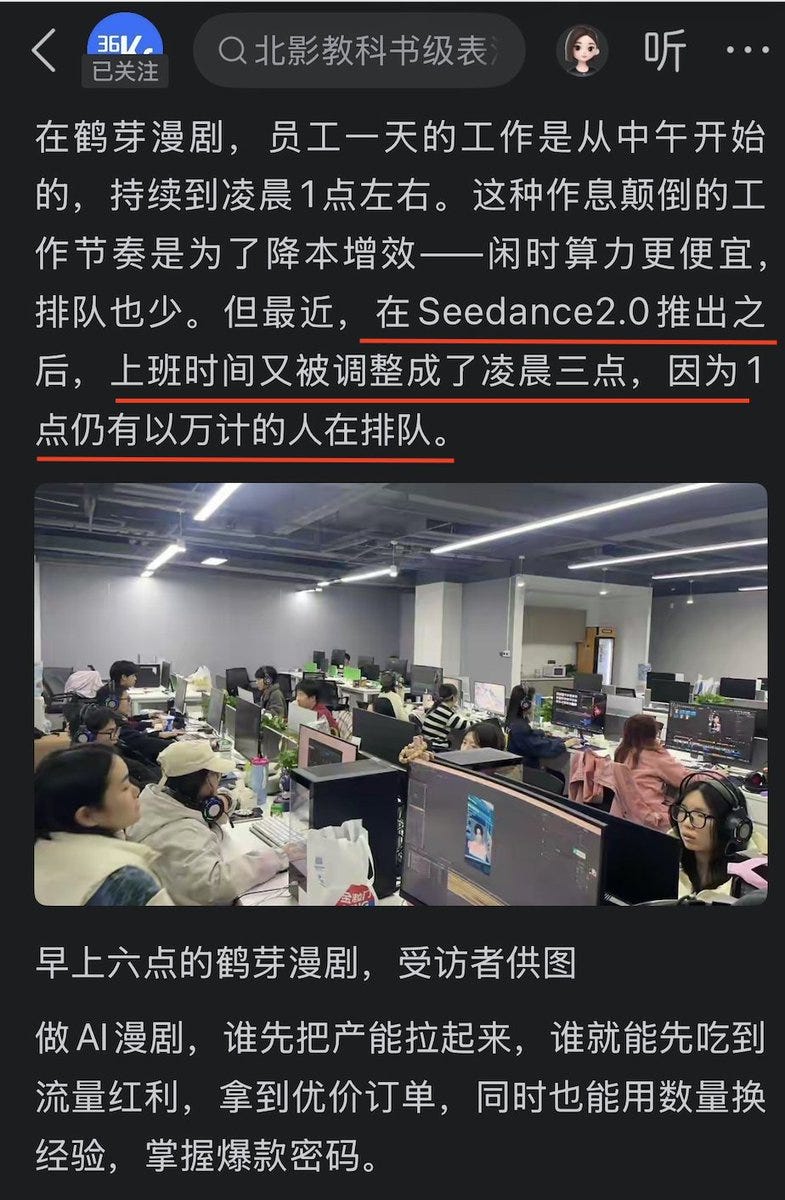
The reaction inside the industry was also brutal. SeeDance 2.0 made content creators unable to sleep. Teams returning after the Chinese New Year holiday were working overtime just to test the new model—average queue times on the platform exceeded six hours during peak periods. In response, a Chinese production studio began working at 3 am to use SeeDance 2.0 during off-peak hours and skip the daytime queues.
Comic dramas gain traction
Over the past week, I noticed my wife watching an AI-generated animated drama on her phone for several evenings running. She is not usually a short drama or cartoon person, so I paid attention.
The show she was watching, on Hongguo (红果, Red Fruit), ByteDance’s dedicated short drama app, is set during a catastrophic cold event that has made most of the earth uninhabitable. A small community tries to survive an endless winter storm.
The animation is not good by any conventional standard. The character movement is limited, the rendering is sometimes inconsistent, and in any other context she would have found it easy to dismiss. She kept watching because the story was interesting enough that the visual shortcomings stopped mattering after the first few episodes.
What she was watching is called Manju(漫剧), literally comic drama, and it has quietly become one of the fastest-growing entertainment formats in China, thanks to AI.
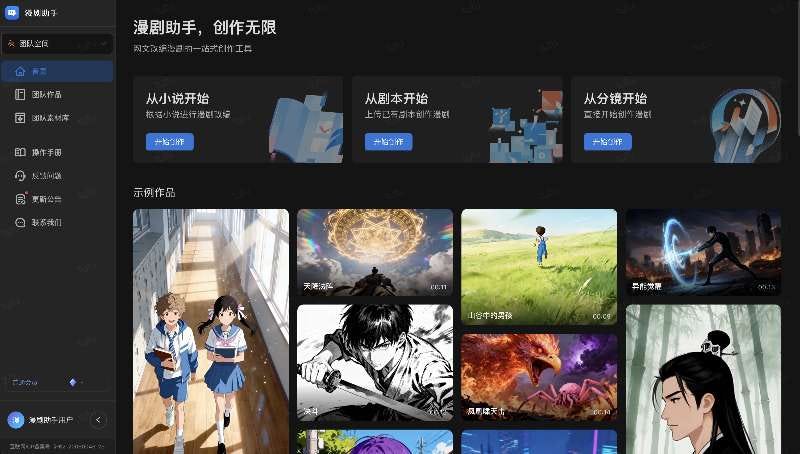
The term comic drama was originally coined in 2021. It converts static illustrated panels—sourced from web novels, existing comics, or AI-generated art—into short video through voice acting, limited character animation, and sound design. Episodes run one to three minutes. Series typically run 60 to 120 episodes. The visuals are semi-static, much closer to a comic panel that has been given breath than to fluid animation, which is precisely why AI can produce them at cost. The format is quite close to motion comics, sitting between comics, audio drama, and animation without being any of them.
There are three tiers of comic dramas, each with different economics.
At the bottom, meme and emoji comics cost ¥400–600 ($58–87) per finished minute. Competition has squeezed margins below 10%.
The middle tier, 2D/3D comic drama, is currently the platform traffic mainstay, carrying profit margins of around 30–40%.
At the top, AI humanlike drama pushes costs to ¥30,000 ($4,350) per minute but delivers profit margins above 60% for teams that can maintain the quality, though output is constrained to roughly one title per 10-person team per month.
To understand what makes it work, look at the biggest hit of 2025, Below the Immortal Execution Platform, I Shocked the Gods (斩仙台下,我震惊了诸神), which reached 1 billion views on Douyin.
The setup would be impossible to film affordably as live action: a lowly court servant in the celestial bureaucracy, accused of conspiring with demons and slaughtering gods, is brought before a divine tribunal for judgment. As the gods interrogate him, his true identity is actually a disciple of Sun Wukong, also known as the Monkey King, and he dismantles the moral hypocrisy of each deity who claims to judge him. The story is built on two mythologies every Chinese viewer knows—Journey to the West and Investiture of the Gods—and reframes them as a story about corrupt institutions protecting their own.
With AI, non-human characters, magical transformations, alien worlds, thousand-soldier battle scenes—all are as cheap to generate as a prompt. As one producer put it simply: “Comic dramas can creaate non-human characters. That’s the biggest difference from live-action short drama.”
Grace Shao’s latest piece on AI-generated microdramas, which I highly recommend, offers a framing that clarifies why AI found its commercial footing here. A conventional studio requires a massive crew to create a masterpiece. An AI content factory tests, iterates, acquires traffic, and monetizes retention. It is optimized not for Emmys but for thumb-stopping cliffhangers. As Shao writes:
The product is not pretending to be prestige storytelling, nor is it even attempting to be jaw-dropping cinematography; it is shamelessly positioned as narrative dopamine.

China’s comic dramas generated an estimated ¥16.8 billion (roughly $2.3 billion) in revenue in 2025, with 70 billion cumulative views and more than 60,000 titles produced on Douyin alone, according to DataEye Research Institute’s 2025 annual report. A separate estimate from iMedia Research put the figure at ¥18.98 billion with year-on-year growth of 276%.
Soy Sauce Animation, one of the industry’s most prominent production studios, describes its operation as 100% AI-generated with no traditional animation staff, produces 60-70 titles per month, and generates approximately ¥50 million ($7.2 million) in monthly revenue.
While western platforms monetize AI through subscriptions, cloud services, and enterprise software, Chinese companies monetize still primarily through advertising—and advertising revenue is directly proportional to time spent on platform. This creates an incentive to invest in content that maximizes user’s screen time. AI-generated comic drams, with its binge-optimized episode structure, daily release cadence, and cliffhanger-every-90-seconds rhythm, is among the most effective time-on-platform vehicles ever built.
The foundation is China’s web novel ecosystem, which collectively host tens of millions of works with years of readership data already validating which stories have audiences. Before comic dramas, traditional animation cost ¥50,000-100,000 per finished minute of footage, which meant only a small fraction of those novels could justify visualization. With AI-driven comic dramas now lowering costs, that entire long tail becomes economically viable. Thousands of novels that would never have been filmed now have a visual form.
The distribution infrastructure was already built. China had 1.164 billion monthly active short video users as of December 2025, according to QuestMobile. The algorithmic recommendation systems on Douyin and Kuaishou are designed precisely for such type of content. According to ByteDance’s data, comic drama achieves a test-out rate of 50-75%, meaning more than half of new titles successfully gain algorithmic recommendation.
Take ByteDance as an example. Its Tomato Novel app provides 67,000 novel IPs available for visual adaptation. Jimeng, ByteDance’s AI generation platform for images and videos, supplies the production tools. Douyin handles distribution. Hongguo Comic Drama, a dedicated comic drama app launched in November 2025, reached 8.54 million monthly active users in its first month. Ocean Engine manages advertising monetization. The company controls the source novel, the production tool, the distribution platform, and the ad revenue in a single stack. Tencent, Kuaishou, Baidu, and Bilibili have all launched competing apps and subsidy programs.
It’s worth noting that comic drama’s growth happened against a backdrop of the broader short drama industry contracting. Live-action short drama had expanded recklessly in 2023-2024. Production costs were rising as the market demanded higher quality, new titles were being uploaded faster than audiences could absorb them, and platforms began pulling back guaranteed stipends in early 2026. For producers caught in that squeeze, AI comic dramas offered a back up plan.
The regulator is also watching cautiously. China’s media and films watchdog National Radio and Television Administration brought comic drama under formal regulatory review in late 2025. The industry had already received a warning: One title that crossed 100 million views, Failed the College Entrance Exam, Tricked Classmates into a Ghost University (高考落榜,忽悠同学上冥牌大学), was pulled from all platforms for promoting superstition.
But the regulatory posture so far is not hostile. Local governments are simultaneously offering subsidies to attract comic drama production talents, and state-owned broadcast CCTV produced its own official AI comic drama in January 2026.
The part that’s harder to watch
The same AI tools producing comic dramas are also threatening the livelihoods of Chinese actors.
On March 18, 2026, a hashtag called “actors replaced by AI” trended to the top of Weibo, China’s equivalent of X. Reports circulated that major production studios and platforms were planning to replace background actors with AI. The same day, a production company called Youhug Media launched two AI actors, gave them social media accounts, and announced their first dramas. The two AI actors were immediately noted to resemble well-known actresses.

The backlash was immediate enough that state-owned People’s Daily weighed in within days. Its commentary column published a piece on March 21 arguing that people resist AI actors because they lack liveliness. The editorial warned that companies rushing to deploy AI simply to cut headcount without creating new value are using tactical efficiency to mask strategic failure. “The advantage is not doing old things faster, but doing new things in new ways.”
It doesn’t mean AI actors will be regulated away. China’s regulatory priorities in this space remain focused on content labeling and stability rather than labor protection. But it signals that the displacement anxiety is being taken seriously.
At one major industry conference, ChinaEquity Group founder and CEO Wang Ran said background performers and stunt double professionals will essentially disappear because of AI. Mid-tier actor demand will be massively compressed. Even top actors will see their upfront fees dramatically shrink. Hengdian, the filming base that has been the working home of tens of thousands of Chinese actors, saw short drama production starts fall roughly 75% in the first quarter of 2026 compared to last year.
Chinese tech media 36Kr profiled one actress who spent three years building a career playing supporting roles in short dramas, from the cheerful best friend, to the arrogant young miss. After the 2026 Chinese New Year, she voluntarily dropped her quoted rate by a third. Production companies were coming back with offers at half her previous day rate. She accepted. “Before you played the female lead, now they ask you to play second female lead. Now they ask you to play featured extra. Take it or leave it.”
There is no Chinese labor union representing actors. Unpaid short drama actors will post social media and hope public embarrassment forces a response. Sometimes it works.
Displacement and new opportunities co-exist
The conventional AI displacement story is about AI coming for existing jobs, actors losing work, the industry shrinking. That’s not quite what’s happening here.
Comic dramas didn’t destroy traditional animation. It created an entirely new market segment, at a cost and volume that was impossible before generative AI, serving content that could not have been produced otherwise.
And it is starting to move beyond China.
Chinese short videos and dramas are already a global phenomenon. Platforms like ReelShort and DramaBox, both backed by Chinese companies, have built meaningful audiences in the US and Southeast Asia. TikTok is replicating the entire Chinese short drama playbook in the US through a dedicated in-app section and a standalone app called PineDrama. The global short drama market hit $2 billion in overseas app revenue in 2025, according to Sensor Tower, and projections from TikTok put the eventual global market at $10 billion with 200-300 million monthly users.
AI comic drama is also moving. China Literature Online, one of the largest IP holders, has already produced original overseas comic dramas with localized art styles—a vampire drama rendered in an American comic art style, distributed on the overseas platform Sereal+. Industry insiders say the format’s global test is just beginning, with a six-to-twelve month window before anyone knows whether it can replicate the domestic model abroad.
But the Hengdian silence is also real. The actress who spent three years playing supporting roles is taking gigs below her usual rate, trying not to think about whether the category she built a life around will still exist in two years.
Both of these things are true simultaneously. The rest of the world will find out soon enough whether any of this translates.
Great piece. Small correction: "braised duck" instead of "braised dusk" :)