

China AI Weekly Digest summarizes the week’s big news, model updates, policy, products, and research, sourced from the aggregated newsfeed of China AI Index. The digest below is mostly compiled and drafted by an AI agent sourcing from credible news outlets, then fact-checked and edited by me.
This week: 331 stories tracked (2 editor picks, 115 English‑language, 214 Chinese‑language 🇨🇳) over August 15–22, 2026.
The Big Three
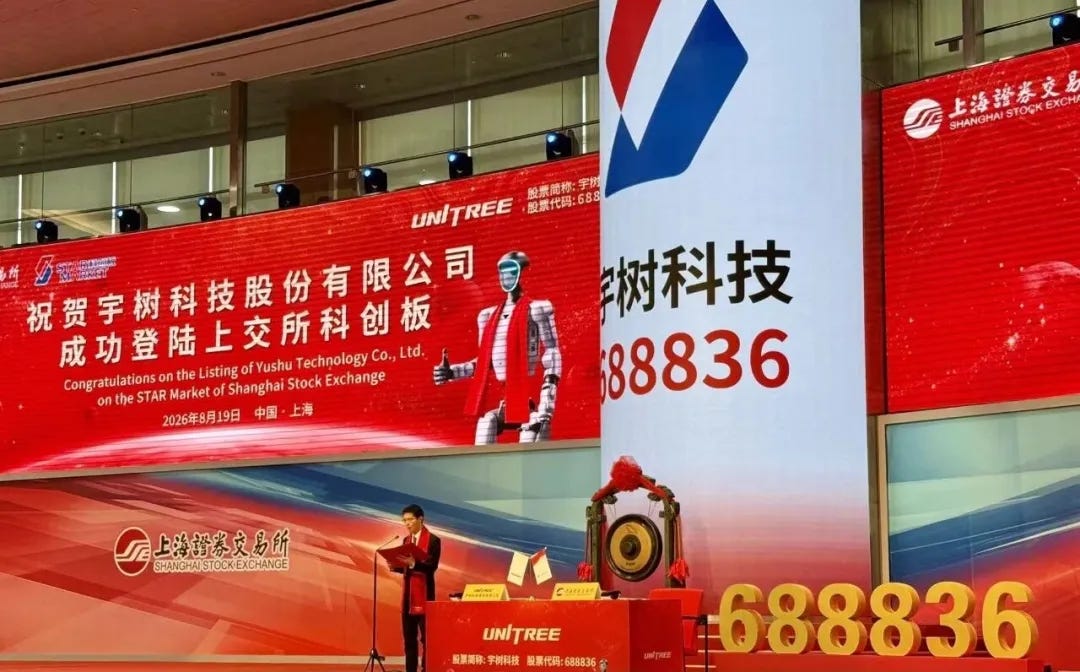
Unitree turned China’s humanoid-robot hype into a $66 billion stock, and the market still can’t decide if that’s rational. Unitree debuted on Shanghai’s STAR Market on August 19 and opened as much as 629% above its IPO price, at one point valuing the company near $66 billion and pushing founder Wang Xingxing’s net worth up roughly $18 billion to make him China’s richest post‑90s entrepreneur. However the stock shed nearly $10 billion in market cap over the following two trading days. Wang himself tempered expectations, saying robots’ “ChatGPT moment” is still two to ten years out and that factory‑scale deployment “can’t be rolled out broadly yet.” (Bloomberg/Reuters/SCMP)
China’s AI-spending hit Big Tech earnings across the board this week — everyone’s AI revenue is up, and everyone’s profit took a hit for it. Alibaba’s net profit dived 75% even as revenue grew 9% and cloud revenue jumped 45% on AI demand; Baidu logged its fifth straight quarterly sales decline as ad weakness outran AI‑cloud gains; Xiaomi’s profit slid too, with executives saying they’re “in no rush” to turn AI spending into returns; and Kuaishou’s net profit dropped by a third even as its Kling AI unit posted ¥850 million in quarterly revenue, with reports that Tencent’s free cash flow also swung negative on AI compute prepayments. (Bloomberg/SCMP/CNBC/Bloomberg)
The US is working to close a loophole that has let Nvidia’s best chips keep reaching China despite the existing export ban. Nvidia denied a separate report that it plans to roll out a China‑specific chip by year‑end. China, meanwhile, eased its own restrictions on importing Nvidia’s H200, a notable loosening given how tightly Beijing has otherwise policed foreign‑chip dependence. A separate report this week found domestic chips still fall short on coding tasks, forcing firms to stretch scarce Nvidia allocations rather than switch over. (CNBC/FT/Reuters/SCMP)
Models
DeepSeek’s new multimodal and frontier “test” models led a busy model week, with Kimi, Alibaba, Zhipu, Xiaohongshu, Ant, and SenseTime all shipping too.
DeepSeek launched DeepSeek‑V4‑Flash‑Vision‑Exp, its first true multimodal model, priced identically to the standard V4‑Flash and confirmed live on the DeepSeek API platform. (财新/@deepseek_ai)
Moonshot’s Kimi K3, paired with a new Harness, is closing in on Opus 5‑class performance on autonomous research benchmarks, and an OpenAI‑backed legal‑tech startup switched its stack to the open‑weight model, a notable vote of confidence from a US‑based customer. (量子位/SCMP)
Alibaba shipped a lightweight, laptop‑capable Qwen model aimed at Meta’s and OpenAI’s smaller open releases and a beta AI music generator called HappyShrimp, while a separate Wall Street test of eight leading AI agents ranked Qwen’s office agent first — ahead of Claude Cowork and Codex. (SCMP/CNBC, Bloomberg, 雷峰网)
Xiaohongshu (Rednote) quietly open‑sourced its first foundation model, dots3, joining the growing list of Chinese platforms building their own model layer. (虎嗅)
Zhipu’s GLM‑5.3 API went live, priced the same as GLM‑5.2 and built for coding, defensive cybersecurity, and long‑horizon agentic tasks. (@Zai_org/量子位)
Ant’s AGI unit open‑sourced six new Ling‑3.0 base‑model checkpoints plus a draft model for speculative decoding. (@AntLingAGI)
SenseTime released an open, lightweight unified multimodal model, SenseNova U1.5 Lite. (@SenseTime_AI)
Funding
Unitree’s IPO frenzy is fueling a wave of robotics and chip listings, while Alibaba kept reshuffling its balance sheet toward AI.
Two more Alibaba‑backed companies are lining up Hong Kong IPOs in Unitree’s wake — AI video platform ShengShu and legged‑robot maker LimX Dynamics, the latter seeking up to $300 million. (Bloomberg/Bloomberg)
Memory chipmaker YMTC is moving closer to what would be China’s next marquee chip IPO, following CXMT’s own blockbuster debut. (Bloomberg)
ByteDance drew more than $30 billion in orders for a jumbo bank loan, and separately agreed to pay the US $400 million to settle a TikTok children’s‑privacy suit. (Bloomberg/SCMP)
Alibaba kept trimming non‑core assets to fund its AI pivot, agreeing to sell gaming arm Lingxi for $1.5 billion. (Bloomberg)
Alibaba said its open‑weight Qwen models have passed 3 billion downloads, overtaking Meta’s and Google’s open models. This is a milestone CNBC frames as a “tipping point” pulling investors back into China AI names. (Bloomberg/CNBC)
China’s embodied‑AI sector raised ¥93.5 billion (roughly $13 billion) in the first half of 2026 alone, as the industry shifts from proof‑of‑concept demos toward scaled deployment. (虎嗅)
Policy
Beyond the chip-export back-and-forth above, this week’s other policy posts were about data, talent, and regional alignment.
A US congressional advisory body warned that China’s systematic collection of enterprise and physical‑world data gives it a real edge in training AI for robotics and autonomous vehicles. (Reuters)
China appears set to lift its travel ban on Manus’s founders, months after the startup’s team drew scrutiny amid Meta’s acquisition interest. (FT/Nikkei)
China and the US are each courting Southeast Asian governments to align with their respective AI standards and infrastructure — a push that could test the region’s longstanding preference for non‑alignment. (SCMP)
Products
Doubao pushed further into cars and Alipay made its agent ambitions official.
ByteDance’s Doubao model is now built into Tesla’s China‑market vehicles, handling real‑time information and natural conversation in early hands‑on tests. (虎嗅/第一财经)
Alipay launched a full-stack agentic commerce platform that lets merchants use AI agents to automate tasks and reach customers. (Bloomberg)
Research
Two research items stood out this week — one on AI‑safety norms, one on a genuinely novel clinical application.
Zhipu published research that a Chinese cybersecurity specialist framed as an answer to Anthropic’s Project Glasswing, described as marking a shift in how Chinese labs approach AI‑safety disclosure. (SCMP)
A Chinese brain‑reading AI model reportedly can help predict depression risk up to four years in advance — one of the more concrete medical applications to come out of a Chinese lab this year. (SCMP)