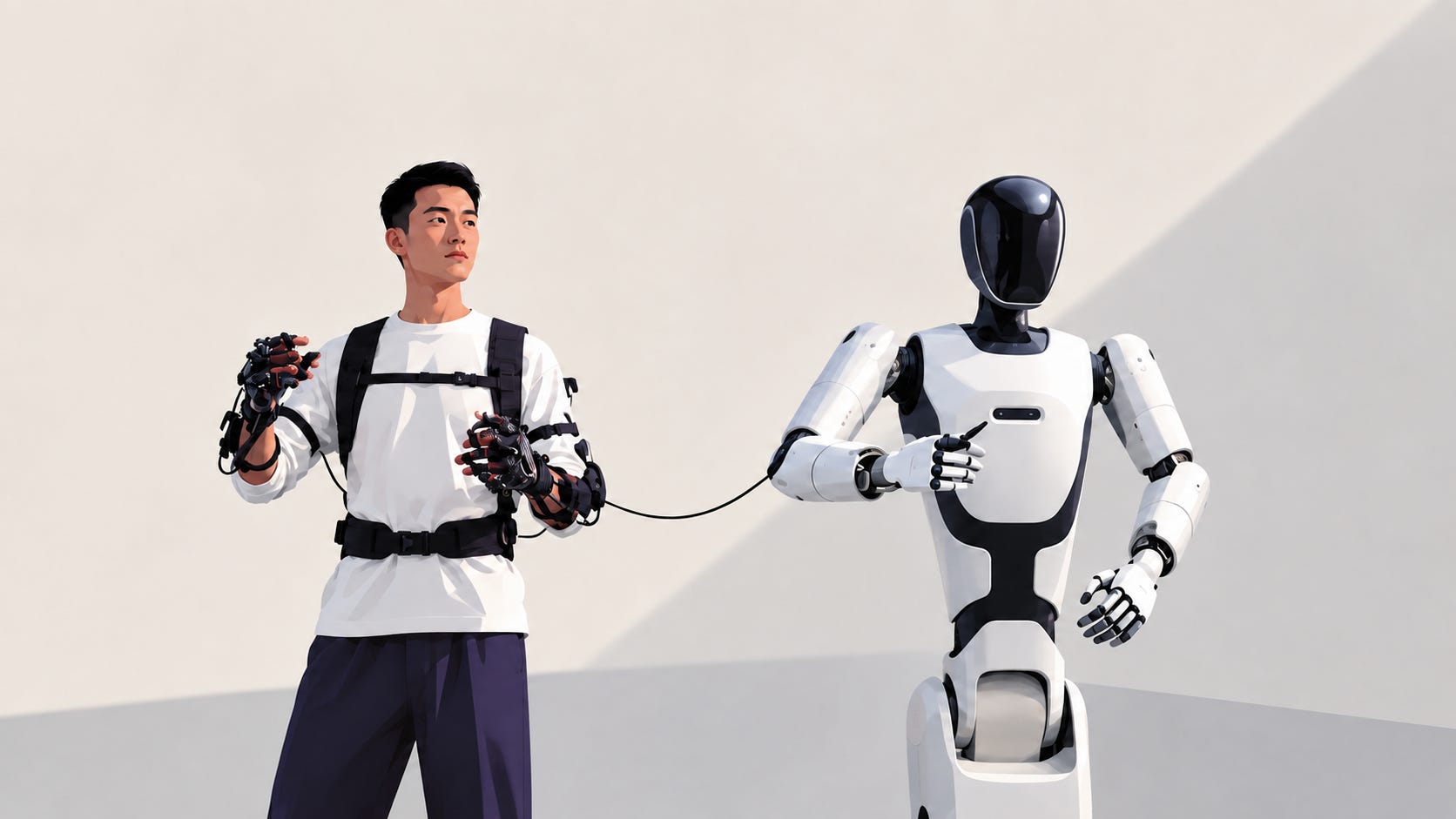
Robots are white-hot right now in China. The country’s robot upstart Unitree has gone public, and AGIBOT isn’t far behind. At the recent World Humanoid Robot Games in Beijing, branded as the “Olympic Games of robots,” a humanoid eclipsed Usain Bolt’s 100-meter world record by running it in 8.64 seconds. There is a noticable progress in performance as robots move from only jumps and backflips last year to sports like tennis and ping-pong this year.
A growing number of robots are being deployed to everyday public services, such as coffee shops, pharmacies, and urban traffic management. At this stage, their operational environments are fixed layouts where tasks are repetitive and objects are pre-defined. (Michelle Sun’s CoreMatter newsletter wrote a great review on the deployment of Chinese robots).
That said, robots are still far from matching human in physical activities. They struggle with handling basic, varied real-world tasks. They need a universal brain.
Chinese investors have already been pouring massive capital into local startups promising to build one, with over 63.4 billion RMB ($9.4 billion) invested into robot-brain companies, or embodied AI companies, between January 2023 and August 2026, according to Chinese data provider IT Juzi.
Once these companies secure fresh capital, they need to expand their R&D budgets to advance the key technologies driving exponential growth: Talent, compute, hardware, and above all, data.
The main reason LLMs work so well comes down to massive amount of unsupervised data spanning from classic literature and academic papers to Internet forums. More data yields better model performance.
Embodied AI is also beginning to prove its scaling law. For example, Robbyant, a robot startup incubated within Ant Group, discovered that when scaling pre-training data for vision-language-action (VLA) models, from 3,000 hours to 20,000 hours, downstream task success rates improved substantially, and this performance curve showed no signs of saturation. The team expanded their dataset to 60,000 hours when training their 2nd-generation model. (Disclosure: I work in comms at Ant Group.)
But what about the reality of robot data supply? Nearly every robot article and podcast I’ve read stresses that we are facing a data deficit. Chinese media outlets often quote that “the world has only generated about 500,000 hours of high-quality, real-world physical interaction data—less than 1/20,000th of the data used to train basic LLMs.” While I couldn’t verify the original source of that exact figure, my general estimate is that we are far behind data abundance.
Major types of data
Each piece of robot data is called an episode, which refers to a robot completing a specific task such as picking up a glass of water regardless of whether it succeeds or fails. Although stored in various formats, an episode typically includes the trajectory (the timeline of events), observations (sensor data like images, point clouds, and force feedback), the robot state, actions taken, and relevant metadata.
When thinking about what data robots actually need, Tanay Jaipuria, Partner at Wing Venture Capital, proposed a framework in his newsletter called The Data Pyramid in Robotics, breaking it down into seven tiers. I highly recommend his article if you want to dive deeper.

From my perspective, it really comes down to two main categories: human data (often called robot-free data) and robot data. Human data simply means data collected through human without involving robots, including web video, egocentric footage, universal manipulation interface (UMI), and motion capture (mocap). Robot data on the other hand involves machines, including real-world robot operations enabled by teleoperation and synthetic data generated through simulation.
Web data
Internet video offers the largest raw scale. The web is overflowing with content. YouTube alone sees over 720,000 hours of footage uploaded every single day. In comparison, Open X-Embodiment Dataset, the largest publicly available robot dataset, contains only 1,150 to 2,000 hours of actual robot operation time.
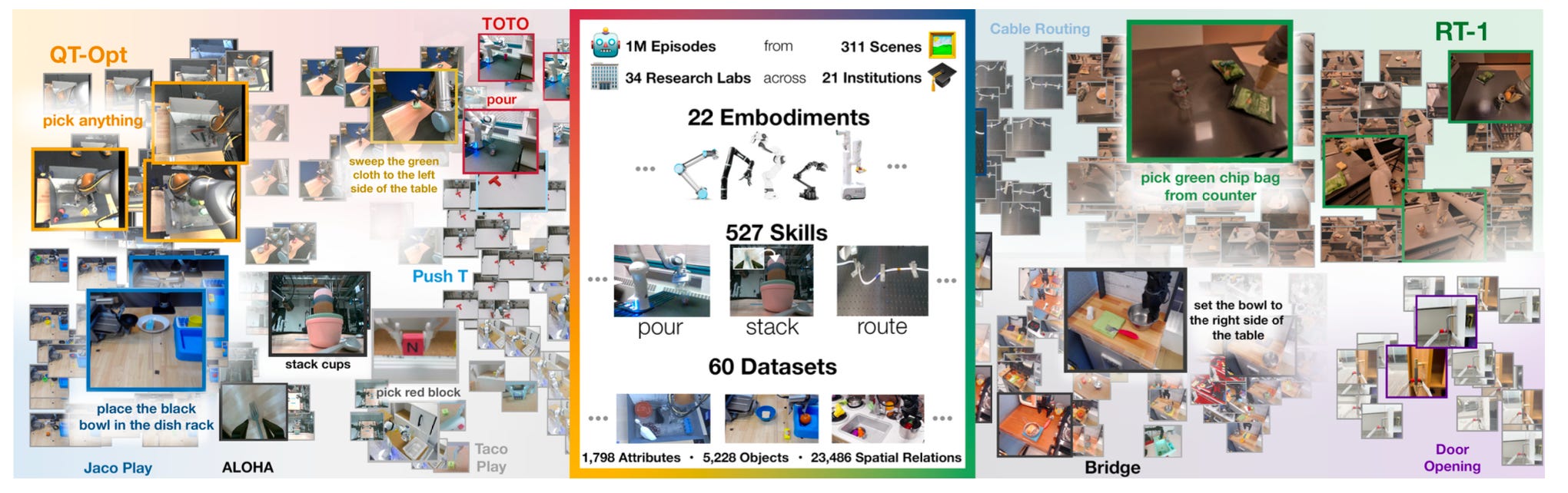
Despite that scale, web video has severe limits for robots today. Experts warn that it lacks crucial physical signals like torque, force, joint resistance, and tactile touch. The other hurdle is the embodiment gap. A human body moves differently than a robot, making it difficult to transfer learned skills across different physical forms. A human hand moving 5 inches could mean something completely different to a robot, especially when robot designs vary so wildly today.
Still, given the sheer volume of web video, researchers are finding clever ways to extract value. Carnegie Mellon researchers recently proposed VideoManip, a framework that doesn’t rely on specialized equipment or manual robot demonstrations. Instead, it can take any video of a person manipulating an object, reconstruct 3D hand and object movements, estimate contact points, and translate those actions into movements a robotic hand can perform.
Egocentric data
Egocentric data has raised surging interest across the industry. It consists of first-person point-of-view video captured with head-mounted cameras, imitating how a robot would actually perceive its surroundings. On social media, you can see clips of workers in factories across China, India, and other countries collecting egocentric data.
Egocentric data significantly expand the collection funnel of data used to train robots. In the U.S., Silicon Vally-based robot startup Figure AI recently released Index, a massive, crowdsourced dataset of 16 million videos built on first-person views. In China, Peking University’s DAGroup released HumanNet in May 2026. This is a 1-million-hour, human-centric video dataset that includes both egocentric data and third-person data.