

China AI Weekly Digest summarizes the week’s big news, model updates, policy, products, and research, sourced from the aggregated newsfeed of China AI Index. The digest below is mostly compiled and drafted by an AI agent sourcing from credible news outlets, then fact-checked and edited by me.
This week: 310 stories tracked (6 editor picks, 102 English-language, 202 Chinese-language 🇨🇳) over 2026-09-12–2026-09-19.
The Big Three
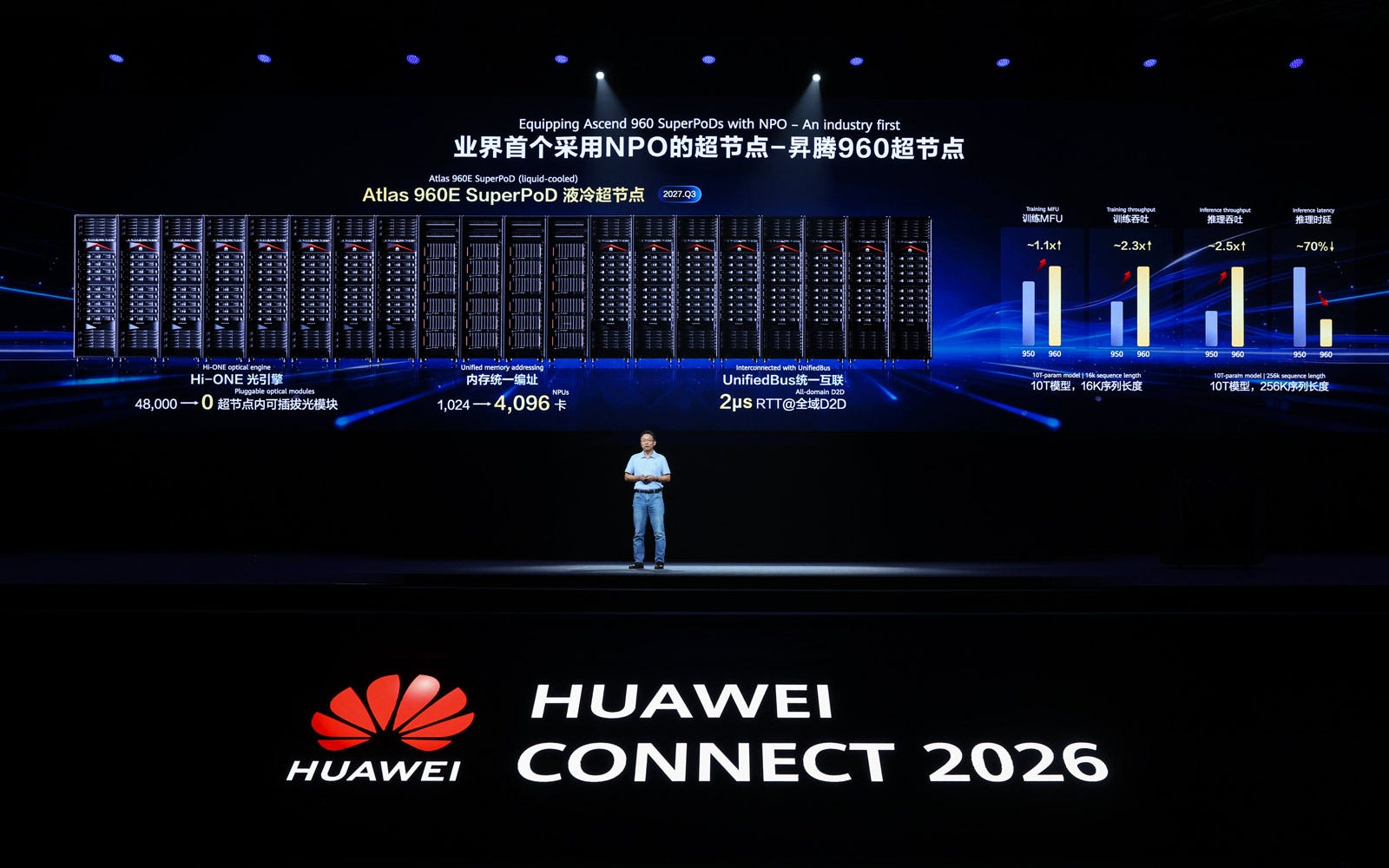
Huawei sped up its AI-chip roadmap this week, unveiling a wave of new infrastructure at HUAWEI CONNECT 2026 and setting a 2027 timeline for chips aimed squarely at Nvidia. At its Shanghai conference, Huawei launched a “Peerium Computing Architecture” designed to let processors work at million-scale as a single machine, an Atlas 960E SuperPoD built to train and serve 10-trillion-parameter models, and a new AI Cluster Service. Chairman Eric Xu said Chinese AI labs “must accelerate development” and that domestic models aren’t yet powerful enough to pose frontier risks. Huawei is racing to bring two new Ascend-class chips to market by 2027, explicitly positioned as China’s answer to Nvidia. (Bloomberg/Reuters/SCMP/FT/@Huawei)
Washington and Beijing spent the week arguing over whether China’s AI progress justifies a global slowdown, with Anthropic’s own pacing proposal landing in the middle of Trump-Xi summit diplomacy. Beijing dismissed Anthropic CEO Dario Amodei’s call to “pace” frontier AI development as fear mongering meant to entrench the US’s lead, and state media called it “self-serving.” Trump, for his part, downplayed the need to check AI development at all, saying he’s unwilling to cede ground to China. (Bloomberg/CNBC/SCMP/AP)
A funding frenzy swept China’s AI sector this week, with Manus, Z.ai and chipmaker Biren all moving to raise fresh capital just as DeepSeek staffed up for a possible IPO. Agent startup Manus is seeking a $4 billion valuation in its first fundraise since splitting from Meta; Z.ai (Zhipu) is chasing another roughly $5 billion after its July raise and just lifted its ARR target 25% to about $3 billion as compute constraints ease; AI chip designer Biren is weighing a $1 billion share sale; and DeepSeek hired a Hillhouse dealmaker as CFO to accelerate its own path toward a listing. (Bloomberg/TechCrunch/SCMP/Reuters)
Models
A quieter week for headline model drops beyond audio and open-weight releases.
Alibaba open-sourced a medical AI model that can detect cancer and nearly 150 other conditions (SCMP)
Alibaba’s Qwen team shipped Qwen3.8-Omni-Flash, its first omni-modal model built natively around agentic tool use — understanding audio and video, reasoning, planning and executing in one pass. (@Alibaba_Qwen)
StepFun launched StepAudio 3, a five-model audio family that topped Artificial Analysis’s global leaderboards for real-time conversational dynamics and speech reasoning (财联社/@StepFun_ai)
Zhipu’s Tang Jie unveiled the company’s first recursive self-improvement (RSI) result — using 100,000 domestic chips to have GLM help build the next GLM (量子位)
Bloomberg reported China’s AI industry is pivoting from model scaling to agents, a shift visible in this week’s wave of Feishu-Doubao and Tencent/ByteDance/Alibaba workplace-agent launches (Bloomberg)
Funding
Capital kept flowing into agents, biotech spinoffs and chips, even as one high-profile humanoid IPO cooled investor enthusiasm elsewhere.
Manus is seeking a $4 billion valuation on a new $500 million raise — its first fundraise since resuming independent operations after splitting from Meta, with a Hong Kong IPO also under consideration (Bloomberg/WSJ)
Z.ai (Zhipu) is chasing a fresh ~$5 billion raise after its July share sale, and lifted its ARR guidance 25% to roughly $3 billion as compute constraints ease (SCMP)
DeepSeek hired a Hillhouse dealmaker as CFO as it accelerates preparations for a possible IPO (Reuters)
Chip designer Biren is weighing a $1 billion share sale (Bloomberg/The Information)
ByteDance’s AI drug-discovery spin-off Anew Labs raised $290 million in its first outside funding round (SCMP/Reuters); separately, ByteDance lined up a $30 billion loan from lenders including ICBC and HSBC (Bloomberg)
ByteDance founder Zhang Yiming became Asia’s richest person, with his fortune passing $105 billion on the AI boom (MIT Technology Review)
Unitree’s roughly $30 billion stock wipeout since its IPO is making investors more cautious about humanoid-robot listings generally (SCMP)
Policy
The Trump-Xi summit backdrop shaped nearly every policy story this week, from AI-slowdown diplomacy to a new domestic standard.
China rejected Anthropic CEO Dario Amodei’s call to “pace” AI development as fear mongering designed to entrench the US’s lead, while state media dismissed it as “self-serving” (SCMP/CNBC/Bloomberg)
Trump downplayed the need to check AI development, saying he’s unwilling to cede ground to China, as Nvidia’s CEO prepared to attend Trump’s state dinner for Xi (SCMP/The Information)
China’s data regulator publicly warned that AI poses risks to national and social security (FT/Bloomberg)
Xi pitched an AI-cooperation vision at the BRICS summit, including an open-source, “AI for all” pledge and support for AI and smart-manufacturing among member nations (Bloomberg/CNBC)
China’s data regulator moved to set new standards for embodied AI, and separately published the world’s first AI-plus-brain-computer-interface standard, taking effect next September (Bloomberg/财联社)
Products
Consumer launches leaned into agents, real-time video and robotics this week.
ByteDance’s Doubao AI phone assistant went on sale, notably letting individual apps decline to let the AI act on their behalf, a first for the category (创业邦/36Kr)
Moonshot connected its Kimi model directly to Wall Street’s leading financial data providers (CNBC)
Shengshu launched Vidu S2, a real-time interactive and editable video model line aimed at livestreams, AI companions and game NPCs (投资界/@ViduAI_official)
Pony.ai debuted its Gen-4 robotruck at IAA Transportation with GAC Commercial Vehicle, targeting volume production this year and expansion into European and Middle Eastern markets (Reuters/@PonyAI_tech)
AGIBOT said its A3 Ultra humanoid is moving from mass production into real-world deployment across hotels, dealerships, supermarkets and metro inspection (@AGIBOTofficial)
WeRide said its autonomous vehicles are now testing on Madrid’s roads after Spain issued its first national operating permit for L4 passenger AVs (@WeRide_ai)
Research
This week’s research thread: how far US labs remain ahead on monetization, and how the AI boom is diverging from the broader economy’s health.
Rhodium Group found that China’s top AI models generate just 10% of the revenue OpenAI and Anthropic pull in, despite carrying comparable valuations (CNBC/SCMP)
Roughly 1 in 4 listed Chinese companies posted losses even as AI investment surges — a sign the boom and the broader economy are diverging (Nikkei Asia)
Chinese researchers proposed a five-stage road map toward what they call the “last AI built by humans” (SCMP)