

I am bringing back my old weekly news roundup, China AI Weekly Digest, which summarizes the week’s big news, model updates, policy, products, and research, sourced from the aggregated newsfeed of China AI Index. The digest below is mostly compiled and drafted by an AI agent (given my limited capacity) sourcing from credible news outlets, then fact-checked and edited by me.
This week: 263 stories tracked (5 editor picks, 101 English-language, 157 Chinese-language 🇨🇳) over 2026-08-08–2026-08-15.
The Big Three
DeepSeek shipped V4 Pro and open-sourced an agentic coding tool called DeepSeek Harness — then jacked up API prices by as much as 11x. The official V4 Pro release lands with heavier “Agent” upgrades and flexible reasoning effort, but reviews were mixed: strong gains in cybersecurity and coding, “underwhelming” elsewhere. DeepSeek Harness, MIT-licensed and explicitly positioned against Anthropic’s Claude Code, is the bigger tell: DeepSeek is chasing the agentic-coding wars, not just benchmark leaderboards, and it’s willing to charge higher prices to fund it. (Bloomberg/Reuters/Nikkei Asia/The Information)
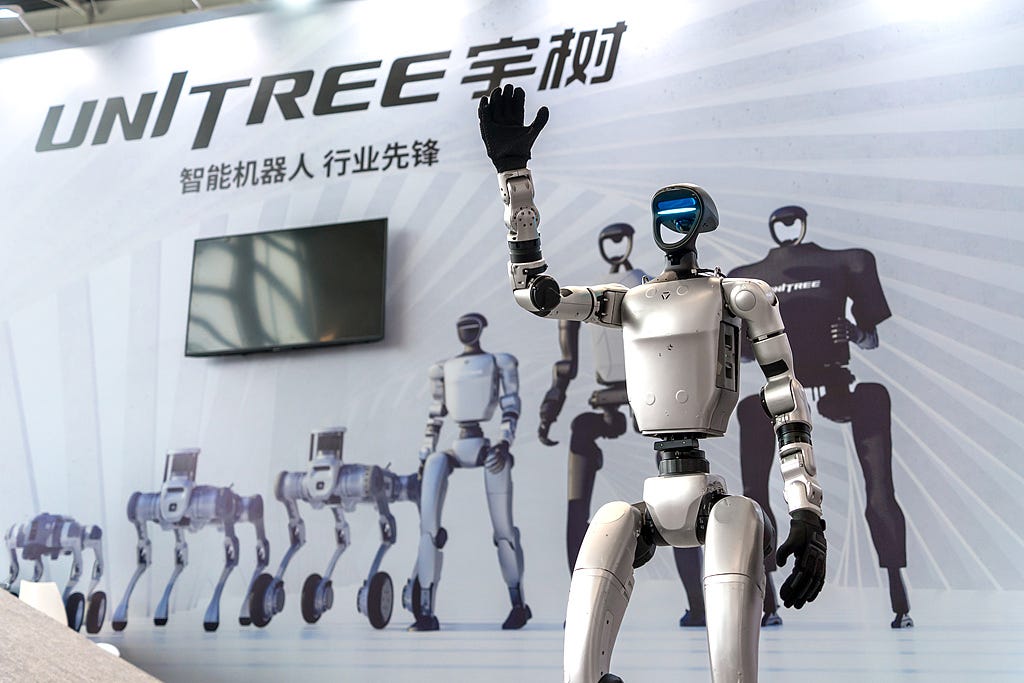
Unitree’s Shanghai IPO was oversubscribed by thousands of times. Retail investors chased “meat lottery tickets” at odds of roughly 1-in-5,500 as China’s first pure-play humanoid robot maker priced its Shanghai debut. SCMP reported AgiBot has already overtaken Unitree as the world’s top humanoid vendor by first-half shipments, a reminder that the IPO valuation and the actual competitive lead aren’t the same thing. (Bloomberg/SCMP/Reuters)
Meta has unwinded its $2 billion Manus deal, and Tencent stepped in to become the AI agent startup’s top shareholder. Manus’s original backers, Tencent included, bought the company back from Meta after Chinese regulators blocked the acquisition, and Manus will resume independent operations. The Information reports Manus’s revenue is soaring even mid-unwind, a rare case where a geopolitical veto arguably strengthened the asset it was aimed at protecting. (SCMP/CNBC/Bloomberg/The Information)
Models
Zhipu’s GLM-5.3 landed this week and immediately drew comparisons to frontier coding models; two more open-weight releases surfaced first via their labs’ own accounts.
Zhipu shipped GLM-5.3, keeping the same base model but pushing coding performance up sharply and adding new cybersecurity capabilities — testers highlighted it catching a decades-old class of vulnerability in a demo. (量子位/雷峰网/@Zai_org)
Alibaba added commercial-use restrictions to its open-weight Qwen3.8-Max, a notable tightening for a model line that’s leaned hard into permissive licensing. (SCMP)
Ant’s AGI lab open-sourced Ling-3.0-tiny (7.9B total / 1.3B active parameters), designed to run agentic RL post-training locally on a single Nvidia DGX Spark rather than a cluster. (@AntLingAGI)
MiniMax released MiniMax-Music3, an open-weights, production-ready music generation model. (@MiniMax_AI)
Enterprise AI costs hit a 2026 low, per new research, as price wars and Chinese open-source models compress what companies pay to deploy AI. (SCMP)
Funding
Beyond Unitree, the IPO pipeline for China’s AI hardware and agent players kept widening, while Tencent’s earnings became a proxy fight over whether Big Tech AI spending is paying off.
Moore Threads filed for a Hong Kong listing after first-half revenue jumped 147% year-on-year; separately, chip designer Kiwimoore is reportedly eyeing its own HK IPO at a $2 billion valuation. (SCMP/Bloomberg/Reuters)
Former Alibaba Qwen lead Junyang Lin launched Shanghai-based Pragmatik Labs to build digital and physical AI agents, reportedly backed by Tencent among other investors at a roughly $2 billion valuation. (The Information)
Tencent’s Q2 revenue beat estimates on WeChat ad and gaming strength, but AI capex surged to ¥52.8 billion for the quarter. Free cash flow reportedly turned negative for the first time, sharpening investor questions about whether Tencent is falling behind on AI even as it outspends. (Bloomberg/CNBC)
WeRide beat Q2 estimates on surging domestic ride-hailing demand and flagged Australia and Southeast Asia as potential new markets. (Bloomberg)
Memory-chip maker CXMT overtook Tencent to become China’s most valuable company by market cap — a milestone that captures just how hot AI-driven memory demand has gotten. (Bloomberg)
The AI frenzy more broadly is pushing Chinese tech valuations to multiples of their US peers, per the FT — a trend worth watching for how much further the re-rating has to run. (FT)
Policy
Washington and Beijing both moved this week — one tightening chip-related pressure, the other easing a consumer-tech irritant.
A key House Republican pushed the Trump administration to block advanced chips from reaching sanctioned Chinese firms by any route, underscoring that enforcement is now the fight. (Reuters)
An expert warned that a full US ban on Chinese AI models could cross one of Beijing’s genuine red lines, a sign the decoupling debate is edging toward higher-stakes territory. (CNBC)
The US lifted its TikTok ban on government devices following ByteDance’s ownership restructuring. (SCMP)
Chinese users of AI companion apps reported being left “bereft” as new government regulations tightened what the apps can offer. (AP News)
Products
Robotaxis went transatlantic, Apple kept quietly deepening its China-AI supply chain, and Qwen pushed further into paid and multi-device territory.
Uber and Pony.ai announced plans to deploy over 2,000 robotaxis across Europe, the most concrete sign yet of a Chinese autonomous-driving player scaling outside China and Southeast Asia. (TechCrunch/Reuters)
Apple is reportedly testing CXMT memory chips for iPhones and MacBooks sold in China, while separately confirming Mac users in China can now connect directly to Alibaba’s Qwen AI service — two small moves that together sketch Apple building a parallel, China-specific AI and supply-chain track. (Reuters)
Alibaba opened the Qwen Open Platform, extending agent and service access to phones, PCs and AI glasses for developers and ecosystem partners, and rolled out QwenWork, a $30-a-year paid office-assistant subscription — Alibaba testing both distribution breadth and willingness-to-pay in the same week. (雷峰网/SCMP)
Baidu’s Wenku cloud-storage AI office tool rebranded to “KuKu AI” and now claims over 25 million monthly active users, alongside a new standalone office client. (量子位)
Booz Allen research flagged that Chinese AI models may produce more vulnerable code specifically for US-based users — worth tracking as a specific, testable claim rather than a general security worry. (CNBC)
Research
Chinese researchers are betting on AI weather forecasting as extreme weather intensifies, with some models already matching or beating conventional forecasts on select measures. (Reuters)
China released a powerful DNA-screening AI tool for free, aimed at helping researchers and clinicians fight rare diseases. (SCMP)
Tencent Hunyuan published early research on Hy3D WorldClaw, an agentic workflow for generating explorable, large-scale 3D worlds from text prompts. (@TencentHunyuan)
A GAIR paper (AdvNav) examined safety risks in embodied navigation robots, showing how adversarial “tripping” can expose weaknesses in black-box navigation systems. (雷峰网)