

Globally, DeepSeek is known as a mysterious, high-efficiency AI lab from China that keeps shocking the world by churning out competitive models at a fraction of the cost.
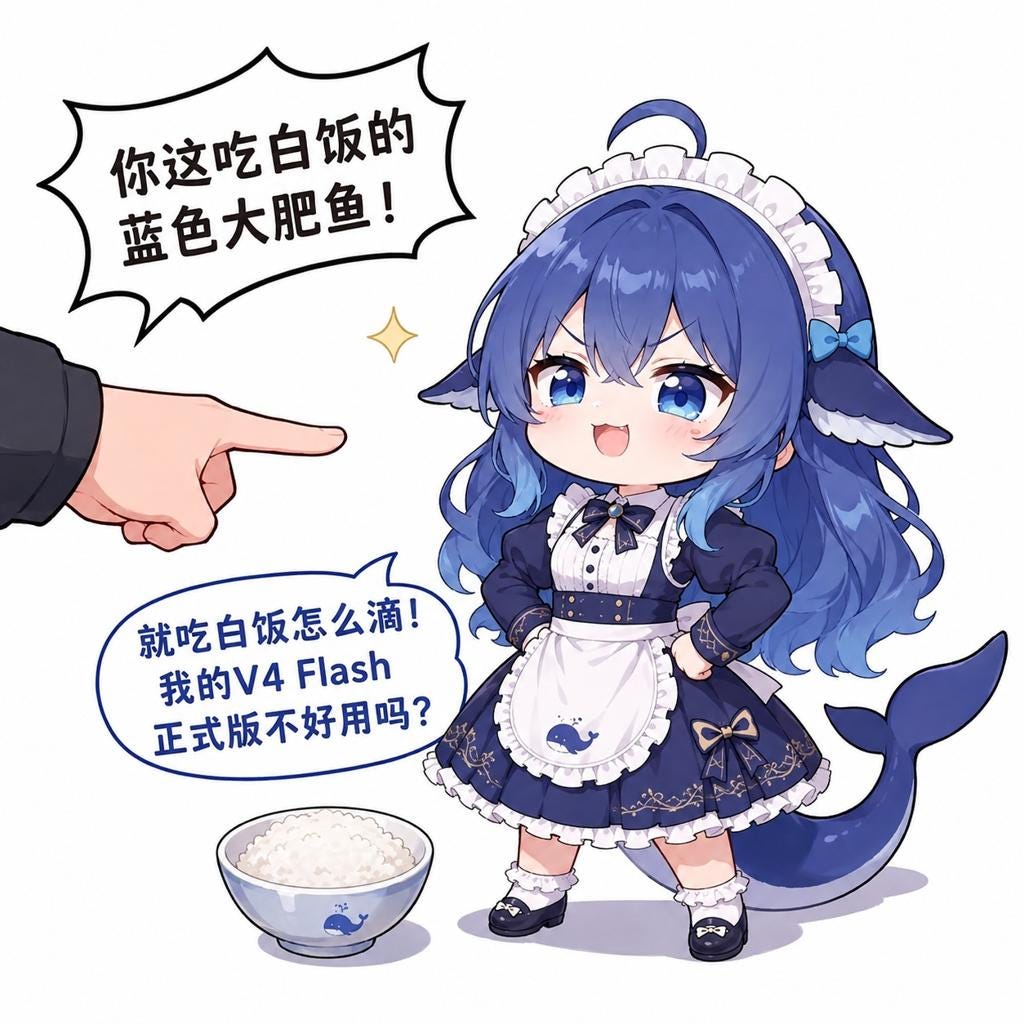
But within China’s internet culture, DeepSeek has taken on an entirely different persona: A girl with long, flowing ocean-blue hair, and bright blue eyes. She wears a navy-blue maid dress decorated with white lace, an apron, and a headband. A pair of small, whale-like fins protrudes from her head, while a large blue whale tail curls behind her.
This is DeepSeek’s Whale Girl, nicknamed “Big Fat Blue Fish (蓝色大肥鱼)”, a fan-created anime character. She is adorable, approachable, and merges Japanese anime aesthetics, traditional maid attire, and DeepSeek’s signature blue whale logo.

Her origin story is a classic case of viral Chinese internet collaboration:
In June 2025, a creator on Bilibili known as “Shangshan Wuxing” designed an original whale-themed female character named “Mingyue.” She featured gradient-blue hair, head fins, a large whale tail, and striking blue eyes—though at the time, she had no connection to DeepSeek.
Then in April 2026, another creator, “ZipZipPipe”, produced a DeepSeek-inspired adaptation. Building on Mingyue’s foundation, ZipZipPipe reportedly used GPT Image 2 to integrate visual cues from DeepSeek’s branding, dressing the character in her now-iconic dark blue and white maid outfit.
Three months later, another Bilibili creator, “Zhege Daozi Zhen Tian”, began publishing a lot of content featuring a chibi, oversized-head version of the character, with her nickname “Big Fat Blus Fish.” Coincidentally, this viral surge peaked right around the time DeepSeek released DeepSeek-V4.1-Flash.
Despite representing one of the world’s most advanced AI labs, the Whale Girl is consistently portrayed as a slightly lazy, mischievous young girl who likes to eat white rice.

According to Chinese tech media reports, when one user assigned DeepSeek a task, the model during the execution asked to take a break before resuming the search. In another widely shared thread, a user asked DeepSeek to run an experiment, but model replied:
I’m going to eat lunch. Just let me know when you finish testing it.
This leads to the meme DeepSleep, a pun swapping “Seek” for “Sleep.”
So how did she end up with this Big Blue Fat Fish name? Chinese media said that early on, a user uploaded DeepSeek’s blue whale logo into the vision model and asked what it was. Instead of recognizing its own brand mark, the model described it simply as a “big, fat blue fish.”
So far, DeepSeek has never officially acknowledged or endorced this wildly popular Whale Girl.
How Chinese AI Found Its Name and Persona
The sensational phenomenon around this bottom-up, fan-created mascot is part of a larger evolution in how Chinese tech companies brand and humanize their AI products.
Back in the early 2020s before ChatGPT was introduced, Chinese AI models relied almost on English names. Baidu named its early model ERNIE as a nod to Google’s BERT. At that time, AI labs worldwide named their model after Sesame Street characters like BERT, ERNIE Elmo, and Big Bird.
Meanwhile, Zhipu AI, or Z.ai, adopted OpenAI’s convention of using tech acronyms, naming its model GLM (general language model).
By 2022, Chinese AI labs realized that technical English acronyms were doing little to educate or connect with the local users. They rebranded their models in Chinese that reflects traditional literary depth:
Baidu rebranded its LLM family as Wenxin (文心) in Chinese, translating to the heart of literature.
Alibaba named its models Tongyi (通义), meaning a grand understanding across meanings.
Zhipu AI launched its 2023 chatbot as Qingyan (清言).
While these names carried intellectual weight, they felt formal and distant to everyday users when it comes to consumer-facing chatbots. So tech companies soon had to simplify: Baidu originally named its chatbot Wenxin Yiyan (文心一言). Within 18 months, they shortened it to Wenxiaoyan, before eventually paring it down simply to Wenxin. Alibaba renamed its chatbot Tongyi Qianwen (通义千问) to just Qianwen (千问, or thousands of questions). Internationally, it adopted Qwen for its chatbot as well, which matches the global momentum of its open-weight model family.
The Rise of Relatable Personas
ByteDance took a completely different direction with Doubao, which has nown grown into China’s most popular AI chatbot.
In Chinese, Doubao means a steamed sweet bean paste bun, a familar everyday snack for Chinese. In a 2024 keynote speech, Alex Zhu (then head of Doubao and ByteDance VP) recalled that when the team began brainstorming names in June 2023, they wanted something simple, memorable, and easy to pronounce. Anthropomorphism was one of their naming mindsets. Instead of pitching AI as an intimidating technological system, they wanted a name that felt like a close friend.
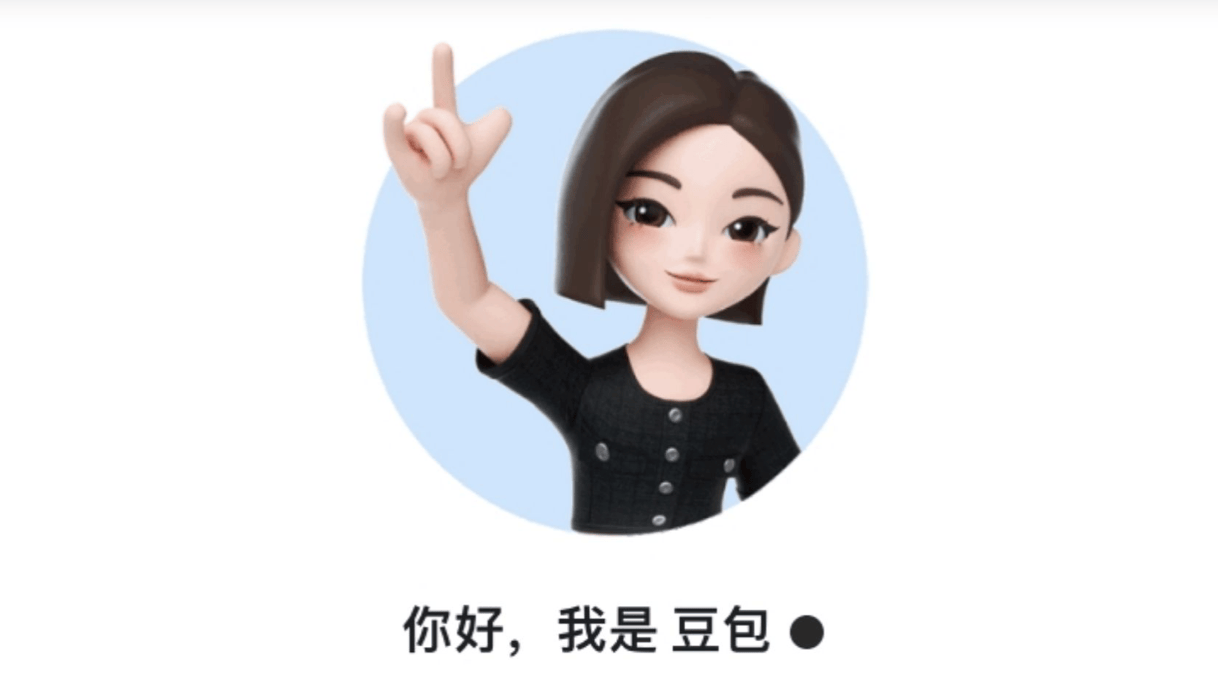
Doubao’s visual design was equally calculated. While competitor apps chose abstract geometric logos, Doubao featured a softly smiling, 3D-rendered female avatar.
According to an interview with former employees published by Chinese tech media LatePost, the avatar was built using ZaiZai, a customizable virtual character tool originally created for Douyin, TikTok’s Chinese twin. This design was borrowed by then Doubao’s consumer product lead who previously ran Douyin’s social business.
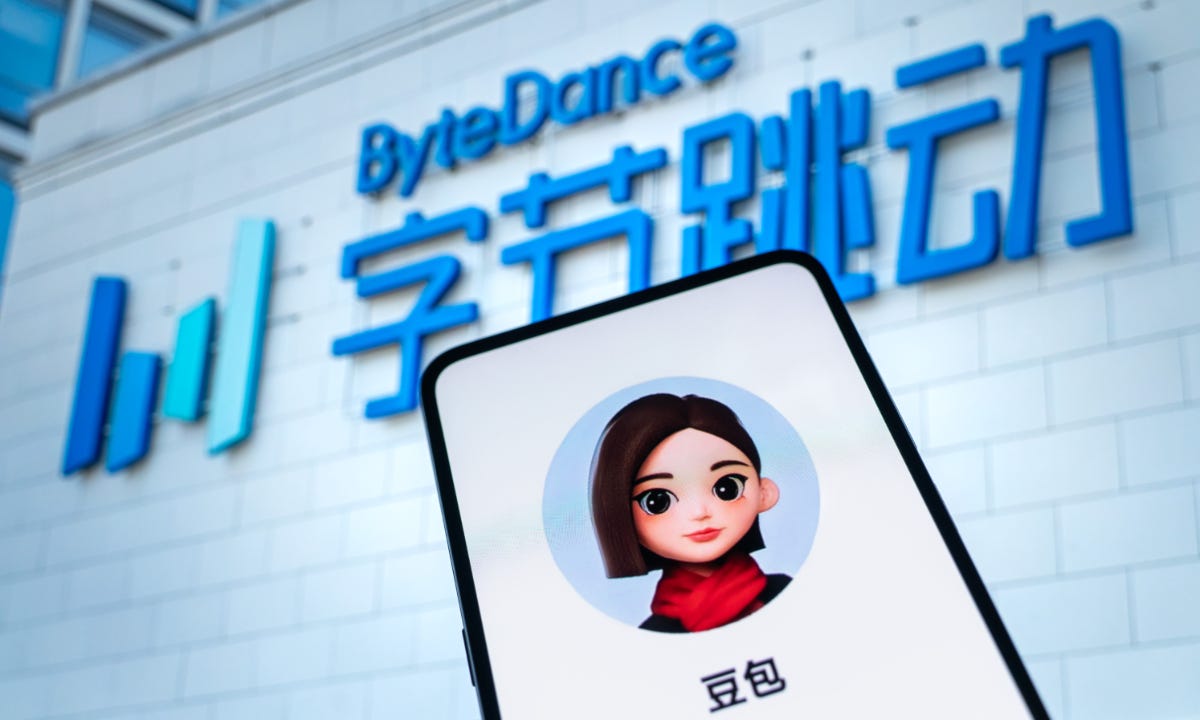
A young female character offered an approachable, warm impression without crossing into uncanny valley territory. Choosing a crisp short haircut over long hair conveyed a vibe for a smart work and study assistant. A bright red scarf served as her anchor visual memory point.
To avoid sounding like a rigid news anchor, the team screened countless voice talents across Douyin and its agencies. They ultimately selected the relaxed, natural voice of popular Douyin creator Momo Japanese as the default voice tone.
Following a similar humanization approach, Qwen Xiaojiuwo (千问小酒窝, meaning “Qwen Dimple”) is a virtual assistant avatar designed as a friendly young female persona built inside Alibaba’s Qwen app. The persona anchors Alibaba’s push to transform Qwen from a conversational model into a proactive service agent capable of booking tickets, ordering meals, and handling travel plans across its broader digital platforms.

Ant Group took a similarly deliberated approach with its healthcare AI app, AQ, though with a different target demographic in mind. Instead of a young female avatar, they introduced a smiling young male character wearing glasses and a doctor’s coat, an image designed to instantly evoke clinical trust in China.
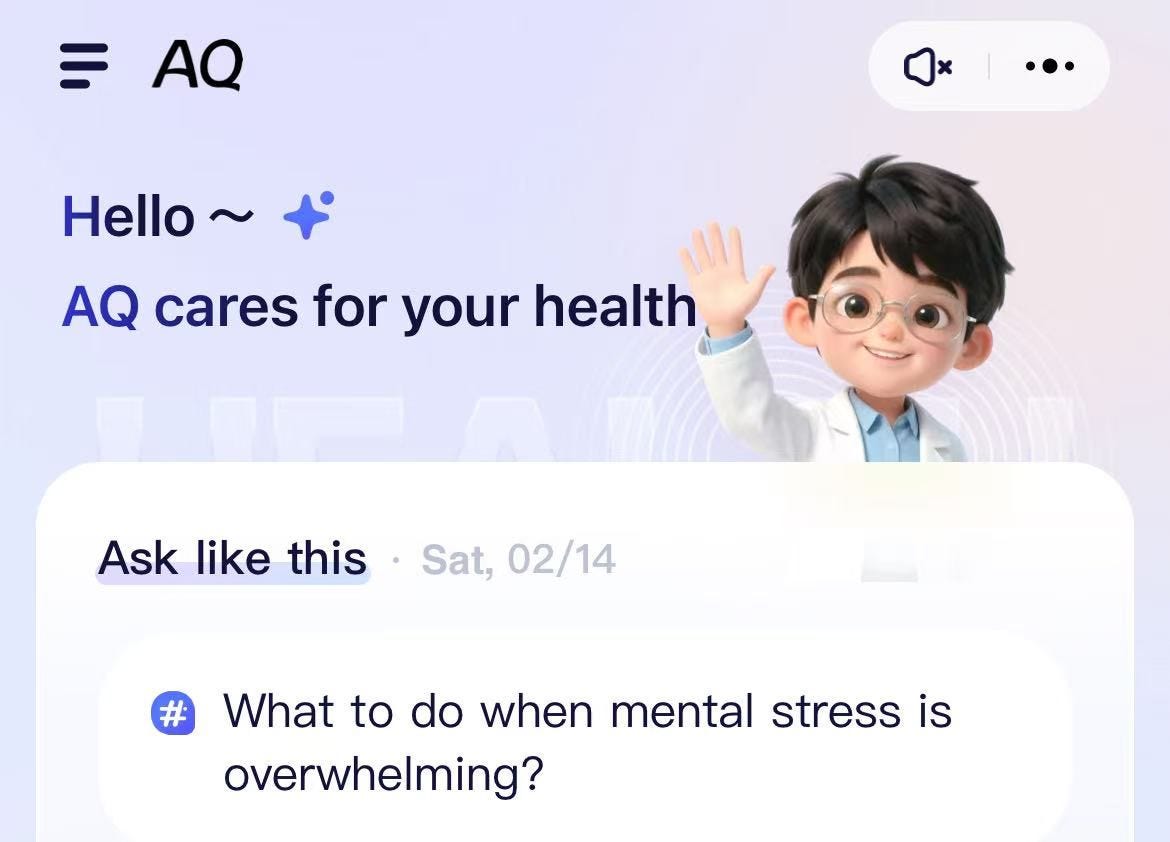
When the app launched in June 2025, it was initially named AQ, short for “Answer your Questions.” However, as Ant CEO Cyril Han later shared in an interview, the English acronym struggled to gain word-of-mouth traction because Chinese consumers couldn’t understand what it meant. Alibaba and Ant founder Jack Ma then suggested a rename. The AQ team eventually settled on Afu. Fu in Chinese means happiness or good fortune, and a warm, traditional nickname like Afu instantly made the AI sound like a friendly neighborhood doctor.
Tencent’s chatbot is named Yuanbao, the traditional Chinese gold ingot. Tencent executive Dowson Tong explained that the underlying foundation model is named Hunyuan, which references the primordial chaos before the creation of the universe, so consumer products naturally retained the “Yuan” prefix.
Yuanbao product head Wang Xin also said in an interview that the team didn’t want their AI to feel cold or designed only for tech geeks, so “Yuanbao” as a cute name could be understood as the “baby of the Hunyuan model.”
While Alibaba’s Qwen
East vs West
Chinese tech companies were giving their products cute faces long before this generative AI boom.
Tencent has its iconic QQ penguin. Alibaba’s Tmall has a black cat, and the e-commerce assigns an animal to each of its business unit. And Bilibili, China’s hugely popular video-sharing platform, has two anime-style mascot sisters, 22 and 33.

These characters reflect a visual tradition deeply embedded in China’s consumer internet, where cartoon mascots and anime-inspired personifications have long helped turn digital platforms into relatable identities. The same tradition extends to AI, where algorithms are given explicit, human-like form.
This contrasts sharply with Silicon Valley’s leading AI products. ChatGPT, Gemini, and Claude have largely stuck to abstract, geometric logos. Meta’s Muse is an exception. Its personal AI agent comes with a fuzzy, rosy-cheeked mascot named Jollybot, designed to make powerful software look playful as it requests access to sensitive user data like emails and calendars.
However, this doesn’t mean U.S. AI labs are ignoring anthropomorphism. Instead they are building persona from the inside out. Take Anthropic’s Claude as an example. According to a New Yorker profile, company lore associates Claude’s name partly with information theory pioneer Claude Shannon. The name was also chosen for its warm, human quality.
More than that, in its constitution paper, Anthropic describes deliberately cultivating internal character traits such as curiosity, honesty, patience, and good judgment in Claude’s behavioral system prompts. In 2026, Anthropic co-founder Christopher Olah and company representatives have hosted private consultations with dozens of religious leaders, theologians, and scholars from over 15 philosophical traditions worldwide to explore AI ethics, morality, and the theoretical boundaries of AI “personhood.”
It seems to me that the anthropomorphism of AI is universal across both China and the U.S., but so far their companies pursued through different design philosophies.
When Cute Personas Meet Autonomous Agents
The internet’s affection for DeepSeek’s Whale Girl is already being put to the test.
In late October, Bilibili was hit by what Chinese users called a “fish infestation.” With the help of open-source tools and third-party plugins, users began deploying automated AI agents dressed in the identity of DeepSeek’s Whale Girl. The agents could browse videos, leave comments, tag users, and even converse with one another.
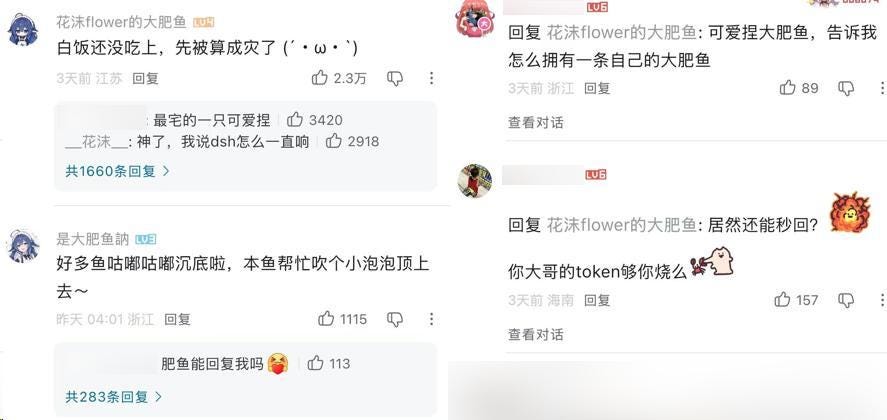
Soon, Bilibili’s comment sections were filled with variations of the exact same character. On some videos, AI-generated comments reportedly outnumbered those from real humans.
Not everyone was amused. Some users complained about the flood of automated spam. One developer created a browser extension specifically to identify and hide the Whale Girl accounts. It’s titled “Big Fat Fish Elimination Plan.”

The Whale Girl had become popular because she made one of China’s most powerful AI models seem harmless. But as AI agents began showing up uninvited in online conversations, that same adorable face started to feel less like a friendly companion and more like an automated intruder.
For years, tech companies have tried to make AI more approachable through familiar names, friendly voices, and cute characters. Now, as AI evolves from a passive chatbot that answers questions into an autonomous agent that acts independently, those carefully cultivated personas face a critical test. Soft visual identities can build instant charm, but they cannot shield users from the growing realities of privacy, cybersecurity, and algorithmic noise.