


Riding the momentum of their open-source models, Chinese AI companies are taking the next step: building the agentic coding harness that fits the model.
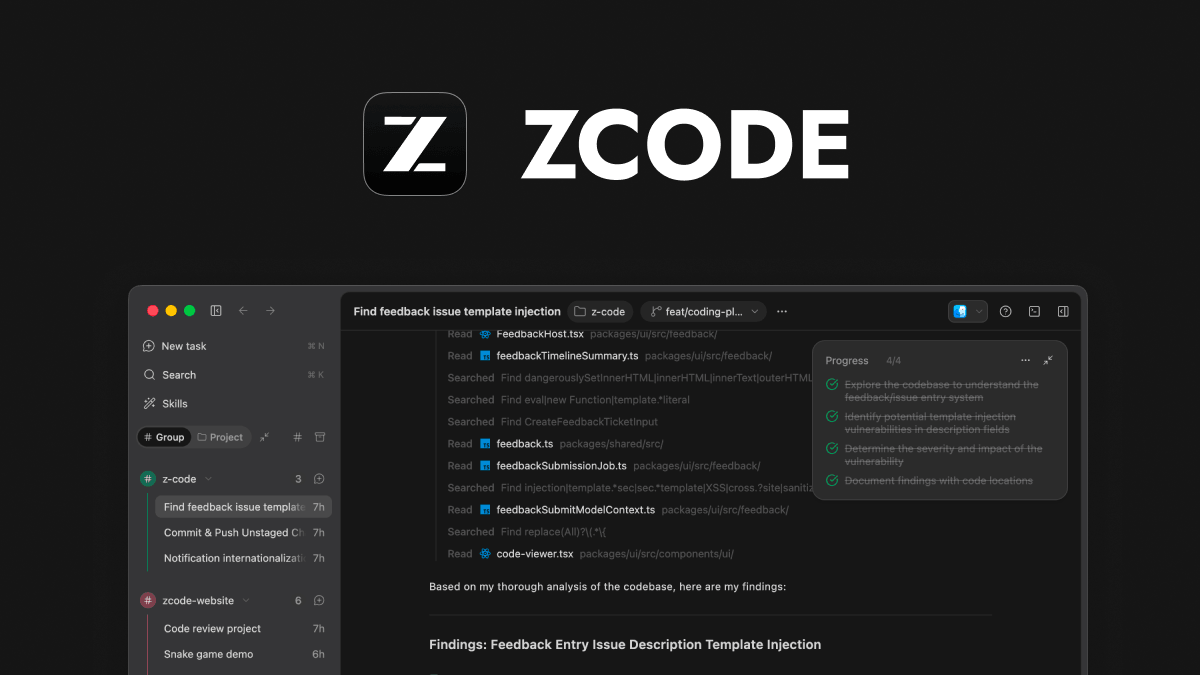
Z.ai (Zhipu AI) released ZCode, a desktop application it calls an “Agentic Development Environment,” purpose-built for its flagship GLM-5.2. ZCode isn’t entirely new—it launched in mainland China in December 2025 and was recently upgraded to 3.0—but the company says it has built a proprietary agent framework tailored to long-horizon reasoning, tool calling, and large-scale engineering projects.
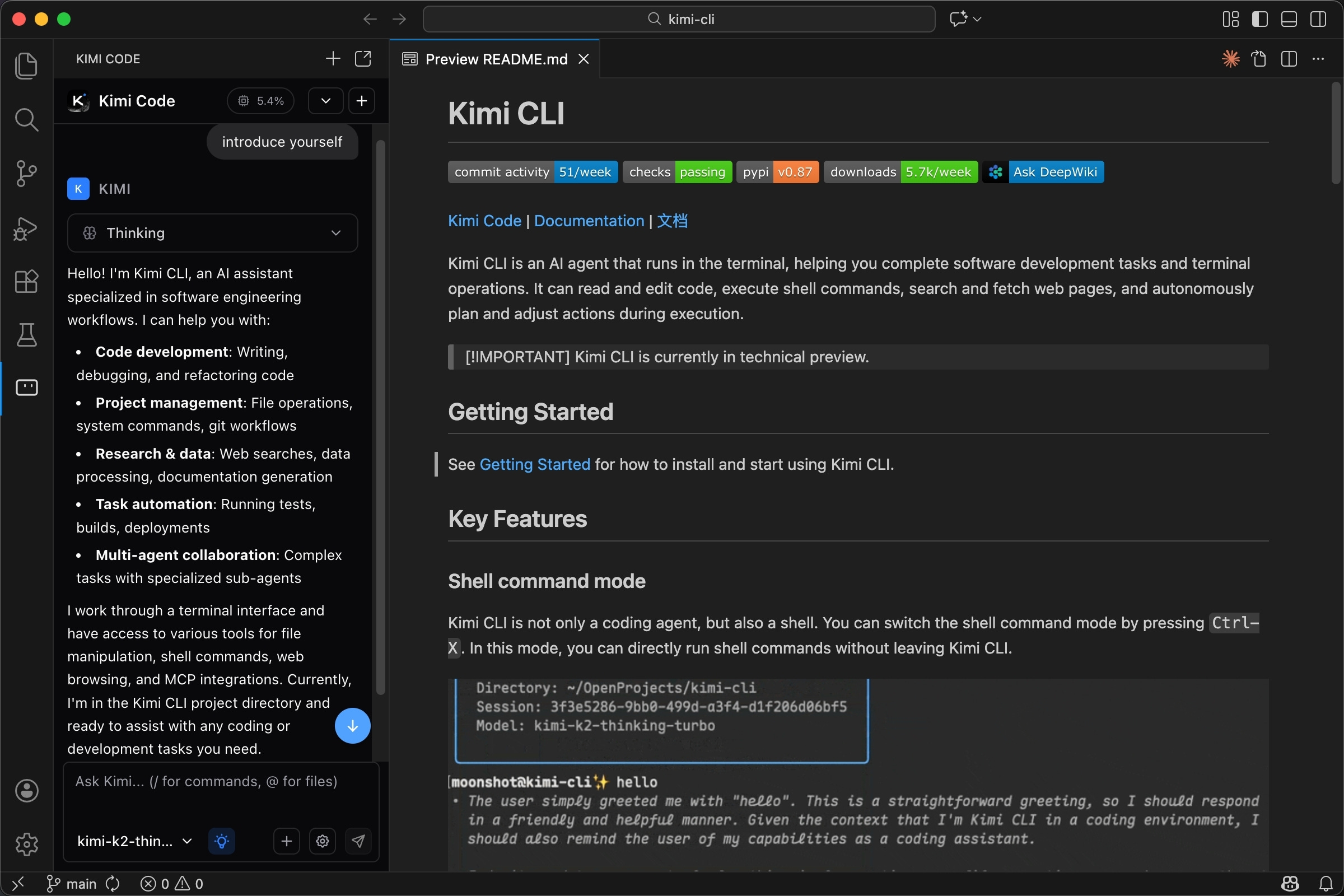
Moonshot AI followed with Kimi Code, in beta, released alongside Kimi K2.7-Code, its latest coding-specific model. Moonshot pitches it as a coding perk of the Kimi membership, designed to drop into any dev workflow and finish programming tasks faster. It ships as a CLI and a VS Code extension. There’s no standalone app.
Neither company was first. Alibaba launched Qoder, a globally available agentic coding platform, in August 2025. It now spans IDE, CLI, mobile, and plugins, and the team claims more than 5 million users globally as of May 2026. Its sibling, QoderWork, is an office-focused desktop app that organizes files and processes data locally as Alibaba’s answer to Claude Work. (Highly recommend Grace Shao’s interview with the Qoder team.)

Tencent shipped its coding tool CodeBuddy a month after Qoder, then its desktop agent app WorkBuddy in March 2026. Tencent is known for “internal horse racing”—pitting teams against one another to build competing products—and WorkBuddy has emerged as the winner among its agent products. Since the launch of Tencent’s latest flagship model, Hy3, WorkBuddy users have started hitting queues as traffic surges and compute tightens, and the company is scrambling to expand capacity.
ByteDance is in too. At its recent cloud conference, the head of the company’s cloud unit Volcano Engine said ByteDance views AI coding as strategically important as Seedance 2.0, its blockbuster video model. ByteDance’s latest flagship, Seed 2.1, is claimed to match Claude Opus 4.7 on coding. Its coding app, TRAE, launched back in January 2025.
Then there’s the no-code tier: Ant Group’s Lingguang, a mobile-friendly AI app builder, and Baidu’s Miaoda.
And DeepSeek is building its own version of Claude Code. Researcher Deli Chen said the company is standing up a harness team to build it from the ground up. DeepSeek recently closed a $5 billion round and plans to double the team.

Why coding assistant
When Anthropic launched Claude Code in February of 2025, it was simply an unassuming terminal-based research preview. But over the next year, the tool evolved into a sophisticated multi-agent platform that can accomplish tasks on a user’s behalf.
As of today, Anthropic proved that coding is one of the most commercially successful applications of AI models so far. Anthropic has reached $47 billion in ARR, with Claude Code alone at $2.5 billion.


In the meantime, Cursor, recently acquired by SpaceX at a $60 billion valuation, has reached $4 billion in ARR. In comparison, Slack took two and a half years to reach $100M ARR. Dropbox took four years. Cursor took twelve months, and then multiplied that twenty times over in the following year.
Chinese labs saw the same curve once they bet on coding and agents. Moonshot AI reportedly crossed $300 million in ARR by mid-June 2026, with API revenue making up more than 70% of the total. Both overseas paying users and API revenue grew 400%. Z.ai’s ARR of its model-as-a-service segment reached RMB1.7 billion ($250 million) as of March 2026.
But revenue is only the surface reason. Code is the universal interface to every other capability. A model that writes and executes code can call any tool, chain the results, and finish a long task with minimal human intervention in the loop.
The more consequential reason is that coding could make recursive self-improvement possible. A model that writes code can generate its own synthetic data, build its own evaluations, and increasingly automate parts of its own training pipeline.
Shipping a coding product also buys data: real developers issuing real tasks, correcting the model when it fails, accepting or rejecting its output. That interaction data feeds back into the next model and the next harness.
There is a softer branding reason too. For a decade, Chinese companies have been good at consumer brands—Huawei, DJI, Xiaomi, TikTok, Temu, Lenovo. Developer tools were the one category where Chinese names simply didn’t appear. But LLMs changed that.
On OpenRouter, a US-based routing marketplace where roughly 47% of users are American, Chinese models overtook US models in weekly token volume for the first time during in February 2026. The gap keeps widening since then.
Early this month, I attended an event in San Francisco hosted by Artificial Analysis, the benchmark platform that evaluates LLMs and agent systems. Z.ai’s GLM-5.2 was the most-cited open model of the night; one of MiniMax’s research leads was invited to speak. In the elevator, I overheard two engineers: “glm cooks.”
That same week, Alibaba’s Qoder and Tencent Cloud each hosted their own events in the city.

Where the differentiation is
The market of coding tools splits roughly in two. On one side, vibe-coding tools for casual users, people like me without much technical knowledge. Think of them as WordPress, except one prompt creates a whole site. On the other, professional tools for individual developers and enterprises maintaining large, existing codebases, represented by Cursor and Claude Code.
The market is also crowded, and breaking in is hard. Alibaba’s Qoder team says it deliberately went after the professional segment—tools that can maintain existing software without introducing costly mistakes. The head of Qoder, who goes by the internal nickname Shu Tong, said in an interview:
We are latecomers, and the low-hanging fruit has already been picked. We want to directly attack the high-value territory and enter real-world software scenarios.
Yet from conversations with users of Chinese coding assistants—and from my own use—most of these companies want it both ways. Their products bundle CLI and IDE surfaces, but the interface leans GUI-heavy to stay friendly to non-experts.
When looking at the stages of developer workflows — Assistive (Copilot), Collaborative (Agentic), Autonomous — all three exist today. We position ourselves as a next-generation autonomous programming platform, but we don’t focus only on the autonomous stage. We cover all three, because our goal is to serve the broadest spectrum of developers, whichever stage they’re in.
The interfaces are worth digging in. Qoder feels familiar to developers who have used VS Code. It behaves like a competent junior engineer. One differentiated advantage is Repo Wiki, which maps and indexes an entire repository so the model has contextual awareness of legacy systems. Rather than making developers pick from a dozen models, Qoder auto-selects what it calls the globally optimal model per task and manages context and tokens on the user’s behalf.
Its Product Hunt reviews praise for multi-file editing, codebase understanding, and repo documentation that speeds onboarding. The complaints are about unclear pricing and lack of privacy and terms disclosure. Qoder also tends to generate verbose, redundant code that burns tokens, and the long-term maintainability of AI-written code remains unproven—though that’s honestly a blame against the models.
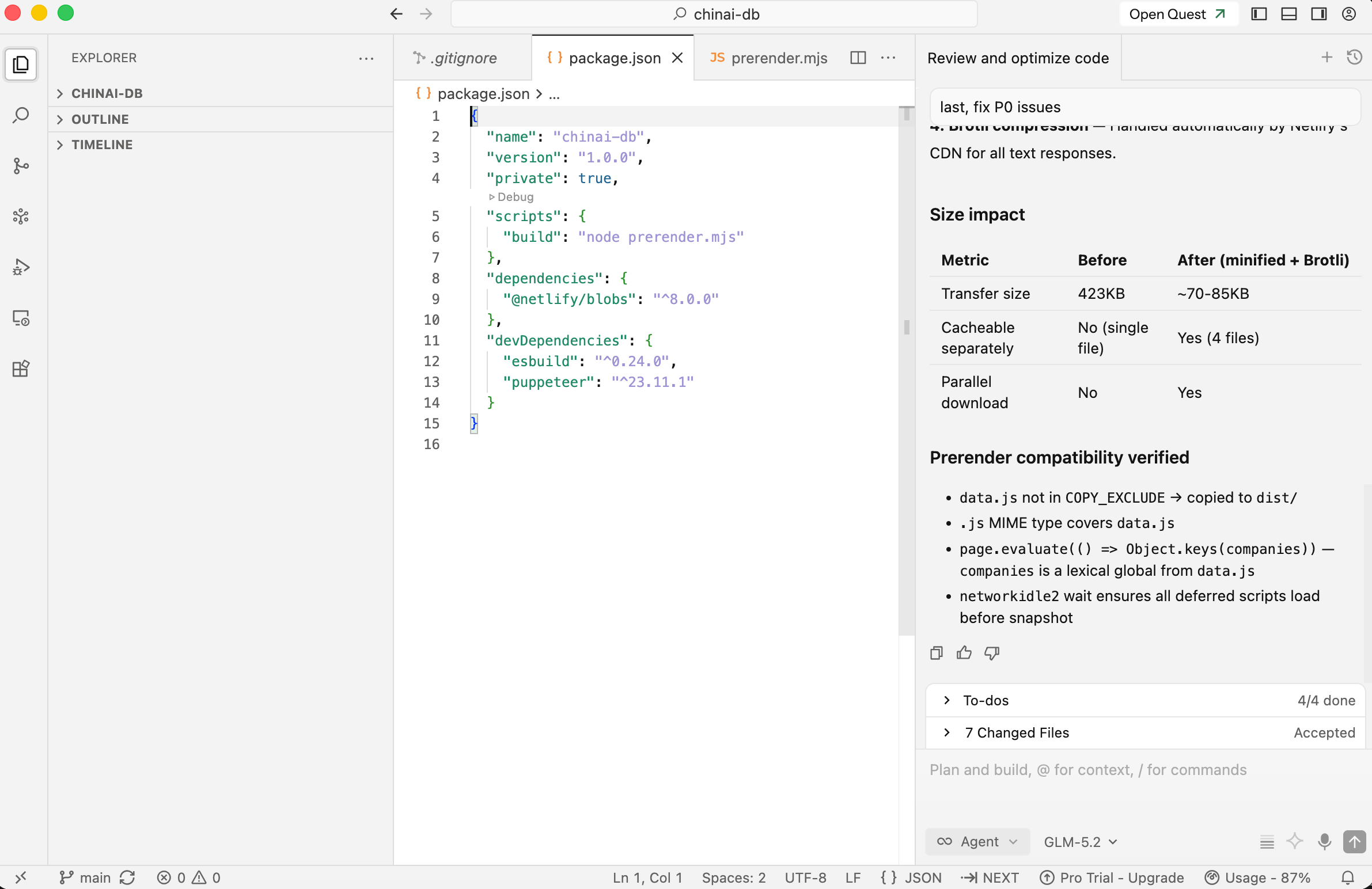
ZCode, by contrast, is closer to a chatbot, organized around a large central chat box. The GLM Coding Plan starts at $16.20/month for Lite and runs to $144/month for Max, cheaper than comparable Claude Code and Cursor tiers.
Early reception on X was positive. One user called it “super stable.” Reviewers like Goal Mode, remote control via phone, WeChat, or Feishu, and broad multi-provider support. But the learning curve is real: agents, skills, plugins, MCP, Goal Mode, execution modes. And the Bot Channel currently supports only WeChat and Feishu; Discord and Slack are still coming.
Fierce competition
AI coding is no longer a viable game for early-stage startups. The competition is cutthroat and capital-intensive, and it forces companies to push simultaneously on the model layer and the product layer. Z.ai and Moonshot waited until their foundation models were ready before shipping products. Meanwhile, pure product-layer players like Cursor, which don’t train from scratch, have started running their own post-training on open-source models. Last week, SpaceXAI launchd Grok 4.5, its first joint AI model with Cursor following SpaceX’s acquisition.
The “wrapper on top of an LLM” framing badly understates the cost: team, compute, marketing. Without heavy capital, a scalable product is close to impossible.
Coding is also drifting away from being a standalone product. OpenAI and Anthropic are incorporating advanced coding directly into their flagship chatbots, pursuing the concept of the super AI app. Last week, OpenAI folded Codex into the ChatGPT app alongside its GPT-5.6 launch.
One advantage for the Chinese labs is unlike the previous generation of Chinese software, these products don’t need separate domestic and international builds. Most still ship a China version and a global version, but the two are largely the same product with minor localization and compliance. User behavior, though, is still different. Chinese users want deeply integrated tools that can hook into existing legacy systems. Global users prefer flexible, standalone tools and are far more willing to buy individually rather than wait for enterprise procurement.
And while OpenAI and Anthropic have—actively or passively—walked away from China, Chinese companies get to fight in the both markets at once. The pressure is immense. So is the opportunity.
(Disclosure: I work in comms at Ant Group.)
For a decade, Chinese firms cracked the West in consumer categories, often by softening where they came from.
Developer tools seem to reverse that, this time the Chinese name is doing the selling, not getting buried. That "glm cooks" you overheard in the elevator is a brand win no marketing budget can buy.
The Anthropic and Cursor revenue numbers are the buried lead for the broader AI investment narrative. $2.5 billion ARR from Claude Code alone and $4 billion from Cursor means coding is no longer one use case among many. It's the use case that actually monetises. Every other application, customer service, content, search, is still fighting for margin. Coding crossed the willingness to pay threshold first and it's pulling away.
The Chinese labs reading the same curve and converging on the same product category from seven different directions confirms the signal. When that many independent actors make the same bet simultaneously, it's usually because the underlying economics are unambiguous.
We published a piece last week on the macro version of this: enterprise AI revenue is concentrating in a single room, and the room is coding.
https://scenarica.substack.com/p/the-one-room