

Today, SpaceX created the largest IPO in history, raising $75 billion at a $1.75 trillion valuation and trading on Nasdaq under the ticker SPCX. The stock rose 30% in its debut.
If you read SpaceX’s roadshow presentation, next to its “traveling to Mars” ambition sits another promise Elon Musk is selling—putting data centers in space.
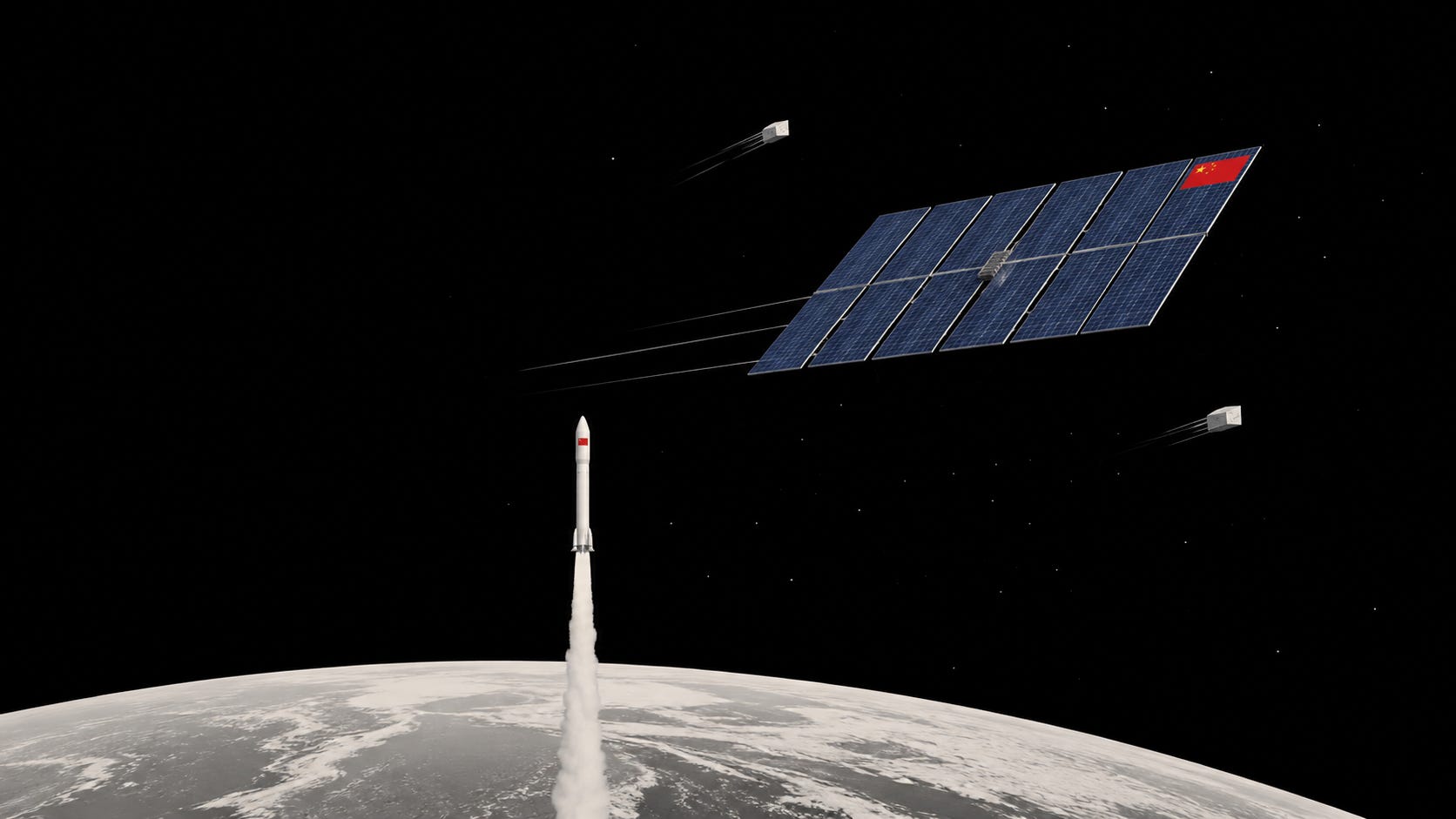
A space data center is one of the sexiest stories from Wall Street’s perspective: shipping AI chips to orbit on cheap, reusable rockets, and letting them run on energy from sunlight and inside the free, near-infinite space, both of which are scarce and expensive on Earth.
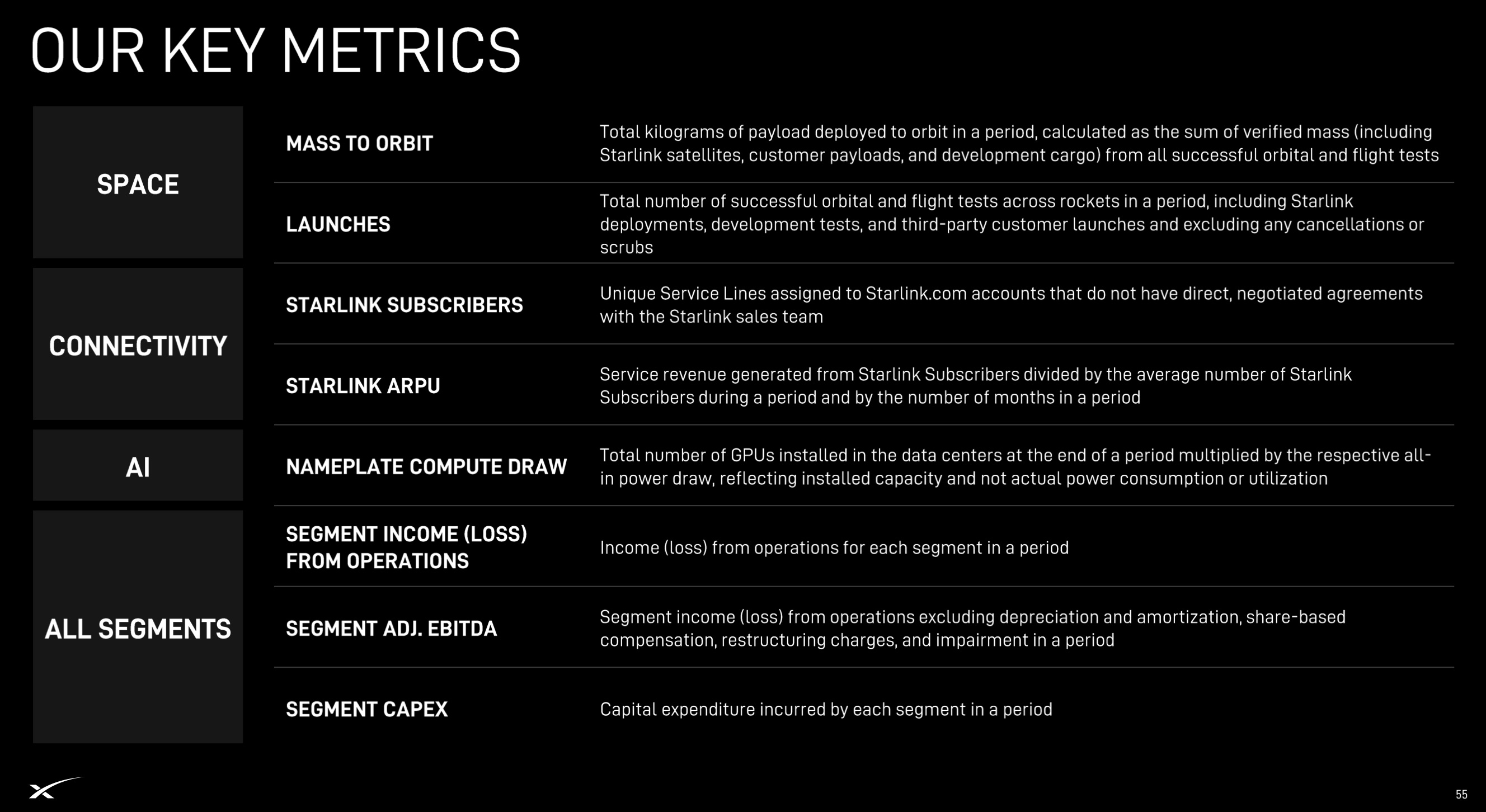
What was a pitch slide a year ago is now becoming a reality. In November 2025, the Nvidia-backed startup Starcloud placed an H100 into low Earth orbit by using SpaceX’s rockets and ran a Google model on it. A Blackwell GPU is due around October 2026. Nvidia Founder and CEO Jensen Huang said “space computing, the final frontier, has arrived.”
But this is not just an American story. China has been flying the same wager through its own commercial companies and state-affiliated labs, and on at least two achievements—running a general-purpose model in orbit, and using a satellite to command a machine on the ground—China actually got there first.
China is Already Up There
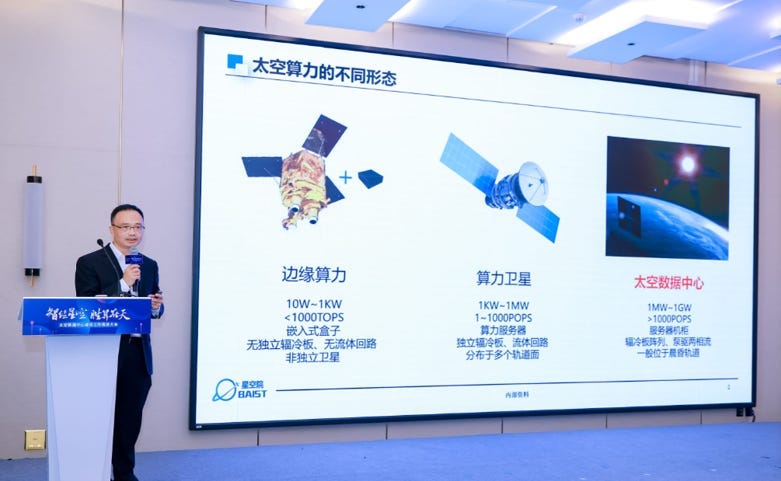
According to Zhang Shancong, president of the Beijing Astro-future Institute of Space Technology (BAIST), space computing is evolving across three tiers defined by scale, power, and thermal infrastructure:
It begins with Edge Computing Satellite, which consists of small, low-power (<1kW) embedded boxes hosted as secondary payloads on satellites without complex cooling systems.
The next tier is the Computing Satellite, a dedicated, medium-scale platform (1kW to 1MW) built specifically around data servers that requires independent radiator panels and fluid loops to manage heat across multiple orbital planes.
The final and most advanced tier is the Space Data Center, which scales computing up to massive, mega-to-gigawatt infrastructure featuring full server racks. To handle the intense heat generated by this industrial-scale workload, it utilizes advanced radiator arrays and pumped two-phase cooling loops, and it is typically deployed in dawn-dusk sun-synchronous orbit, a specialized near-polar satellite trajectory, to maximize continuous solar energy.
Today, China’s orbital footprint is in the early pilot deployment phase—the edge computing satellite stage—driven by a mix of commercial firms and government-affiliated labs.
The flagship project is the Three-Body Computing Constellation, named after the famous Chinese sci-fi epic, built by the government-affiliated Zhejiang Lab alongside dozens of partners, including a Chengdu-based satellite company called ADA Space. In May 2025, the partnership put their first 12 satellites into low Earth orbit aboard a Long March rocket.
Rather than relaying raw data to the ground for handling, those satellites carry edge computing onboard, delivering a combined five POPS—peta-operations per second—and 30 terabytes of storage in their opening batch. The roadmap scales toward as many as 1,000 networked satellites and 1,000 POPS of pooled compute by 2032.
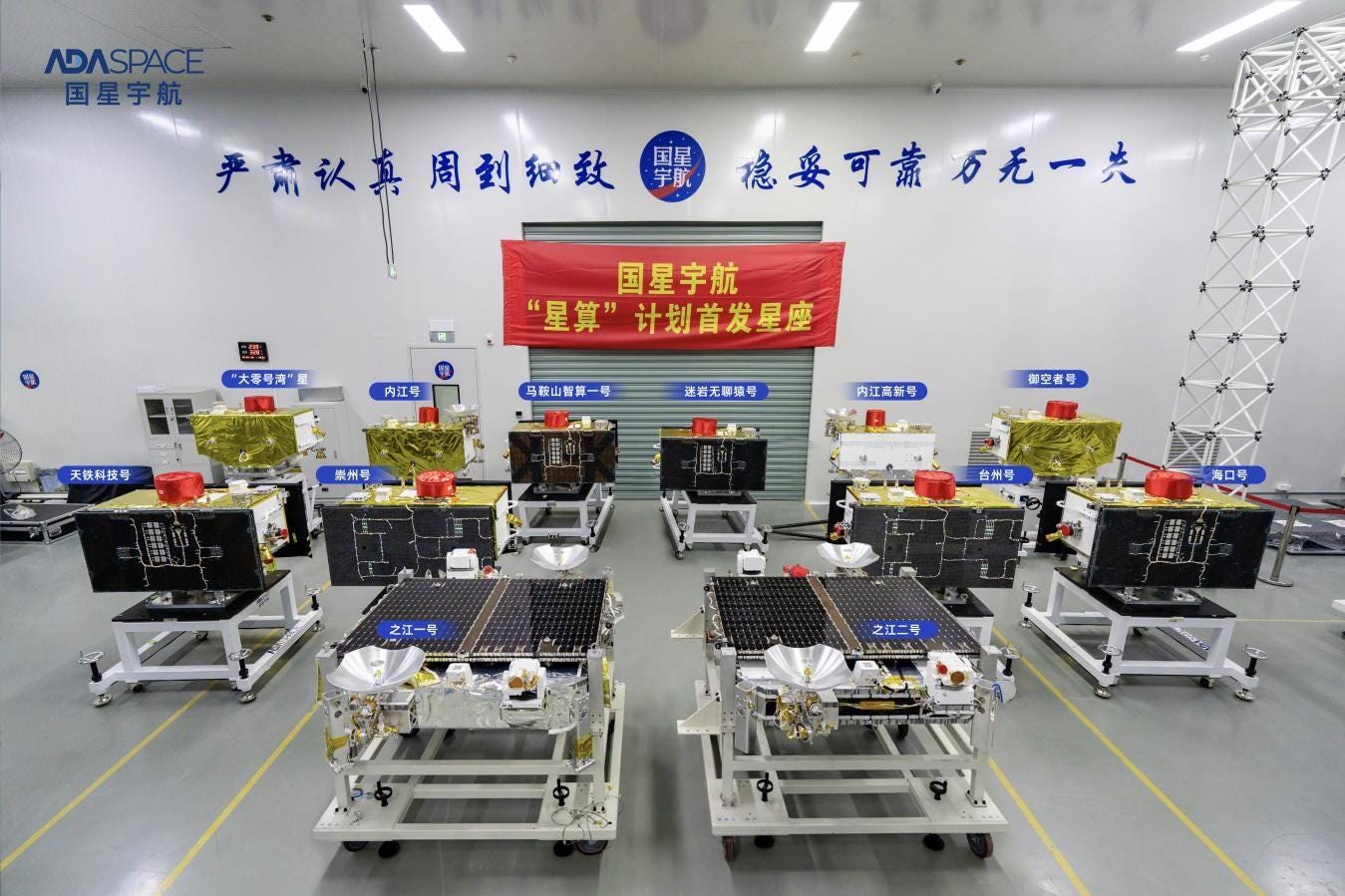
ADA Space, full name Chengdu Guoxing Aerospace Technology, is also pursuing a larger plan of its own: a decentralized “Star Compute” constellation of 2,800 satellites, 2,400 for inference and 400 for training, spread across sun-synchronous, dawn-dusk and low-inclination orbits.
The company has pulled off multiple technical experiments. In November 2025, it flashed Alibaba’s Qwen3 onto an operational satellite and ran end-to-end local inference in under two minutes, the first general-purpose LLM to run in orbit. In a separate demonstration with Shanghai Jiao Tong University, it used space-borne compute to directly command a ground robot, proving compute satellites can act as low-latency control nodes if terrestrial networks fail. Then, in March 2026, working with the Ministry of Industry and Information Technology (MIIT), it launched “Prometheus,” billed as the first space-based cloud platform aimed at commercial enterprise customers.
ADA Space has filed for an IPO on the Hong Kong Stock Exchange, with a pre-IPO valuation of RMB 11.5 billion (~$1.7 billion). The company reported 2025 revenue of 703 million yuan ($104 million) alongside a net loss of 256 million yuan ($38 million).
Meanwhile, Zhongke Tiansuan, or Comospace, is a deeper-pocketed commercial spin-off of the Chinese Academy of Sciences and Zhejiang Lab. The company is designing a near-Earth “10,000-processor super-intelligent cluster in orbit,” built from three upgradable modules:
Energy Module (100 MW): Utilizing high-efficiency, flexible space photovoltaic arrays and modular energy storage systems to capture continuous solar exposure in dawn-dusk orbits.
Communication Module (10 Tbps): Utilizing 100 separate 100 Gbps laser links to establish high-speed, dynamic space-to-ground and inter-satellite networks.
Compute Module (10 EOPS): Integrating 10,000 high-performance computing cards optimized for the extreme thermal and vacuum environment of space.
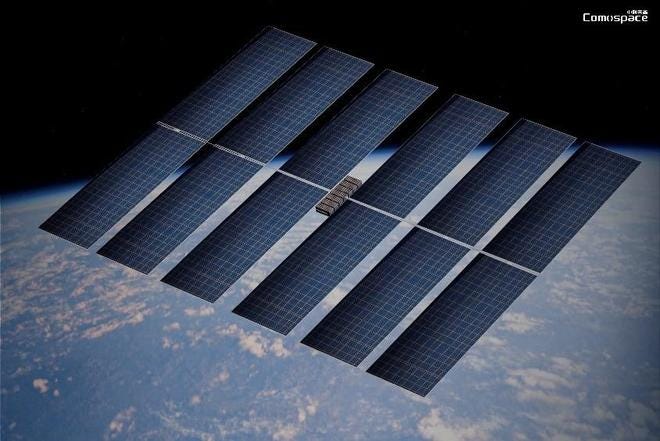
Their premise is that ground-proven commercial chips can be adapted to the vacuum through software-defined resilience and environmental engineering, rather than the long design cycles of traditional, radiation-hardened space silicon.
Other key players include Beijing-backed Orbital Chenguang, which just closed its Pre-A1 funding and secured 57.7 billion yuan ($8.4 billion) in strategic credit lines in April. Shanghai Bailing Aerospace raised early-stage money toward a 100kW-class platform. Oriental Tiansuan, also based in Shanghai, partnering with the photonics startup Guangbenwei, claimed in May to be developing the world’s first space-based optical computing satellite.
The latest headline is on June 1, 2026, Beijing established its first space-computing innovation center in Haidian, jointly led by Beijing University of Posts and Telecommunications (BUPT) and built around six priority areas that include heat-resistant, radiation-tolerant chips made specifically for orbit. At the same, a space computing research institute was also built up in Beijing E-Town aimed at ramping up tech innovation.
Beijing’s Answer to Vertical Integration
The people building it are candid about China’s weakness. As Wang Shangguang, Dean of the School of Computer Science at BUPT said at the Beijing center’s launch:
We have to recognize that SpaceX, by itself, can pull the entire industry chain together—chips, rockets, satellites, payloads, applications—and then sell the resulting compute through that same network, earn money, and reinvest it, closing its own loop; domestically, by contrast, everyone is doing their own thing, and the state we are in is ‘small, weak, scattered, slow.
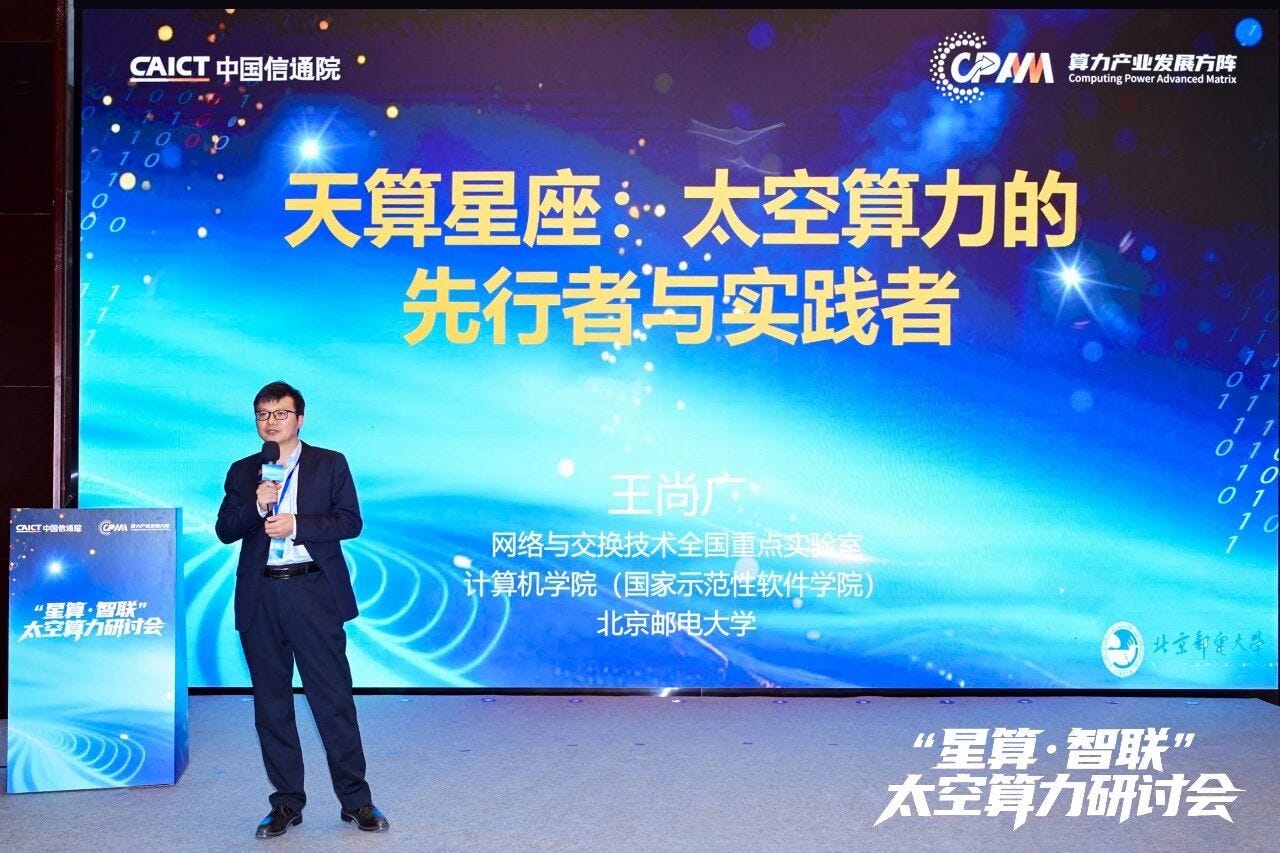
Digging into the research, I found Wang often delivered sharp quotes. For example, he said the core challenges facing China’s orbital computing ambitions in just twelve words: “网网不同、星星并存、算算失衡” (Fragmented networks, isolated satellites, and broken compute).
It means fragmented protocols disconnect space from Earth, isolated hardware architectures prevent satellites from collaborating, and a severe asymmetry in compute leaves orbit underpowered while ground response lags.
To prevent fragmented commercial development, the Chinese government is building a highly structured, top-down regulatory and technical framework.
The China National Space Administration (CNSA), through its commercial space department, has opened a national feasibility study for a unified “space-based intelligent computing constellation.”
The China Academy of Information and Communications Technology (CAICT), under the MIIT, has built a Space Computing Power Professional Committee to align chips, inter-satellite laser links, thermal management and space photovoltaics into commercial standards.
The MIIT is drafting a full standards stack covering orbital hardware, operating systems, networking protocols and cybersecurity.
Beijing, Shanghai, Hangzhou, and Chengdu also lead the regional clusters. These centralized efforts are driving optimistic economic forecasts. Preliminary estimates from CAICT project that China’s domestic space-based computing power industry will surpass 250 billion yuan (~$36.6 billion) by 2030.
Engineering the Extremes
Operating high-density silicon processors in the vacuum of space presents brutal environmental challenges. Chinese engineers have been developing architectural workarounds to mitigate radiation, handle thermal dissipation, and establish high-speed communications.
Space radiation is deeply hostile to semiconductor hardware which would cause damage and hardware failure. To deploy powerful, commercial off-the-shelf (COTS) chips without relying on slow, outdated radiation-hardened components, Chinese engineers are turning to software-defined fault tolerance. For instance, Zhejiang Lab utilizes a “space-based distributed operating system” paired with a ground-based digital twin. This architecture simulates radiation anomalies before deploying AI models to orbit, using dynamic task migration and real-time error-correcting codes (ECC) to instantly reroute computing tasks away from degraded satellite nodes to healthy neighbors across the constellation.
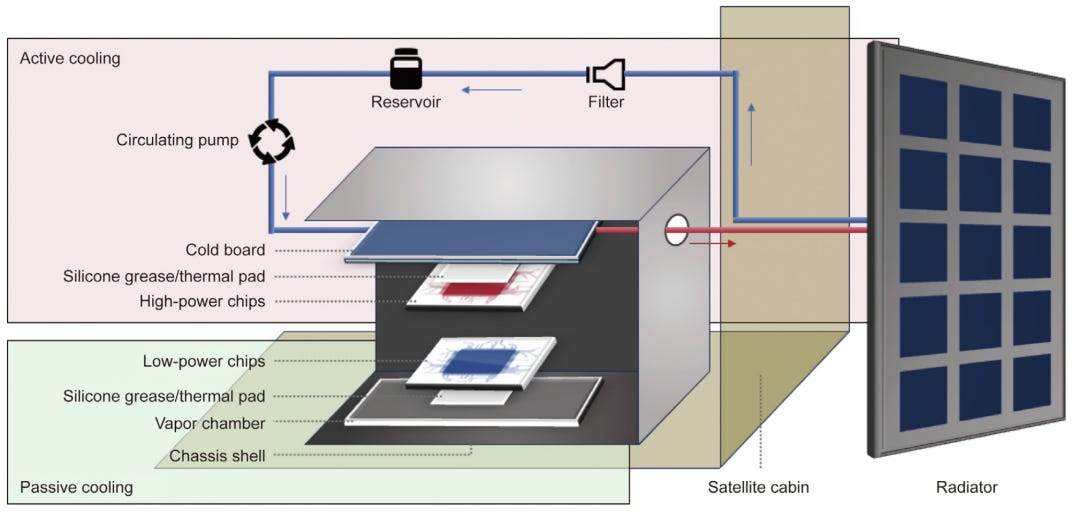
Thermal management poses another hurdle in a vacuum, where the lack of air convection leaves radiation as the only mechanism for heat dissipation. To handle the intense thermal loads of high-density AI accelerators, Comospace developed a hybrid active-passive cooling architecture. This microgravity-safe system pumps liquid coolant directly across high-power processors and routes the heat to deployable, high-emissivity structural radiators. To maximize efficiency, these satellites are placed in 700-to-800 km dawn-dusk sun-synchronous orbits, keeping solar panels continuously powered while permanently pointing the radiators into the deep-cold shadow of space.
Finally, the viability of these space-based supercomputing networks hinges on ultra-high-bandwidth communications. The Chinese Academy of Sciences recently achieved a major breakthrough by establishing a stable satellite-to-ground laser link peaking at 120 Gbps over the Pamir Plateau. Remarkably, the engineering team doubled the system’s previous 60 Gbps capacity without changing any hardware; instead, they used in-orbit software reconfigurations to optimize beam-forming and modulation algorithms, successfully downlinking over 12 Terabits of data in a single 108-second window.
The US-China Gap
So, where does China lag? The most immediate bottleneck is hardware: domestic AI accelerators trail state-of-the-art U.S. chips by four to five years. To achieve equivalent system-level compute, China must bundle significantly more chips across more physical racks. This dramatically penalizes the system by inflating power consumption, weight, and thermal dissipation loads.
The second and perhaps more challenging shortfall is launch economics. As BUPT’s Wang Shangguang admitted:
The cost of reaching space—the maturity of reusable rockets—is where the United States is plainly ahead, and that directly governs how many compute satellites you can deploy and how quickly you can iterate... What worries me more is that much of their key technology is never made public, because a visible gap we can still chase, while the invisible one—disruptive technology evolving quietly in the dark—is what creates real pressure.
SpaceX’s future orbital data-center business relies on fully reusable rockets driving payload costs down to the low hundreds of dollars per kilogram—eventually targeting $183/kg. This will make throwing up modular, disposable compute clusters economically competitive with building data centers on land. In contrast, China still relies primarily on expendable launch vehicles like the Long March series.
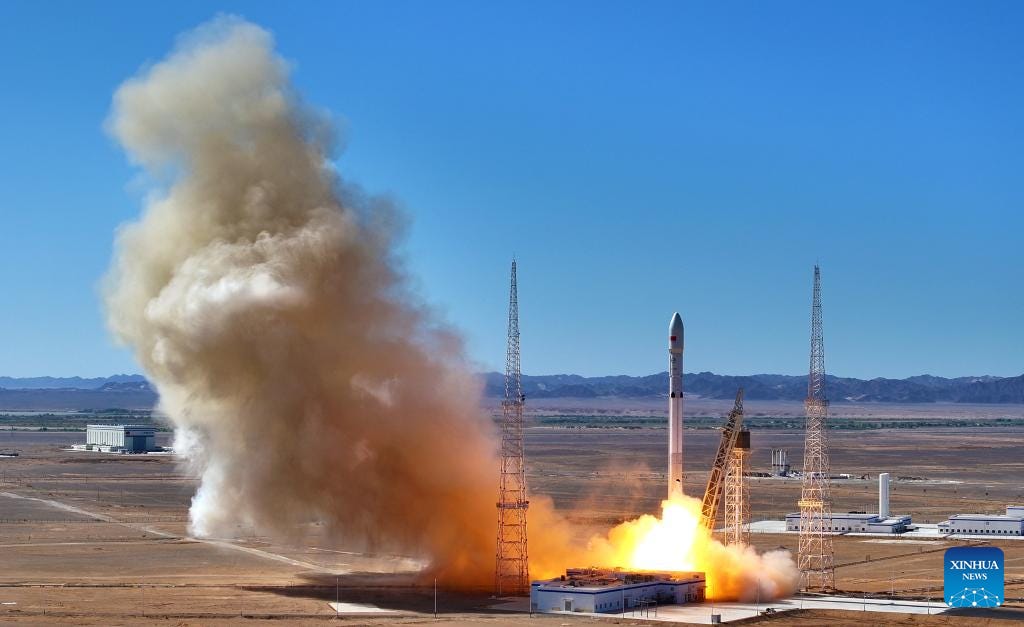
China is aggressively pursuing reusable rocket technology. On June 1, 2026, China successfully completed the mainden flight of its 72-meter Long March 12B rocket—a new, reusable vehicle designed as a rival to SpaceX’s Falcon 9. The rocket flew in an expendable mode for its debut, delivering its first operational payloads for the Qianfan internet megaconstellation. According to the China Aerospace Science and Technology Corporation (CASC), the successful launch signals that “China has added a new commercial rocket to its fleet for building large-scale internet constellations.”
China has flown the GPUs, run the models in orbit, stood up the regulatory committees, and drawn the roadmaps. It is unequivocally aiming to build gigawatt-level data centers in space as AI continues to fuel an insatiable global appetite for compute.
SpaceX’s massive IPO will act as a global catalyst, stimulating an influx of capital, state support, and friendlier regulation across the industry. But China doesn’t have its SpaceX yet. Its top-down approach to uniting academia, industry, and government to build an orbital supercomputer is a great strategy, but catching up with SpaceX is going to be a long journey ahead.
China isn't planning a D-Day invasion of Taiwan; they’re executing a slow, systematic strangulation. While the U.S. waits for domestic chip fabs to come online in 2030, Beijing is tightening the noose today using the Russian playbook. Here is why a sliver of silicon is the most dangerous geopolitical flashpoint on earth.https://triggledger.substack.com/p/the-silicon-choke-point-why-the-next?utm_source=share&utm_medium=android&r=8gc1qf
China isn't planning a D-Day invasion of Taiwan; they’re executing a slow, systematic strangulation. While the U.S. waits for domestic chip fabs to come online in 2030, Beijing is tightening the noose today using the Russian playbook. Here is why a sliver of silicon is the most dangerous geopolitical flashpoint on earth.https://triggledger.substack.com/p/the-silicon-choke-point-why-the-next?utm_source=share&utm_medium=android&r=8gc1qf