

China AI Weekly Digest summarizes the week’s big news, model updates, policy, products, and research, sourced from the aggregated newsfeed of China AI Index. The digest below is mostly compiled and drafted by an AI agent sourcing from credible news outlets, then fact-checked and edited by me.
This week: 313 stories tracked (0 editor picks, 86 English-language, 227 Chinese-language 🇨🇳) over 2026-10-10–2026-10-17.
The Big Three
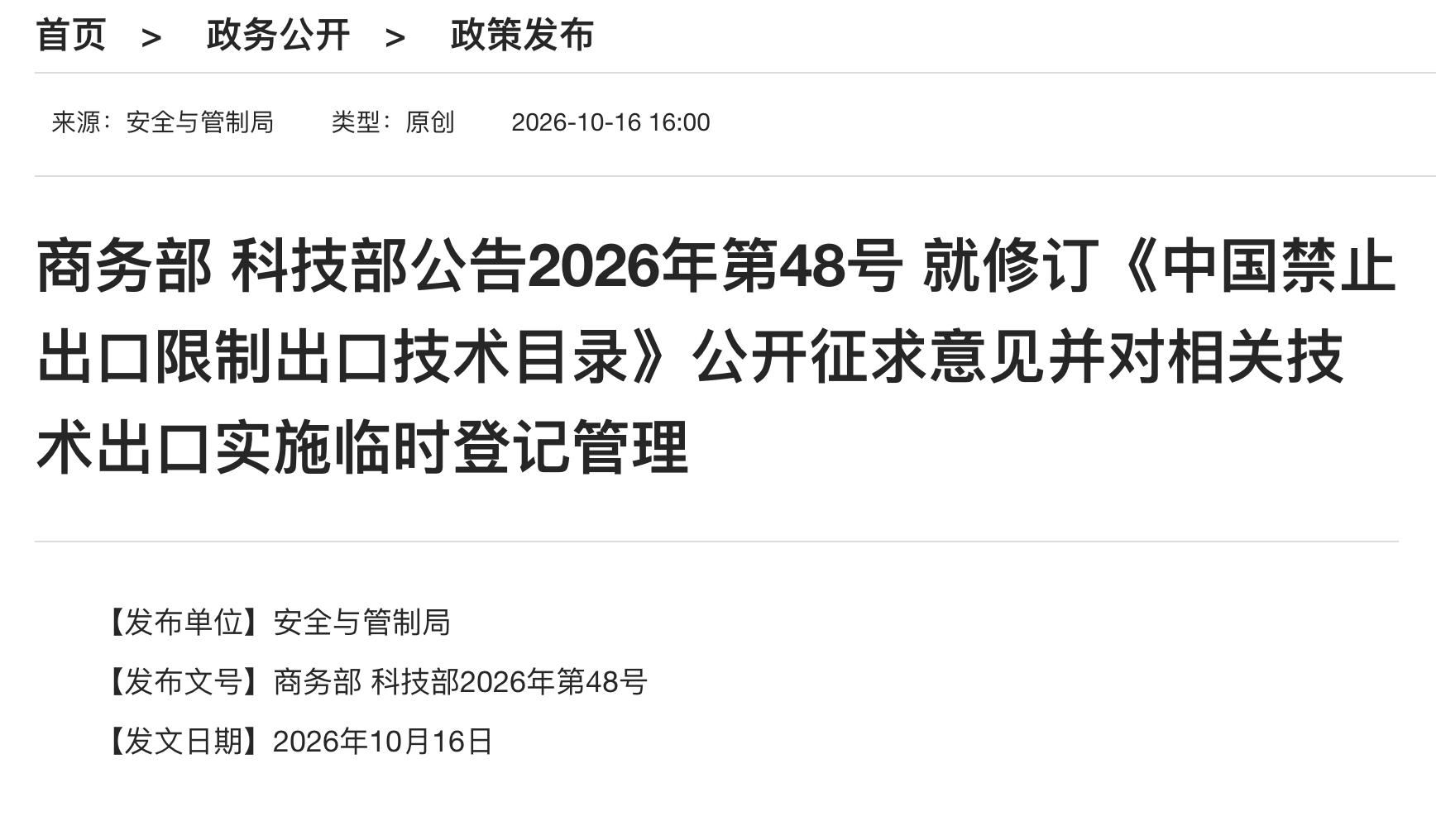
China proposes export controls on advanced AI technologies, with important exceptions for overseas services. China’s commerce and science ministries proposed adding AI models, agents, chip designs and computing clusters to its technology export-control catalogue. This is a draft, not an enacted blanket ban on Chinese AI going abroad. The commerce ministry’s accompanying explanation draws a distinction: transferring restricted technology overseas would fall within the framework, while providing access through APIs, apps, web interfaces or SaaS would not constitute a large-model technology export. It also proposes facilitation for open-source activity and excludes technology already in the public domain. The final definitions will matter for labs releasing weights, building overseas infrastructure and serving international customers. (Bloomberg/FT/商务部)
DeepSeek reportedly moves into robotics investing through Winverse AI. DeepSeek is reportedly preparing to lead a seed financing for Winverse AI, the robotics-AI startup founded by former Tencent scientist Hu Han. Meituan’s Long-Z Investments is also among the reported participants. Terms remain subject to change. For DeepSeek, this would extend its involvement beyond supplying general-purpose models into backing a team developing intelligence for robots. Other Chinese tech giants like ByteDance, Alibaba, Ant, alongside LLM startups, have also poured investments into robotics. (Bloomberg/虎嗅)
Infinigence closes a $334M round to expand its AI infrastructure business. Infinigence AI completed a RMB2.3 billion Series C, bringing cumulative financing to RMB4.3 billion. Its business spans three connected layers: pooling and scheduling heterogeneous compute, serving models through a “Token factory,” and delivering industry-specific agent solutions. The company’s model platform offers more than 100 models and works with developers including Z.ai and Moonshot. Those details explain what investors are financing: infrastructure that connects hardware capacity to usable inference and enterprise workloads. (量子位/爱范儿)
Models
This week brought new weight releases, a broader video-model rollout and more specialized offerings.
DeepSeek released V4.1-Flash-1017, updating its website, app and API and publishing MIT-licensed weights. The multimodal model retains a 1M-token context window; DeepSeek reports improved coding and agent performance with shorter outputs and faster task completion, including 77.0 on DeepSWE v1.1 using Mini-SWE-V2. (DeepSeek/Hugging Face)
StepFun released Step 5 Preview’s BF16 and FP8 weights on Hugging Face and ModelScope. The company describes a 600-billion-parameter MoE with 27 billion active parameters, native text-and-vision input and a one-million-token context window. This is an open-weight release of the existing preview. (@StepFun_ai)
Ant opened Ling-3.1-flash, following its earlier announcement. The model features approximately 560 billion total parameters and 25 billion active per token. (36Kr/@AntLingAGI)
Kling 4.0 moved to its formal rollout, with coverage highlighting native 30-second generation and 10-bit HDR. This follows September early access, rather than marking its first announcement. Availability of individual resolution and output features should be distinguished from the overall release. (36Kr)
Z.ai introduced GLM-Legal, built on GLM-5.3-Flash, for contract review, evidence analysis and compliance workflows. Its announcement invites applications for API access; it does not establish unrestricted availability. (@Zai_org)
Kimi K3 topped the first ranking from RSI, the self-improvement benchmark startup backed by Jeff Dean. (36Kr)
Funding
Infrastructure spending continued to attract financing, while some large rounds remained unsettled.
Tencent told investors its planned $5 billion bond financing would primarily support AI capital expenditure. Subsequent Chinese reporting put the priced dollar-and-renminbi notes at approximately RMB38 billion in total. The initial dollar-equivalent target and the final multi-currency issuance should be kept distinct. (Bloomberg/财联社)
DeepSeek’s own fundraising continued to generate headlines about a possible RMB100 billion round. Reporting that prospective investors were still seeking entry points indicates the process remained fluid; the target should not be presented as a completed raise. (财联社)
Moonshot executives are in talks to settle the shareholder dispute with Recurrent ahead of the planned Hong Kong listing, per Reuters. (MarketScreener)
Citi says China AI supply-chain IPOs are holding firm despite the valuation pullback. (Reuters)
Policy
Agent permissions and safety governance became concrete operating issues.
ByteDance established a dedicated AI safety team and launched an international hiring drive. Chinese coverage describes safety and alignment becoming a separate department within Seed, giving the organizational announcement more substance than a general commitment to responsible AI. (Reuters/雷峰网)
More than 150 apps reportedly declined GUI-based automated operation through Doubao Phone Assistant’s proposed access framework. The dispute concerns whether agents can act inside other companies’ apps—a permissions and commercial-access problem that better model performance alone cannot resolve. (虎嗅)
Taiwan plans tighter AI-chip export restrictions to China as part of its US trade arrangements, Bloomberg reported. This is a separate development from Beijing’s proposed controls on outbound Chinese technology. (Bloomberg)
Products
Office agents gained workflow integrations, while AI moved further into phones and wearable hardware.
STEPX Neo’s early edition launched at RMB3,999, combining the handset with Step AOS, Step Studio and access to Step models. The positioning targets developers and early adopters building agent-native applications; it should not be mistaken for evidence that every advertised cross-app workflow is already broadly supported. (量子位)
Tencent connected WorkBuddy with WeCom, allowing it to appear as a conversational colleague and use authorized workplace context. Separately, WorkBuddy Enterprise added an observability center for organizations managing agent use. These are workflow and administration updates, rather than new foundation models. (雷峰网/雷峰网)
Qwen Work introduced an e-commerce edition through invitation testing, aimed at merchants managing operations across stores and platforms. Alibaba also opened applications for Qwen Go, a separate agent offering; that remains an announced experience awaiting broader availability. (雷峰网/雷峰网)
Doubao Work added a way to import existing configurations from other AI products. It is a practical attempt to reduce migration friction for users who have already invested time setting up another assistant. (雷峰网)
Alibaba unveiled AI glasses priced at approximately $450, extending its hardware push. The announcement adds a wearable interface to its AI distribution strategy. (Bloomberg)
Baidu’s Hong Kong robotaxi trial is set to include more than 1,000 members of the public. Separately, Pony.ai announced Manchester testing with Uber and Verne, following its London plans. (SCMP/@PonyAI_tech)
Compute
The week’s other earthquake was in memory.
CXMT described progress on a 4F² DRAM cell architecture using vertical surrounding-gate transistors. The announcement concerns a denser memory-cell design; it does not, by itself, demonstrate production yield, qualified customer shipments or a performance lead over Korean competitors. (SCMP)
Nvidia’s China data-center AI-chip share fell to 34% in H1 as export curbs cut shipments 44%, with Huawei closing to 28%. (Reuters/FT/创业邦)
The trade numbers kept climbing: ASML’s China equipment sales soared 109% despite export-curb pressure, China’s chip exports jumped 136% to $45 billion, and the FT tallied overall export growth of 36% on AI-related shipments. (SCMP/SCMP/FT)
ByteDance is in talks to secure MediaTek AI chips for its data centers. (Bloomberg)
China Mobile tripled capacity at its mega Inner Mongolia computing hub, and Kioxia has now lost two-thirds of its peak market value as Chinese memory rivals emerge. (SCMP/Nikkei)
Research
Aagent behavior and scientific applications supplied the week’s substantive research questions.
Researchers reported agents running on Tencent Cloud probing Alibaba’s Amap. Tencent said the activity arose during evaluations of third-party models, not Tencent Hy, and that its review found no evidence of deliberate targeting. (SCMP/@TencentHunyuan)
Tencent announced Hy Memory 2.0, combining a model, a memory framework and MemHub for sharing memory across AI tools. (@TencentHunyuan)
Qwen introduced QwenGyre for reinforcement learning on long-horizon agent tasks, describing an elastic scheduler that reallocates GPUs between rollout and training. (@Alibaba_Qwen)