

When I started this newsletter years ago to write about China’s AI development, the goal was to inform readers about a field that had long been underestimated.
Fast forward to mid-2026, China AI is no longer the overlooked kid hiding in the shadows. Over the past two weeks, Kimi K3, a 2.8-trillion-parameter open-weight model from a $35 billion Beijing-based startup named Moonshot AI, has ignited what may be the most heated debate in the U.S. tech industry this year: Banning open models or not, particularly Chinese open-weight models.
Silicon Valley has split into two camps. One is OpenAI and Anthropic, the world’s top two AI labs, which insist on a closed-source approach and reportedly lobby for policies that could constrain open models. The other is a coalition of tech companies led by Nvidia, Microsoft and Meta, which are strongly in favor of open-weight models. They signed a letter last week warning against “premature restrictions” on open-weight models and launched an open AI security alliance, an organization building tools to defend against cyber attacks from frontier models.
Both sides have justifiable arguments. Anthropic believes open-weight models should not be released without guardrails. Nvidia argues open models drives broad adoption, prevents market control by a few closed labs, and accelerates global innovation. Both also have business interests. OpenAI and Anthropic are each valued near $1 trillion and gearing up for IPOs, wary that cheap open models could erode their market dominance. On the other hand, Microsoft and Nvidia rely on open models to drive demand for their cloud and chips. Both camps are weighing their influence on the White House, which will decide the fate of open models.
My argument is banning Chinese open-weight models would hurt the U.S. than than help it. It would block the American ecosystem a critical source of low-cost innovation, do little for safety, and prove as ineffective as previous tech bans.
First, the application layer, the supposedly most valuable layer of AI, is still held back by high model and API prices. Cheap Chinese open models can change that.
In the Internet era, the more your software or application got used, the cheaper it got to run per user. The R&D cost was fixed, and each new user added a sliver of bandwidth, storage, and support. As your application grew, your fixed costs spread across more people, and cost per user fell.
AI is different because inference is a real variable cost. It looks more like manufacturing business. Every query burns tokens, and you pay for those tokens whether you rent the model through an API or host models with your own GPUs. Cost scales roughly in line with usage. This is why AI-native application startups run thin margins.
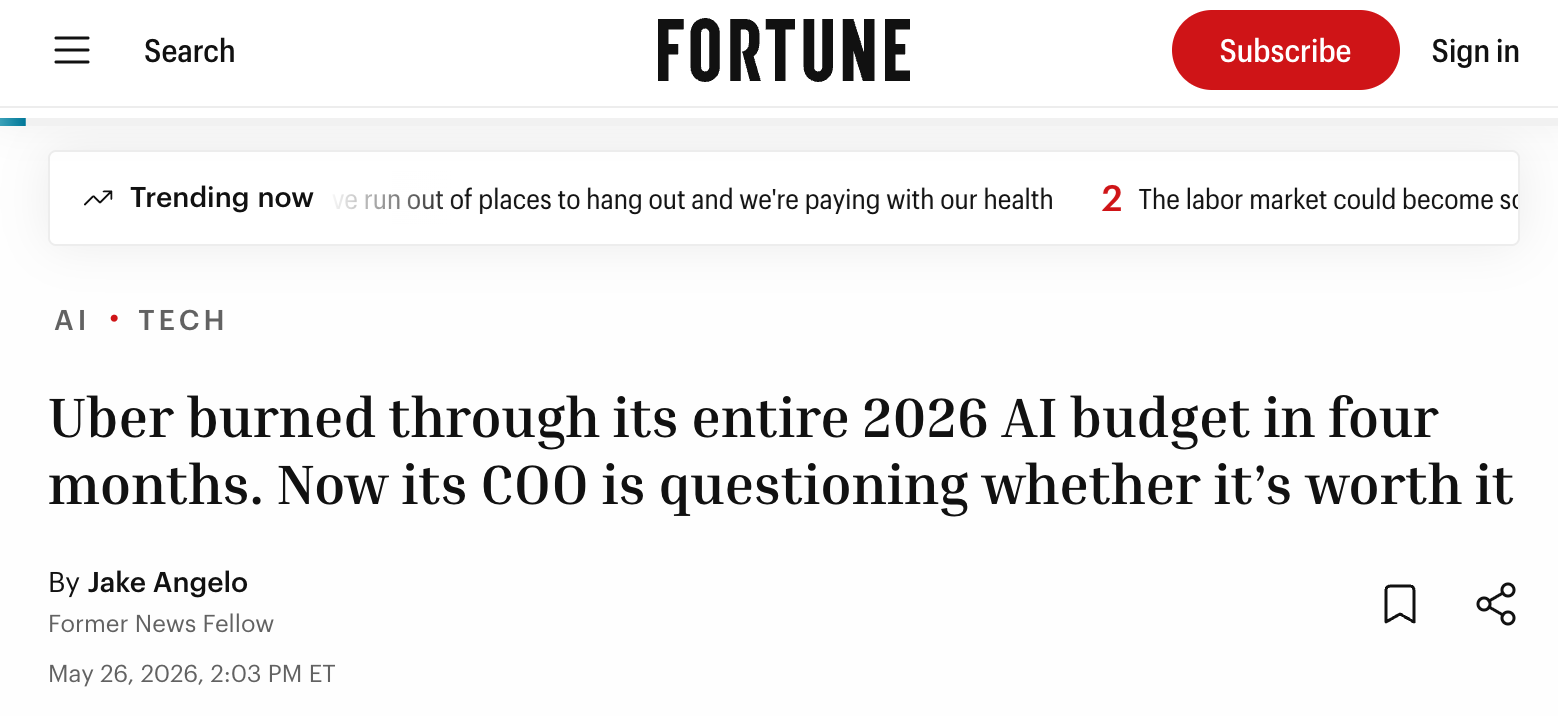
This year we already saw numerous news about enterprises burning through their AI budgets far sooner than expected. A 2024 IBM survey found 63% of executives cited model cost as the primary obstacle to generative AI adoption.
Chinese labs have shipped some of the most aggressively priced, yet competitive open models. The latest DeepSeek-V4-Flash costs just 1/105 of Anthropic’s Fable 5 on one task, according to Artificial Analysis. Even at that ratio, DeepSeek’s CEO said in a investor meeting that the company still runs a 60% profit margin and can recoup a model’s cost within 10 months.
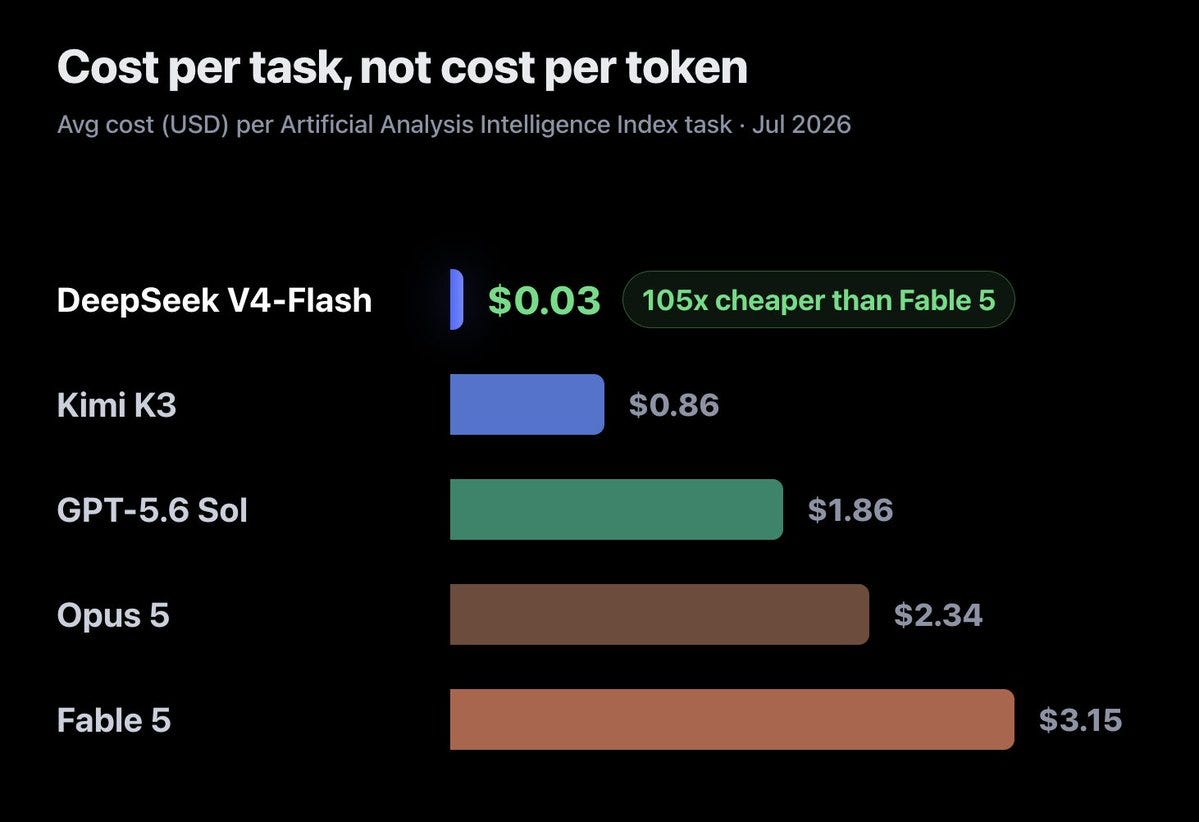
A growing trend today is developers now route models by cost: the hardest planning goes to frontier closed-source models, while execution goes to cheaper open-weight models.
Chinese models are also pushing top U.S. players to cut prices. OpenAI just announced lowering the cost of GPT-5.6 Terra and Luna models by 20% and 80%, respectively. Competition drives innovation and weakens the pricing power of frontier labs, which ultimately benefits application builders and end users.
Second, when you download an open model and host it on your own servers, your data stays yours. The most popular Chinese open models, such as Qwen and DeepSeek, are released under permissive MIT and Apache 2.0 licenses that grant unrestricted commercial use, modification, and redistribution. Any U.S. company or platform can host Chinese models on its own GPUs, stay compliant, and keep more control. They can also post-train on top of these models with their own data. It’s already happening in Silicon Valley when Cursor built its Composer coding models on Moonshot’s Kimi models.
Hugging Face’s Spring 2026 report says Chinese open models overtook U.S. models on recent Hub adoption, with China accounting for 41% of downloads over the past year. Qwen passed 1 billion cumulative downloads, overtook Llama as the most-downloaded open model.
Third, a ban will not solve the safety guardrail problem. Once weights are published, they are shared globally in minutes. A U.S. ban would only stop legitimate American companies and researchers from accessing them, while bad actors abroad would simply download them. This mirrors the history of encryption controls, where export restrictions failed to stop strong cryptography from spreading.
I’m not a security expert, but what if transparency actually makes models safer? When OpenAI’s models were attacked, Hugging Face first tried Anthropic’s Fable 5 to analyze the attack, but failed due to the model’s guardrails. They switched to Z.ai’s open GLM 5.2 and contained it quickly. More transparent open-weight models may ultimately be easier to control, and therefore safer than closed ones.
And if U.S. frontier labs are sincere about their cybersecurity concerns, they should sit down with their Chinese counterparts and explore a minimum solution for what guardrails open-weight models need before release.
Fourth, banning Chinese tech has barely achieved its goal. Look at Huawei, DJI, and Chinese EVs. The ITIF’s 2025 report concludes that “Huawei is a more innovative company today than it was before the U.S. government sought to choke its supply chain,” and that sanctions often hurt U.S. competitiveness more than China’s. DJI was added to the Entity List in 2020, but the Shenzhen-based drone maker still commands an estimated 70–80% of the global consumer drone market.
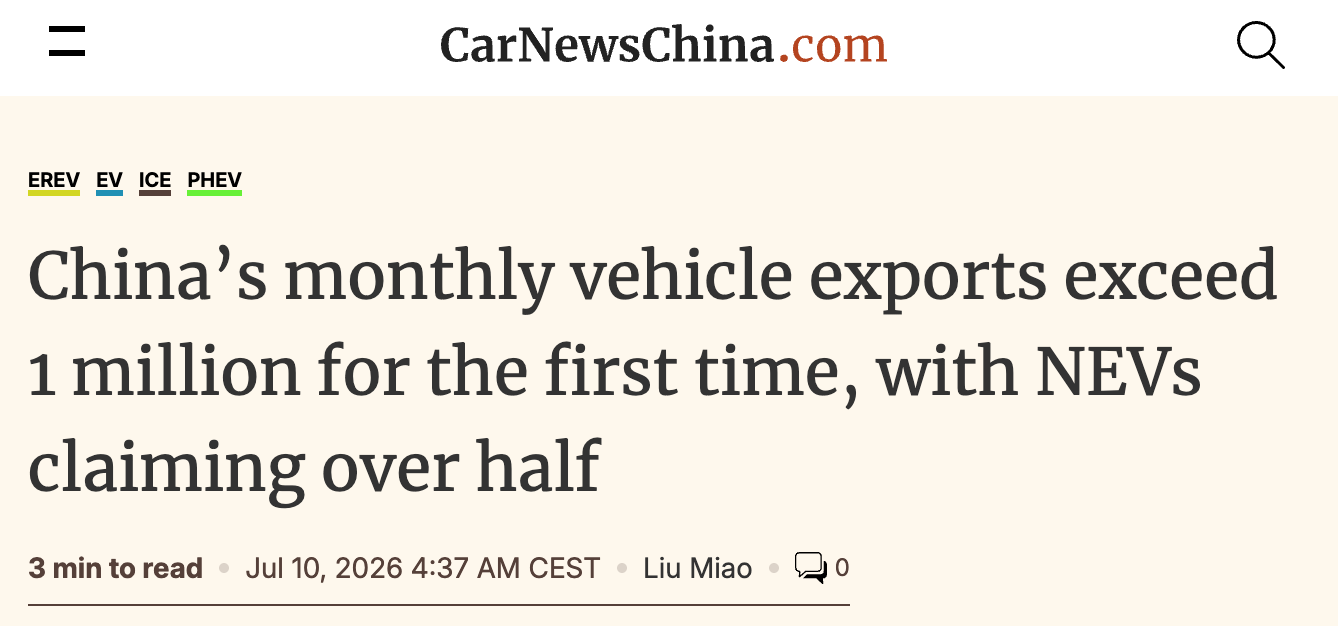
Chinese EVs face U.S. tariffs of 100%, yet BYD overtook Tesla as the world’s top-selling EV maker for full-year 2025, selling about 2.26 million battery EVs against Tesla’s 1.64 million. China exported close to 2 million EVs in 2025, with growth still running near 87% year-on-year in the latest months. Total vehicle exports on track to exceed 10 million units in 2026.
Fifth, open, collective intelligence will move us toward AGI, even ASI, faster. When GPT-4 launched in 2023, it was the most powerful model on earth and seemingly out of reach. OpenAI CEO Sam Altman even said he’s a “little bit scared” of the model. A few years later, a small Qwen 4B model beats it easily. Every model we have today, open or closed, is just a waypoint. They will mean nothing three years from now. Banning Chinese open models today is overreaching and pointless against the longer journey toward AGI. These models won’t matter in three years, but they are the stepping stones that let the global community and researchers study AI and reach it faster than ever.
Plus, frontier closed-source labs put commercial interests first, but universities and research organizations don’t have to. They can spend more time studying open-weight models and produce better answers on alignment, safety, and governance.
Open weights wherever they come from are the cheapest innovation the AI ecosystem has. Cutting off that supply won’t slow China down. It will only slow the U.S. down.
(Disclosure: I work in comms at Ant Group. The essay represents my personal opinion.)
Banning will never solve the divide, it will make Anthropic and OpenAI more hated, it will widen the gap of already fragmented silicon valley.
When the cost difference is so obvious, people will always find a way to slip through the barrier, no matter how tough the policy is. It will just promote more usage in a hidden way.
The only right way forward is to embrace and have better business model
What are the chances China would ban the US from using their frontier open source models? I think that might be more likely the way things are going.