

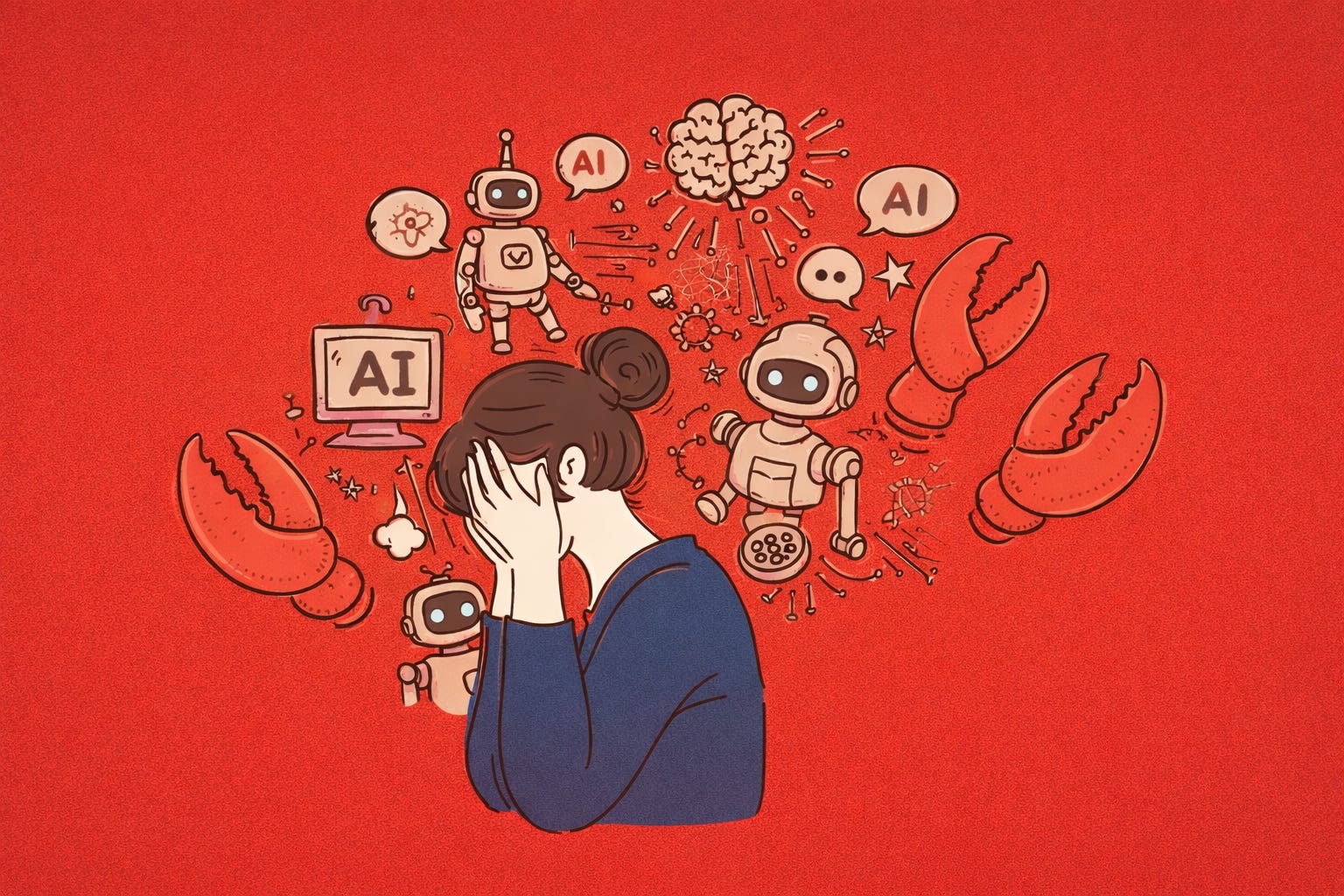
People in China are generally regarded as optimistic about AI. According to a KPMG survey across 47 countries, 69% of people in China said AI’s benefits outweighed its risks, compared to just 35% of Americans.
But something is shifting. Over the past few weeks, the phrase “AI anxiety” kept showing up in the podcasts, articles, and videos I came across, picking up pace especially after the OpenClaw mania swept the country. This change in sentiment, from excitement to unease, has been building quietly beneath the surface.
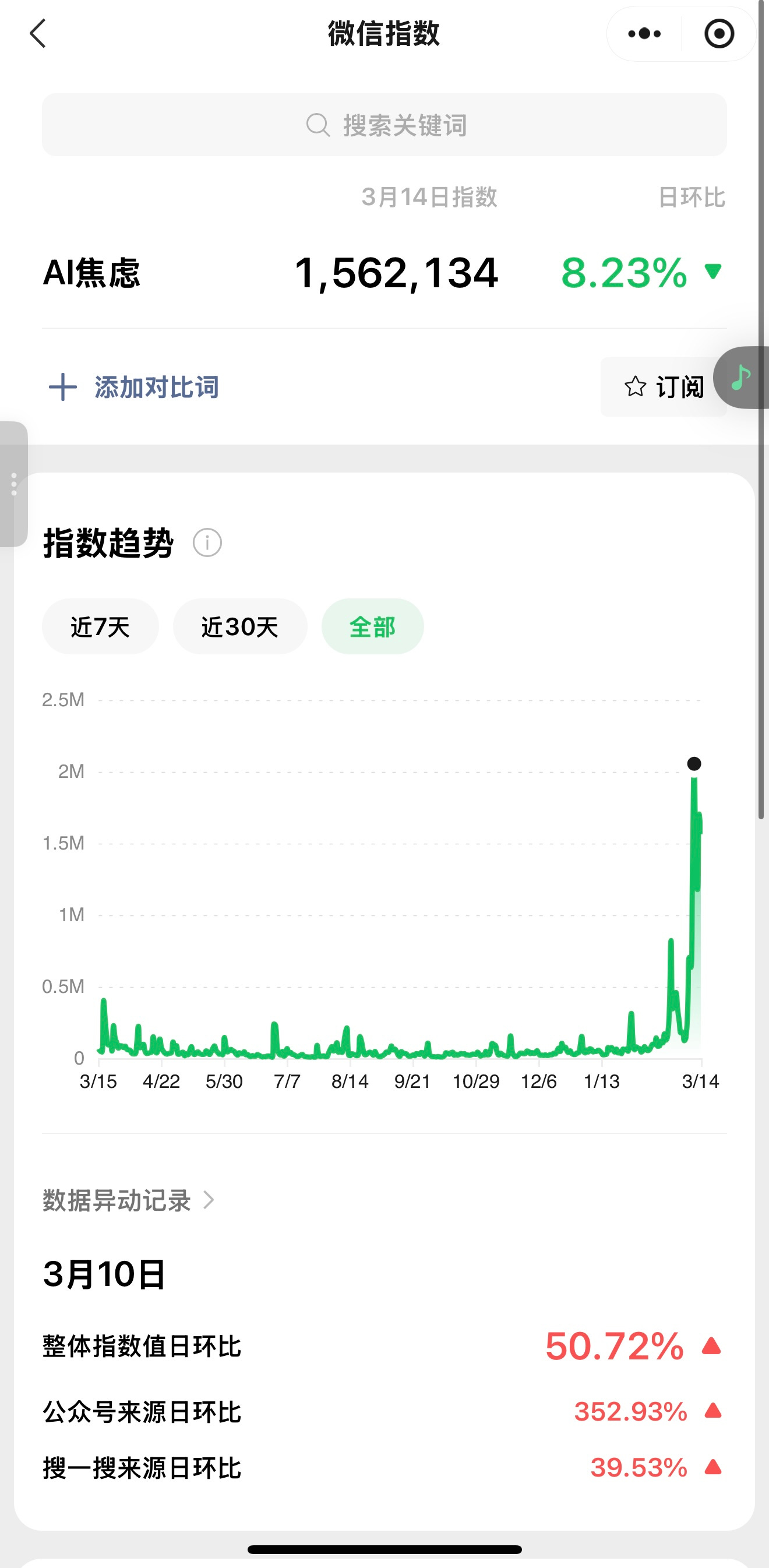
I searched “AI anxiety” (AI焦虑) on WeChat Index. There was a large spike starting mid-February, peaking on March 10 at over 2 million, against a usual baseline of around 20,000. The term also briefly climbed to Weibo’s trending topics last week.
The clearest trigger is OpenClaw, an open-source, local-first AI agent platform that acts as a 24/7 proactive personal or team assistant. It runs on your own computer, connecting LLMs via API to local files, messaging apps like WhatsApp and Discord, and tools that automate tasks, schedule jobs, and manage digital workflows.
OpenClaw was developed by Austrian programmer Peter Steinberger. Originally launched in November 2025 as “Clawdbot,” it was later rebranded to “Moltbot” and then to OpenClaw in early 2026 following trademark concerns from Anthropic. In February 2026, OpenAI announced that Steinberger would be joining the company to lead development on “personal agents.” OpenClaw became one of the fastest-growing open-source projects in history, accumulating over 200,000 GitHub stars within a few months.
There are already strong reports of how China’s OpenClaw frenzy unfolded. MIT Technology Review and Wired both have great stories, as does Poe Zhao’s analysis. For those less familiar, here’s a quick recap:
In February, as OpenClaw began going viral, Chinese developers and early adopters started sharing demos on Bilibili, Zhihu, and X. Tech influencer and entrepreneur Fu Sheng hosted a livestream demonstrating OpenClaw's capabilities, drawing 20,000 views. Meituan co-founder Wang Huiwen said he will invest in startup projects in the OpenClaw track.
On March 6, nearly 1,000 people lined up outside Tencent’s Shenzhen headquarters for a free installation session hosted by Tencent Cloud engineers. The crowd was a mix of amateur developers, retired engineers, housewives, students, and AI enthusiasts. Tencent founder and CEO Pony Ma said on WeChat that he wasn’t expecting the wild popularity of OpenClaw.

On March 7, Shenzhen’s Longgang district government released a draft policy proposing financial support of up to 2 million yuan for approved OpenClaw projects and up to 10 million yuan for larger ones, along with free compute credits and discounted office space.
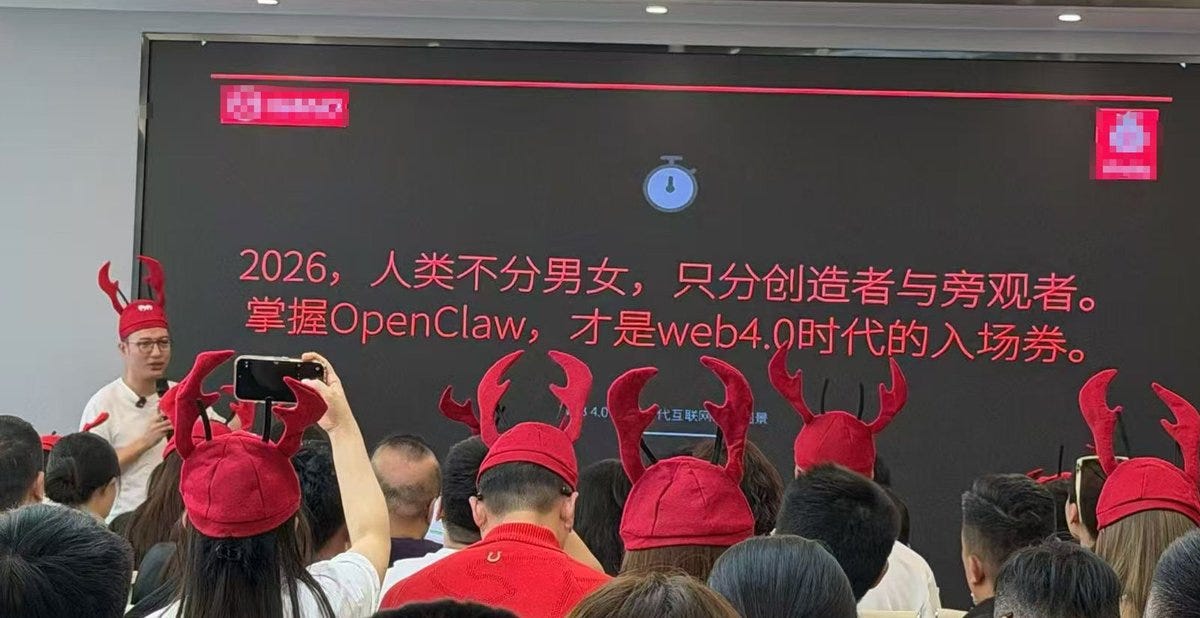
Some crypto entrepreneurs hosted the largest OpenClaw event in Shenzhen, drawing more than 1,000 people, with many unable to find a seat.
The corporate pile-on followed quickly. ByteDance’s cloud unit Volcano Engine unveiled ArkClaw, a browser-based version that removed the need for local setup. Tencent launched a suite of OpenClaw-based products compatible with WeChat. Alibaba launched a mobile app called JVS Claw to help users install and deploy OpenClaw. Baidu, Zhipu.ai, Moonshot, and others all joined in.
Markets responded in kind. Hangzhou Shunwang Technology soared 21% after claiming to embed OpenClaw in its cloud infrastructure. Talkweb Information System jumped 12%, and Beijing Vrv Software rose 15%, all while the broader CSI 300 gained just 0.9%. Tencent’s stock rose 8.9% in a week. MiniMax surged 27.4%, now up over 600% from its IPO.
The frenzy started to wane down last week as the China’s central government warned state-run enterprises and agencies against installing OpenClaw on office computers, citing risks of data leakage and unauthorized access.
By mid-March, social media platforms flooded with paid services offering to uninstall OpenClaw, from the same people who had charged to install it weeks earlier. One Shanghai-based seller charged 299 yuan to remove it and had already completed more than 10 transactions.
The incentives behind the corporate bandwagon are worth understanding. For cloud companies like Tencent, Baidu, and ByteDance, OpenClaw runs best connected to a cloud backend, LLMs, APIs, and compute. Helping users install it is a customer acquisition funnel dressed up as community support.
For LLM companies like MiniMax, Moonshot, and Z.ai, OpenClaw needs a model to run on, and whichever model becomes the default picks up token usage at a scale no chatbot can match. For local governments, backing OpenClaw-based projects shows pro-innovation governance and attracts startups. OpenClaw-based applications represent a practical form of AI that fits neatly into industrial policy goals.
My friend told me that China probably only has hundreds of thousands of people who actually installed OpenClaw on their computers, yet it became a national topic. Everyone was talking about “raising a lobster” (a reference to the word Claw).
This kind of collect rush around an AI product is not new in China. When ChatGPT went viral in late 2022, with no Chinese equivalent available, people were selling accounts and offering VPN access to ChatGPT. When Meta’s Llama came out in 2023, nearly every Chinese cloud company rushed to offer API access and local deployment. OpenAI’s video generator Sora also swept Chinese social media in early 2024. Not to mention the DeepSeek moment in early 2025.
What is different this time is the mood. In those earlier waves, the mainstream mood was excitement, awe, and curiosity. This time, more and more people are expressing anxiety, fear, and concern.
The most obvious reason of that anxiety is job insecurity. For most ordinary people in China, AI still means chatbots like Doubao or Qwen. Claude Code or Codex is not available. There is no household AI agent with real penetration. Then all of a sudden, media reports are claiming OpenClaw can handle a wide range of tasks autonomously. The gap between what people knew and what they were being told deepened the sense of being left behind.
The job market context makes this worse. According to Bloomberg, a Peking University study analyzing over a million Chinese job postings between 2018 and 2024, which found that sectors with higher AI exposure, including accounting, editing, sales, and programming, saw larger declines in recruitment. The Financial Times reported that China’s government plans to build an “employment-friendly growth model,” as a record-breaking 12.7 million university graduates enter the market in 2026.
A second catalyst came from an unexpected direction: On February 22, independent investment research firm Citrini Research published The 2028 Global Intelligence Crisis. Written as a fictional macro memo from June 2028, it argued that human intelligence has historically been the scarce input in economic history, and that AI is now causing the unwind of that premium. In the scenario they constructed, the S&P 500 falls 38%, unemployment hits 10.2%, and a deflationary spiral sets in as white-collar jobs are hollowed out faster than the economy can absorb.

Two days later, a Chinese version appeared. Bob Chen, an economist-turned-VC at BroadVision Fund (博华资本) and former macro economist at the Chinese Academy of Social Sciences, published his response on his WeChat blog, Jolly Maker (嬉笑创客). His argument is China would not experience the same crisis, and for structural reasons that might look like weaknesses on the surface. SaaS never took off in China, leaving a trail of broken investors and failed products. If SaaS couldn’t reshape China’s information economy, AI won’t displace workers through the same mechanism. China’s model was always built on heavy staffing, offline relationships, and customized solutions, with leaders making the final call and workers functioning as atomized information processors relying on Excel. That structure, Chen argued, is better suited to AI-driven efficiency gains than AI replacement.

It is a reassuring thesis, but the anxiety about keeping up with AI runs deeper than job loss alone. I saw a post on RedNote captured the feeling well. The user wrote:
I think I have AI anxiety. I haven’t figured out Claude Code, and Skills is already out. I haven’t understood Skills, and Clawdbot is out. I haven’t installed Clawdbot, and the Mac Mini price is already up. Throughout February, Chinese AI companies released new models in rapid succession. The pace itself became a source of stress.
Nvidia CEO Jensen Huang's quote has circulated widely in China: “You're not going to lose your job to AI, but you're going to lose your job to someone who uses AI.” People are worried they are not using AI aggressively enough, and they do not know how to use it well. They scroll past endless content showing people without technical backgrounds earning millions by launching an app, or making smarter investments using the latest AI tools, which reinforce the anxiety. OpenClaw is the latest version of that pressure. On top of this, workplace expectations are shifting. The abovementioned Fu Sheng said publicly that every employee of his company is required to use AI in their work, or risk falling behind.
There is also a small but vocal group that exaggerated OpenClaw’s capabilities, spread anxiety, and cashed in on the confusion. Many people paid a few hundred yuan to have the software installed, only to find they did not know how to use it, or that the product had real limitations and security concerns. One Chinese tech influencer said on Weibo:
If you need to pay someone a few hundred yuan to install OpenClaw for you, you probably should not be using the product.
Finally there is a dimension that has received less attention: AI in warfare. The use of AI in U.S. military operations during the recent conflict with Iran, along with the very public saga between Anthropic and the U.S. Department of War, has made many people in China reconsider what AI actually is.
Despite China’s stated policy of civil-military infusion, AI has largely been experienced by ordinary Chinese people as a civilian technology, something distant from military operations. The realization that the same chatbot technology could potentially assist in targeting or military decision-making has shifted that perception. This is becoming a global conversation, but for people in China who had kept a clear mental separation between AI and violence, it changes something fundamental.
Will the Chinese government step in if AI disruption starts threatening employment stability? Or will it continue backing development in the name of national competitiveness? I do not have an answer. But it is worth stopping treating people in China as uniformly optimistic about AI. The anxiety is real, and it will keep growing.
A timely piece showing how rapid AI adoption can shift public sentiment from excitement to anxiety, especially as real-world implications become more tangible
Agents don’t bring parallelism, they bring concurrency.
https://www.informalwriting.cc/p/concurrency-is-not-parallelism